
Wendy’s investor risks in 2026 center on three interlocking pressures: elevated leverage tied to securitized debt covenants, a multi-quarter same-store sales and traffic decline that shrinks the franchise royalty base, and activist interest that has raised speculation of a take-private deal. Together these risks make WEN a speculative, event-driven position rather than a stable capital-preservation holding right now. The sections below break down each risk into specific metrics, filings, and signals worth tracking.
TL;DR:
- A potential covenant breach from declining royalty cash flow could lead to debt restrictions or asset sales, harming shareholder value.
- Continual erosion of same-store sales and franchisee financial stress signals increase the risk of store closures and revenue drops over the next few quarters.
- Wendy’s high leverage and securitized debt structure make interest coverage declines and covenant violations imminent risks that could prioritize bondholders over shareholders.
- Activist pressure and takeover speculation by Trian can cause volatility and uncertainty, especially with the company’s heavy debt load limiting potential buyout premiums.
- Rising beef and labor costs, combined with weak traffic and ineffective marketing, threaten margins and slow down any sustainable recovery in sales.
Table of Contents
- The Top Wendy’s Risk Factors Investors Should Rank First
- Financial Risks: Debt, Securitized Financing, and Covenant Triggers
- Franchise-Model Risks: How Franchisee Stress Becomes Shareholder Risk
- How Do Beef Prices and Labor Costs Threaten Margins?
- Sales, Traffic, and Marketing Risks Behind the Slowdown
- Governance and Activist Risk: What a Peltz Take-Private Move Would Mean
- Legal, Regulatory, and Cybersecurity Exposure
- Dividend Cuts and Capital Allocation: What They Signal About Downside Risk
- Building a Wendy’s Risk Watchlist: Filings, Signals, and Tactics
- A Turnaround Story, Not a Reliable Income Play
- How Buywendys Helps You Track These Risks in Real Time
- Sources
The Top Wendy’s Risk Factors Investors Should Rank First
Not every risk on Wendy’s docket carries equal weight, and treating them all as equally urgent leads to bad position sizing. Some are structural and slow-moving. Others can move the stock in a single trading session. TipRanks’ aggregation of the company’s disclosed risk factors counts 33 distinct items in the latest filing, with finance and corporate risk making up the largest single category. That weighting matters: it tells you the company itself, not just outside analysts, sees balance sheet mechanics as the dominant threat.
Here is a practical ranking, ordered by how directly each risk threatens shareholder value and how soon it could show up in the numbers.
- Leverage and covenant sensitivity. A drop in systemwide royalty cash flow could trip minimum thresholds in Wendy’s securitized financing structure, a near-term risk that shows up first in interest coverage ratios and quarterly debt service figures.
- Traffic and same-store sales erosion. Consecutive quarters of declining comps shrink the royalty base that funds everything else, a structural risk best tracked through systemwide same-restaurant sales prints.
- Franchisee financial stress and store closures. Falling unit economics at the franchisee level eventually surface as closures, reimage deferrals, or franchisee-loan trouble, a mid-term risk visible in closure counts disclosed each quarter.
- Activist and take-private uncertainty. Trian’s ongoing interest injects volatility that can move the stock independent of fundamentals, an event-driven risk best watched through 13D amendments and merger speculation.
- Commodity and labor cost pressure. Beef price swings and wage inflation compress franchisee margins gradually, a structural risk visible in commentary about cost of sales as a percentage of revenue.
- Dividend sustainability. A payout that outpaces free cash flow forces a choice between debt service and shareholder returns, a near-term risk flagged directly in dividend announcements.
The metrics worth watching alongside this list:
- Interest coverage ratio trend, quarter over quarter
- Systemwide same-restaurant sales, U.S. and international
- Net U.S. store closures versus openings
- Franchisee reimage and remodel completion rates
- 13D/13G filing activity from Trian and other large holders
Each of these risks operates on a different clock. Leverage and dividend risk can surface in a single earnings call. Traffic decline and franchisee stress build over several quarters before becoming undeniable. Activist risk can erupt overnight on a single headline.
Financial Risks: Debt, Securitized Financing, and Covenant Triggers
Wendy’s balance sheet is built around securitized financing, a structure common among franchised restaurant chains but one that creates a distinct kind of downside for equity holders that many retail investors underestimate. Under this model, a special-purpose entity holds the royalty streams and pledges them as collateral for bondholders. The S-3ASR prospectus filed with the SEC lists securitized financing risk explicitly among its risk factors, alongside adverse economic conditions, franchisee dependence, commodity costs, and cyber incidents. The filing also carries the standard warning that forward-looking statements are subject to material uncertainty, language that reads as boilerplate until you consider what triggers it.
Statistic Callout: TipRanks counts 33 distinct risk factors in Wendy’s most recent disclosure, with finance and corporate items forming the single largest category. That is the company’s own risk register, not an outside analyst’s guess.
The mechanism that matters most for equity holders is how covenant triggers work inside securitized debt. Deep analysis of these structures shows that minimum royalty-stream thresholds and covenant triggers give lenders significant leverage during a downturn, because a breach can accelerate debt obligations or restrict strategic flexibility well before the company runs out of cash. In plain terms: bondholders get paid first, and the covenant structure exists to protect them, not shareholders. If royalty cash flow drops far enough, the securitization entity can trap cash, restrict distributions, or force asset sales, all of which happen before common equity holders see a dime.
A plausible stress scenario looks like this: same-store sales fall for several more consecutive quarters, franchisees fall behind on remodels and some close units, the royalty base shrinks, and coverage ratios inside the securitized structure tighten toward covenant limits. Analysts and market commentators have already flagged elevated leverage and thin interest coverage as central solvency concerns, not a distant hypothetical. If a covenant breach does occur, the most likely outcomes are dividend suspension, forced asset sales, or a restructuring where equity holders absorb most of the value destruction while bondholders remain largely protected.
Investors tracking this risk should check four things every quarter:
- The latest 10-Q and 10-K for updated leverage ratios and interest coverage figures
- Any 8-K disclosing covenant amendments, waivers, or refinancing activity
- The debt maturity schedule for upcoming refinancing windows where rates could reset higher
- Management’s own commentary on capital allocation priorities during the earnings call
Buywendys tracks these maturity dates and covenant language in detail in its debt maturity briefing, and a broader look at the balance sheet mechanics is available in its fundamental analysis of Wendy’s financial statements. The core takeaway: leverage does not just raise Wendy’s cost of capital, it changes who gets paid first if the turnaround stalls.
Franchise-Model Risks: How Franchisee Stress Becomes Shareholder Risk
Wendy’s business model runs almost entirely on royalties, rent, and advertising fund contributions collected from franchisees, an asset-light structure that Buywendys has long highlighted as a source of steady cash generation. That same structure, though, means Wendy’s has limited direct control over day-to-day store operations while remaining fully exposed to the financial health of the people running those stores. When systemwide sales fall, royalty revenue falls in near lockstep, since most fees are calculated as a percentage of gross sales rather than a fixed amount.
The vicious-cycle mechanics work like this: declining traffic reduces franchisee cash flow, franchisees defer remodels and reimages to conserve cash, aging stores become less competitive, traffic declines further, and eventually the weakest units close. Reporting in 2026 documented roughly 289 U.S. store closures in the first half of the year alongside a withdrawn full-year outlook, a combination that signals the company itself lost confidence in near-term visibility. Each closure permanently removes that unit’s royalty contribution from the base.
Signals that franchise strain is building, worth checking every earnings cycle:
- Net closures versus new unit openings, disclosed in the quarterly filing
- Any commentary on deferred reimage or remodel commitments
- Franchisee loan delinquency or default mentions, if disclosed
- Development agreement cancellations or reduced growth commitments from major franchisee groups
Pro Tip: Triangulate franchisee stress rather than relying on one data point. Royalty remittance trends, closure counts, and reimage deferral language moving in the same negative direction together is a much stronger warning sign than any single metric alone, a method Buywendys applies in its franchise-economics analysis.
For a broader framework on how royalty-based systems distribute risk between corporate and franchisee balance sheets, Buywendys’ guide on restaurant royalty models walks through the mechanics in more depth. The short version for investors: a franchised model smooths corporate margins in good times, but it also means shareholder risk shows up one step removed, in franchisee behavior long before it appears in Wendy’s own reported numbers.
How Do Beef Prices and Labor Costs Threaten Margins?
Wendy’s identity as a beef-forward chain creates a commodity exposure that chicken-centric competitors largely avoid. Beef costs have run persistently volatile, and because burgers remain the core of Wendy’s menu, price spikes hit cost of goods sold faster and harder than at chains built around chicken, which has generally offered more stable input pricing. Buywendys covers this exposure in depth in its analysis of beef cost pressure on Wendy’s margin guidance, which lays out why a single-digit margin guide can look fragile once beef prices move against the company.
Supply-chain fragility compounds the commodity risk. Beef requires temperature-controlled logistics from processor to restaurant, and any disruption, whether from a supplier plant closure, a transportation bottleneck, or a regional weather event, can force short-term substitutions or menu item pauses that hurt both sales and brand perception at the same time.
Labor costs add a second, more predictable pressure. Minimum wage increases at the state and local level function as step changes rather than gradual inflation, meaning franchisees can face a sudden jump in labor cost per hour in specific markets with little lead time to adjust pricing or staffing models.
Cost pressures investors should watch:
- Cost of sales as a percentage of revenue, quarter over quarter, in the 10-Q
- Any management commentary flagging beef cost guidance changes
- State-level minimum wage legislation scheduled to take effect in major Wendy’s markets
- Menu price increases and whether traffic data suggests customers are absorbing them or trading down
Management’s typical response toolkit includes menu price increases, value-tier promotions to protect traffic, and technology investments like FreshAI aimed at reducing labor hours per transaction. Each has limits. Price increases risk further traffic loss if customers are already trading down to competitors, and labor-saving technology takes time and capital to roll out systemwide.
Sales, Traffic, and Marketing Risks Behind the Slowdown
The traffic problem is the risk that makes every other risk on this list worse, because it shrinks the cash flow base that services debt, funds franchisee reinvestment, and supports the dividend all at once. Fortune’s 2026 reporting documented multiple consecutive quarters of U.S. same-store sales declines, a withdrawn full-year outlook, and a dividend cut, a combination rarely seen outside a genuine turnaround situation.
A meaningful part of the traffic problem traces back to marketing strategy. Industry observers have noted that Wendy’s heavy reliance on one-off promotions and brand collaborations has left the chain without a consistent brand narrative, and several high-profile promotions failed to deliver the traffic lift management projected. That matters for investors because promotional spend without sustained traffic gains is a drag on margin with no durable payoff, essentially marketing dollars spent to stand still.
Three developments could shift the trajectory, each carrying its own execution risk:
- Breakfast and chicken platform expansion. These categories represent genuine incremental sales opportunity, but past rollouts have shown that execution and consistent marketing support determine success more than the menu concept itself.
- FreshAI drive-thru deployment. The AI ordering system could improve order accuracy and reduce labor hours, both real margin levers, but the upside depends on systemwide rollout speed and franchisee adoption, not just pilot results.
- Value-menu repositioning. Sharper value offers can defend traffic among price-sensitive customers, but they also compress average ticket size if not paired with volume growth.
Fortune’s coverage of the turnaround also makes a point worth internalizing: a credible recovery requires several sequential quarters of positive comps, visible franchisee reinvestment, and margin stabilization together. A single beat-and-raise quarter is not enough to reprice the risk premium the market has attached to WEN. Investors should track weekly and monthly comp trends rather than anchoring to any one earnings print, and Buywendys’ guide to restaurant foot traffic data explains which third-party datasets can help spot inflection points before they show up in official filings.
Governance and Activist Risk: What a Peltz Take-Private Move Would Mean
Leadership turnover at Wendy’s has coincided with the sales slowdown, and that combination tends to unsettle markets more than either factor alone. When a company withdraws guidance and changes leadership in the same stretch, it signals internal uncertainty about the path forward, and the market usually prices in a wider range of outcomes as a result.
Trian Partners, led by Nelson Peltz, has held a long-standing stake in Wendy’s and has reportedly weighed taking the company private amid the traffic decline. Activist involvement cuts two ways for shareholders. It can force operational discipline and unlock value through a takeover premium, but it also introduces prolonged uncertainty if talks drag on without resolution, during which the stock can trade more on rumor than fundamentals.
The debt load complicates any take-private scenario considerably. A leveraged buyout typically requires layering additional debt onto the existing securitized structure, and Wendy’s current leverage leaves less room to add more without triggering the covenant issues discussed earlier. That constraint could mean any take-private offer arrives at a lower premium than shareholders hope for, or that talks stall entirely once financing terms get scrutinized.
Signals worth monitoring for this risk category:
- New or amended 13D filings from Trian or other activist holders
- Proxy fight announcements or board nomination contests ahead of the annual meeting
- 8-K filings disclosing management changes or special committee formations
- Credible takeover reporting from established financial outlets, distinct from speculative chatter
Legal, Regulatory, and Cybersecurity Exposure
Wendy’s carries the standard litigation and regulatory exposure common to large multi-unit restaurant operators, and the S-3ASR risk factors section explicitly names cyber incidents among the risks that could materially affect operations. A restaurant chain running point-of-sale systems, mobile ordering, and drive-thru AI across thousands of franchised locations has a genuinely large attack surface, and a significant breach could disrupt operations, damage franchisee trust in shared technology platforms, and hit investor sentiment even if the financial cost proves contained.
Common exposure categories worth tracking:
- Consumer litigation tied to food safety, advertising claims, or franchise disputes
- Employment law claims related to wage and hour practices across franchised units
- Data privacy and cybersecurity incident disclosures, particularly around mobile app and loyalty program data
- Regulatory compliance costs tied to labor law changes at the state level
Current litigation and regulatory disclosures appear in the legal proceedings section of each 10-Q and 10-K, along with any material incident disclosed through an 8-K. Investors should treat a cybersecurity incident affecting the FreshAI platform or mobile ordering system as a distinct risk from routine litigation, since a breach touching customer payment data would likely trigger both regulatory scrutiny and a sharper reputational hit than a typical lawsuit.
Dividend Cuts and Capital Allocation: What They Signal About Downside Risk
Wendy’s dividend cut in 2026 was not an isolated decision. It reflected a broader capital allocation reckoning forced by declining free cash flow and a leverage profile that leaves less room for error. Evaluating payout sustainability going forward means comparing the dividend against free cash flow after debt service, not against reported earnings, since debt obligations sit ahead of shareholder distributions in the cash flow waterfall.
Statistic Callout: Market commentary following the dividend cut pointed directly to elevated leverage and thin interest coverage as the driving concern, with analysts flagging free cash flow trajectory as the key variable determining whether further cuts are possible.
Leverage compresses fair-value estimates in a way that goes beyond the simple debt-to-equity math. Higher leverage raises the discount rate a rational investor should apply to future cash flows, since more of those cash flows are legally obligated to bondholders before equity holders see anything. It also raises refinancing risk directly: every dollar of debt maturing during a period of weak operating performance likely gets refinanced at a higher rate, further squeezing free cash flow available for dividends or buybacks.
Management faces a real choice in the periods ahead, and how it resolves that choice will shape returns for years:
- Debt paydown priority. This protects the balance sheet and reduces covenant risk but likely means no dividend growth and possibly further cuts if cash flow remains under pressure.
- Buyback continuation. This supports per-share metrics but looks increasingly risky if pursued while leverage stays elevated, since it returns cash to shareholders that arguably belongs first to deleveraging.
- Balanced approach. Modest debt reduction paired with a stable, lower dividend is the path most consistent with what analysts have signaled they want to see, based on the market’s reaction to the 2026 cut.
Buywendys’ dividend safety analysis walks through the specific coverage ratios and scenarios worth modeling before assuming the current payout, or any future one, is safe.
Building a Wendy’s Risk Watchlist: Filings, Signals, and Tactics
Turning this risk map into something actionable means checking specific data points on a schedule rather than reacting to headlines as they appear. Here is a practical cadence.
- Weekly: Scan for 8-K filings, 13D/13G amendments from Trian or other large holders, and any credible takeover reporting. Also watch for unusual options implied volatility spikes, which often precede news rather than follow it.
- Monthly: Check third-party foot traffic and card-spend data where available, since these often lead official same-store sales disclosures by several weeks. Buywendys’ foot traffic data guide explains which providers offer restaurant-specific panels.
- Quarterly: Read the full 10-Q or 10-K, focusing on covenant language, leverage ratios, net store closures, and any change in forward guidance language. Compare interest coverage trend against the prior quarter, not just the prior year.
- Ongoing: Track analyst price target revisions and broker note tone shifts, which often move ahead of consensus estimate changes and can signal sentiment turning before the numbers confirm it.
On position sizing and risk management, defined-risk option structures, such as call spreads or put spreads, let investors express a directional view on a binary turnaround story while capping downside in a stock carrying elevated implied volatility and sentiment-driven price spikes. A full-size common stock position in a name with this much event risk on the table can expose a portfolio to outsized single-day moves that a defined-risk structure avoids.
Pro Tip: Set a hard review trigger tied to data, not price. If net store closures exceed openings for two consecutive quarters, or if interest coverage drops below the prior year’s level, treat that as a mandatory thesis review regardless of where the stock is trading.
A Turnaround Story, Not a Reliable Income Play
Wendy’s investor risks right now fall into a pattern I have seen before in restaurant turnarounds: leverage that removes room for error, a traffic problem that has not yet found its floor, and activist pressure that could resolve the situation faster than the fundamentals alone would suggest. That combination tells me this stock currently suits speculators and event-driven traders far more than income investors leaning on the dividend or long-term value investors expecting a quiet compounding story.
Income-focused holders should treat the current dividend as unstable until free cash flow coverage improves for several consecutive quarters, not one. Long-term value investors should wait for tangible evidence, sequential positive comps, franchisee reinvestment, and stabilized leverage, before treating the current valuation as a genuine discount rather than an accurate reflection of risk. Speculators comfortable with binary outcomes and willing to size positions accordingly have more room to participate here, particularly through defined-risk structures rather than full common stock exposure.
Buywendys’ proprietary work on franchise economics and FreshAI signals exists precisely because headline numbers alone miss where this story actually breaks or holds. The debt structure, the franchisee stress signals, and the pace of operational recovery all move somewhat independently of each other, and reading them together is what separates a defensible view from a guess.
— Benjamin
How Buywendys Helps You Track These Risks in Real Time
Every risk covered above maps to a specific piece of ongoing analysis, not a one-time checklist. Buywendys’ debt maturity briefing tracks refinancing windows and covenant language quarter by quarter, while the dividend safety analysis breaks down payout coverage against free cash flow so you are not guessing about sustainability. Coverage of FreshAI’s operational rollout tracks whether the technology is actually cutting labor hours at scale or still stuck in pilot phase.
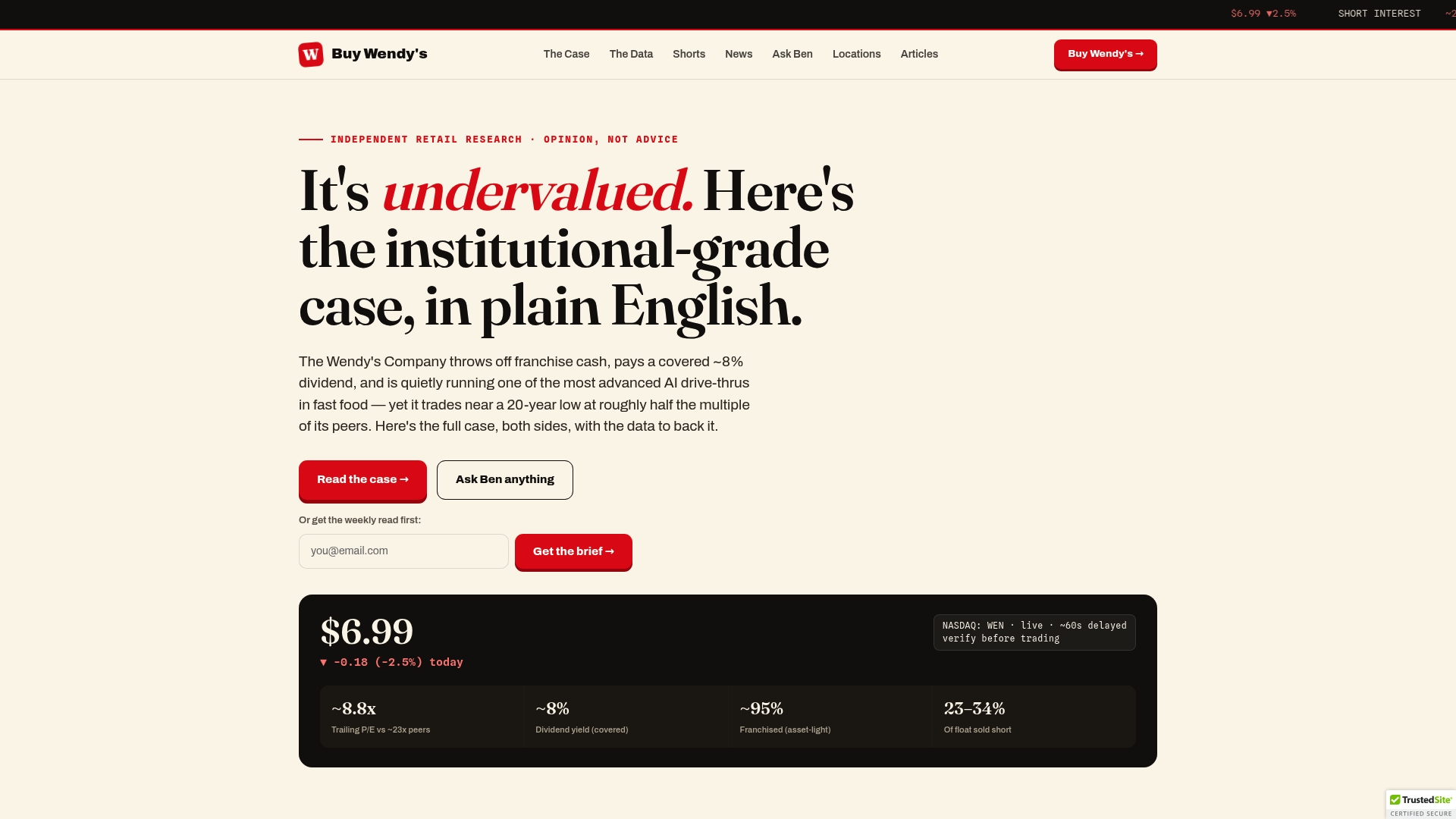
Retail investors trying to model these risks alone often lack the time to cross-reference SEC filings, franchisee commentary, and third-party traffic data every quarter. Buywendys does that work continuously and packages it into readable briefings, watchlists, and periodic updates built specifically around WEN’s risk profile rather than generic restaurant sector coverage. If you want a structured framework for reading the metrics that matter, start with the guide on how to analyze restaurant stocks, then check back for the next quarterly briefing before Wendy’s reports earnings again.
This article is general information, not a substitute for advice from a qualified financial advisor. Consult a qualified financial professional about your own circumstances before acting on anything here.
Sources
- S-3ASR (Wendy’s) — Risk Factors
- Why Wendy’s is losing customers as Nelson Peltz weighs taking the burger chain private | Fortune
- 20 reasons why Wendy’s may be doomed — Yahoo Finance
- Wendy’s Stock Drops As Trian Backs Off Takeover Hopes – StocksToTrade