Table of Contents
- Executive Summary: The AI Revolution in Quick Service Restaurants
- How AI Is Transforming the Fast Food Industry Today
- Automated Drive-Thru Technology and Customer Experience
- Restaurant Labor Optimization Tools and Cost Reduction
- AI Restaurant Analytics for Data-Driven Operations
- AI-Driven Food Safety and Quality Control
- Accessibility and Inclusivity in AI Ordering Systems
- Investment Implications for WEN Stock and QSR Operators
Last Updated: August 14, 2026
Executive Summary: The AI Revolution in Quick Service Restaurants
Artificial intelligence is reshaping how quick service restaurants operate, from order-taking to inventory management. Wendy’s has positioned itself at the forefront of this transformation through its FreshAI drive-thru technology and broader operational AI initiatives. For investors evaluating WEN stock, understanding the impact of AI on fast food operations is critical to assessing competitive advantage, margin expansion potential, and long-term scalability. This analysis examines how AI drives operational efficiency, cost reduction, and customer experience improvements, and what these capabilities mean for franchise economics and shareholder value.
How AI Is Transforming the Fast Food Industry Today
AI-driven solutions address structural challenges that have constrained QSR profitability for decades. Labor represents 25-30% of operating costs in most fast food chains. Inventory waste, missed upselling opportunities, and inconsistent execution across franchises drain margins daily. Minimum wage pressure continues to squeeze unit economics, making automation investments increasingly strategic.
Real-World Applications Across QSR Operations
Wendy’s FreshAI technology represents the most visible implementation of AI in the QSR space. The system uses voice recognition and natural language processing to take orders in the drive-thru, reducing order errors and freeing crew members for other tasks. Beyond order-taking, AI powers predictive analytics that inform menu engineering, real-time sales trend analysis, and dynamic labor forecasting.
Restaurant operators are deploying AI across multiple workflows:
- Drive-thru automation: Voice-activated ordering reduces transaction time and improves order accuracy by handling complex requests consistently.
- Inventory optimization: Predictive analytics forecast demand by daypart, weather, local events, and historical patterns, reducing stockouts and food waste.
- Labor scheduling: AI systems analyze traffic patterns and staffing availability to create optimized schedules that balance service levels with wage costs.
- Supply chain efficiency: Lead time forecasting and automated reordering reduce procurement delays and emergency orders.
- Quality control: Computer vision and sensor-based systems monitor food preparation consistency, temperature compliance, and portion accuracy.
Automated Drive-Thru Technology and Customer Experience
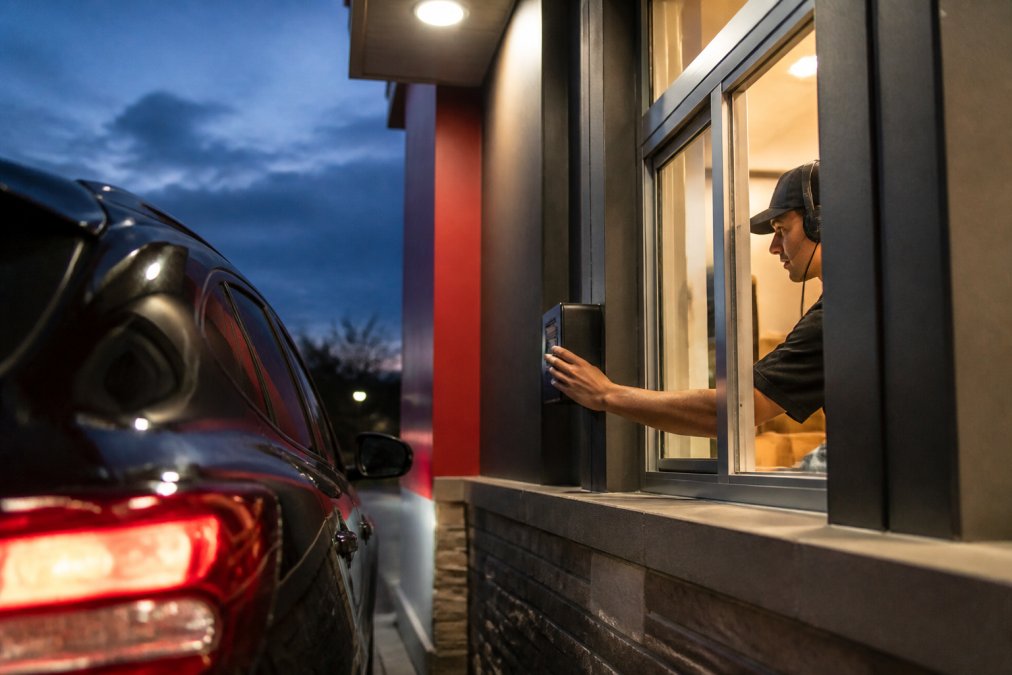
Voice-activated ordering systems represent the most consumer-facing AI implementation in fast food. These systems transcribe spoken orders, parse menu items and modifications, and flag ambiguous requests for human review. The technology addresses a persistent QSR pain point: order accuracy at drive-thru windows, where background noise, accents, and complex modifications create friction.
Wendy’s FreshAI drive-thru technology has been deployed across company-operated locations and select franchise partners.
Voice AI and Order Accuracy
Voice-based ordering systems reduce reliance on crew members to manually enter every order detail. The AI captures the spoken order, cross-references available menu items, identifies modifications, and presents the final order back to the customer for confirmation. This workflow reduces cognitive load on crew members during high-volume periods and minimizes order errors that drive customer dissatisfaction and remakes.
Order accuracy has long been a competitive battleground in fast food. Voice AI systems that achieve high accuracy rates can provide competitive advantage, particularly during peak service windows when human attention is fragmented across multiple tasks. For those tracking operational performance across locations, Wendy’s Restaurant Reviews provide real-world customer feedback on order accuracy and service quality improvements.
Personalization and Upselling at Scale
AI systems can analyze customer ordering history to recommend complementary items or suggest higher-margin menu choices. Upselling algorithms operate at scale across thousands of locations, applying consistent logic to millions of transactions. This consistency is difficult to achieve through training alone; human crew members often skip upselling during high-volume periods due to cognitive depletion.
Restaurant Labor Optimization Tools and Cost Reduction
Labor cost management has become the defining challenge in fast food economics. Minimum wage increases, competitive pressure for worker retention, and physical job demands create a difficult operating environment. AI-driven labor optimization tools address this challenge by improving scheduling efficiency and automating high-friction tasks.
Workforce Scheduling and Cognitive Load
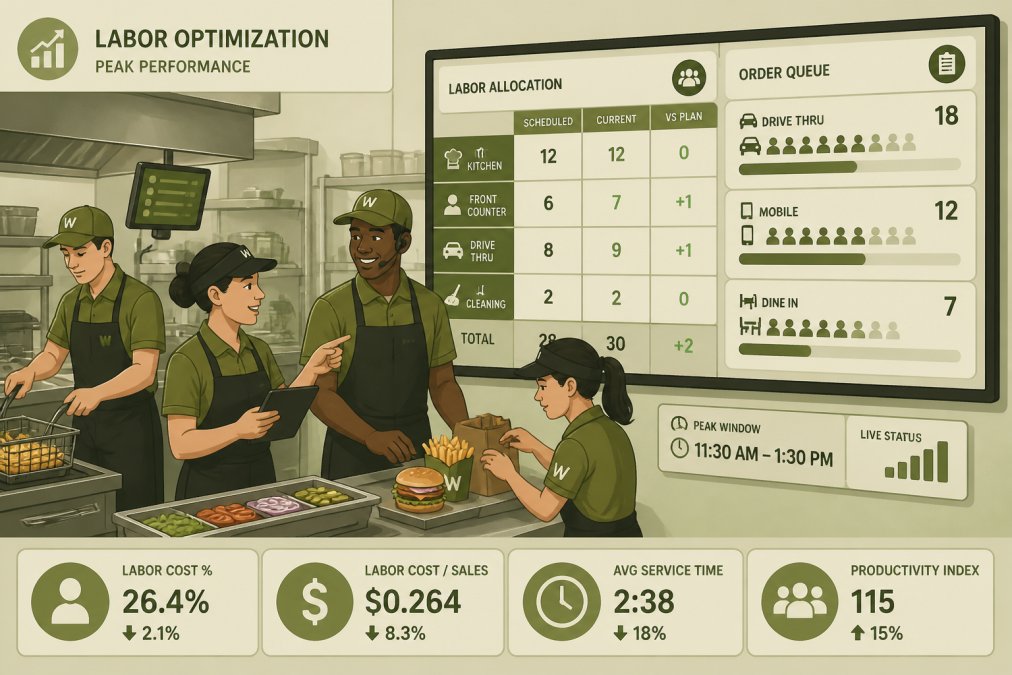
AI scheduling systems analyze historical traffic patterns, staffing availability, skill levels, and labor regulations to create optimized schedules. These systems model multiple scenarios, what happens if a key crew member calls out, what’s optimal staffing for a local event, how should scheduling adjust for seasonal demand variation.
Franchisees who adopt these systems can see reductions in labor hours per location without sacrificing service quality, though results vary based on existing staffing practices and local wage environments.
Addressing Minimum Wage Pressure
Minimum wage increases have compressed fast food margins significantly. This creates powerful incentives to automate labor-intensive tasks. Voice-based order-taking, automated inventory management, and optimized scheduling all reduce the total labor hours required to operate a location at a given service level.
The automation isn’t designed to eliminate jobs entirely, most QSR locations still require similar headcount to maintain service quality, but rather to redeploy labor from routine, error-prone tasks to customer-facing and quality-assurance roles.
AI Restaurant Analytics for Data-Driven Operations
Data-driven decision-making has historically been difficult in franchise systems. Individual franchisees operate independently, using different POS systems and inventory platforms. AI analytics platforms aggregate data from multiple locations and identify patterns that inform operational decisions.
Predictive Analytics and Inventory Management
Inventory management in fast food is a constant balancing act. Overstock ties up capital and increases spoilage. Understock creates stockouts that frustrate customers and force expensive emergency orders. Perishable inventory adds complexity, as lettuce, tomatoes, and prepared proteins have short shelf lives.
Predictive analytics systems forecast demand at the item level, incorporating historical sales data, local events, weather patterns, and promotional calendars. Accurate demand forecasting reduces both waste and stockouts, directly improving margins. Operators monitoring performance trends can reference Wendy’s News & Restaurant Tracker to understand how operational improvements translate to broader business metrics.
Food Waste Reduction and Supply Chain Efficiency
Food waste represents a hidden drag on QSR profitability. AI-driven waste reduction operates through multiple mechanisms:
- Accurate demand forecasting reduces over-preparation of perishable items
- Portion control monitoring via computer vision ensures consistency and prevents waste
- Automated reordering based on inventory levels and shelf-life data prevents stockouts and expiration
- Lead time forecasting reduces emergency orders that often arrive with excess inventory
Supply chain efficiency improvements extend beyond the restaurant to distribution and procurement. Predictive analytics inform purchasing decisions, helping franchisees negotiate better terms with suppliers when they can forecast volume accurately.
AI-Driven Food Safety and Quality Control
Food safety represents both a regulatory requirement and a competitive differentiator. AI systems enhance food safety through continuous monitoring and early detection of potential issues.
Computer vision systems identify food preparation errors, incorrect portion sizes, improper temperature, and contamination risks in real time. Temperature sensors integrated with IoT platforms monitor refrigeration units, fryers, and holding equipment continuously, alerting managers to deviations before food quality is compromised.
Compliance documentation becomes automated. Rather than relying on manual temperature logs and inspection checklists, AI systems generate continuous, timestamped records of food safety parameters. This creates defensible documentation and identifies systemic issues that might not be apparent from spot-check audits.
Accessibility and Inclusivity in AI Ordering Systems
As QSR chains deploy AI-driven ordering technology, accessibility considerations become increasingly important. Voice-based systems must accommodate customers with hearing or speech impairments. Visual menu displays must meet accessibility standards for customers with vision limitations.
Well-designed AI ordering systems include multiple input methods: voice, touchscreen, mobile app, and traditional keypad entry. This redundancy ensures that all customers can place orders regardless of ability. For Wendy’s, accessibility in FreshAI systems is not just a compliance requirement, it’s a market opportunity that expands the addressable customer base.
Investment Implications for WEN Stock and QSR Operators
Competitive Advantage and Operational Scalability
AI capabilities create sustainable competitive advantages for chains that deploy them effectively. A chain with superior drive-thru efficiency, lower labor costs per transaction, and higher attachment rates gains margin advantage over competitors with legacy systems. This advantage compounds across thousands of locations.
For Wendy’s specifically, early adoption of FreshAI technology provides first-mover advantages in drive-thru automation. As the technology proves itself across company-operated locations, franchisees can face increasing pressure to adopt similar systems to remain competitive.
Operational scalability matters enormously for franchise systems. Wendy’s operates roughly 7,000 locations globally, with the majority franchised. AI systems that improve execution consistency across this vast network reduce the management overhead required to maintain brand standards.
Long-Term Maintenance and Technical Debt
Deploying AI systems at scale creates ongoing obligations. Voice AI systems require continuous retraining as language patterns evolve. Hardware systems require maintenance and eventual replacement. Software systems require security updates and bug fixes.
For franchisees, the total cost of ownership for AI systems extends beyond initial capital investment. Subscription fees for cloud-based analytics, hardware maintenance, software updates, and training create ongoing operational expense.
Key Takeaways
-
AI impact on fast food is structural, not cyclical. The technology addresses fundamental economic challenges, labor cost pressure, margin compression, execution consistency, that will persist regardless of economic conditions.
-
Wendy’s FreshAI represents meaningful competitive advantage. Early deployment of drive-thru automation, combined with AI-driven labor and inventory optimization, creates operational advantages that are difficult for competitors to replicate quickly.
-
Franchisee adoption will be critical to long-term value creation. Company-operated locations serve as proof-of-concept, but the real margin expansion comes from franchisees deploying these systems across their units.
-
AI enables margin expansion in a high-wage environment. As minimum wage increases continue, AI automation becomes increasingly necessary to maintain unit economics.
-
Technical debt and maintenance costs are real. AI systems require ongoing investment in updates, training, and infrastructure maintenance.
Frequently Asked Questions
How is AI currently being used in fast food restaurants?
AI powers voice-activated ordering in drive-thrus, automates inventory forecasting, optimizes staff scheduling, and personalizes menu recommendations. Wendy's FreshAI technology exemplifies this, using voice recognition to take orders with minimal human intervention while reducing errors. Predictive analytics help operators anticipate demand, manage food costs, and reduce waste across their supply chains.
What are the main benefits of AI for quick service restaurant operators?
QSR operators gain labor cost reduction through workforce automation, improved order accuracy that boosts customer satisfaction, faster drive-thru throughput, and data-driven inventory management. AI analytics reveal real-time sales trends and consumer behavior patterns, enabling dynamic menu engineering and reducing food waste. For franchisees, these efficiencies directly improve margins and operational consistency across locations.
Will AI replace human workers in the fast food industry?
AI augments rather than fully replaces human workers. While automation handles routine tasks like order-taking and scheduling, human staff remain essential for food preparation, quality control, customer service, and problem-solving. The real impact is cognitive depletion reduction, staff focus on higher-value work instead of repetitive decisions. This shift may reshape job roles and reduce hiring needs, but complete displacement is unlikely in the near term.
How does AI impact Wendy's competitive position and stock valuation?
AI-driven operational efficiency creates a cost advantage that protects margins in a high-minimum-wage environment. Better inventory management and labor optimization improve cash flow, supporting dividend sustainability. Faster service and personalization enhance customer experience, driving repeat visits. For WEN stock investors, these operational improvements translate to earnings growth potential and reduced downside risk in economic slowdowns.
This article was written using GrandRanker