Wendy’s competitive advantage rests on four reinforcing assets: a fresh, never frozen beef supply chain that competitors find costly to replicate, high‑attachment signature products like the Frosty, an asset‑light franchise model that generates recurring royalty income, and a disciplined technology rollout led by FreshAI. Layered on top is Project Fresh, management’s execution roadmap for turning those assets into unit growth and margin expansion. For investors, the question isn’t whether these advantages exist. It’s whether they’re durable enough to survive rising commodity costs, franchisee capital constraints, and copycat competitors.
TL;DR:
- Wendy’s fresh, never frozen beef supply chain is operationally complex, requiring frequent refrigerated deliveries that raise per-unit costs and expose the chain to commodity shocks.
- The company’s signature products like the Frosty and square patty are highly distinctive, creating customer habits that support premium pricing and defend against imitators.
- FreshAI has demonstrated significant efficiency improvements in drive-thru service times, but its full systemwide impact depends on scaling and consistent deployment.
- Franchisee reimaging investments boost store value and royalty income but are risky in tighter credit environments that may delay upgrades.
- Wendy’s competitive advantage relies on durable supply chain and franchise structure, balanced against unproven innovations like FreshAI and evolving marketing measurement efforts.
Table of Contents
- Wendy’s Competitive Advantage at a Glance
- Why “Fresh, Never Frozen” Is a Structural Advantage, Not a Slogan
- FreshAI and Digital Ordering: Where the Efficiency Gains Are Real
- Brand Voice and Marketing: Cheap Attention, Expensive Consistency
- The Franchise Model: Why Royalties Beat Store Margins
- Project Fresh: The Targets Investors Should Actually Track
- Where the Advantages Could Break Down
- Turning These Advantages Into a Valuation Read
- Who Wendy’s Advantages Actually Appeal To
- Supply Chain Complexity: The Cost Behind the Quality Claim
- How Wendy’s Stacks Up Against McDonald’s and Burger King
- Sustainability and Corporate Responsibility as a Competitive Signal
- Menu Innovation: Testing Without Cannibalizing the Core
- Geographic Expansion and Regional Preferences
- What This Means for Operators, Franchisees, and Investors
- Go Deeper With BuyWendy’s Research
- Sources
- FAQ
Wendy’s Competitive Advantage at a Glance
Some of Wendy’s strengths are structural and hard to copy quickly. Others are still being proven out. Here’s how the core advantages break down, with a rough read on durability.
- Fresh, never frozen beef supply chain — Requires higher delivery frequency and refrigerated logistics that competitors running frozen supply chains can’t match overnight. Durable.
- Signature high‑attachment products (Frosty, square patty) — Distinct menu items create habitual repeat visits that generic burger offerings don’t generate. Durable.
- Asset‑light franchise economics — Royalties and rents produce steady revenue with lower capital exposure than company‑owned store models. Durable.
- FreshAI drive‑thru technology — Early tests show roughly 99% voice accuracy and service times cut by more than 20 seconds per vehicle, but the rollout is still scaling. Improving.
- Digital ordering and loyalty programs — Drives order frequency and average check size, though full systemwide adoption data remains incomplete. Improving.
- Brand voice and cultural marketing — Social media tone and collaborations generate earned media cheaply, but they depend on execution consistency that can slip. Risky.
- Franchisee capital and reimaging commitments — Store upgrades raise average unit volume, yet they require franchisees to fund renovations during a tighter credit environment. Risky.
The pattern that emerges: Wendy’s oldest advantages, the supply chain and the franchise structure, are the most durable. Its newest bets, FreshAI and marketing measurement, are promising but unproven at scale.
Why “Fresh, Never Frozen” Is a Structural Advantage, Not a Slogan
Wendy’s built its brand identity on beef that never gets frozen, and that claim carries real operational weight. The company documents sourcing and quality standards for its North American beef supply as a core commitment, not a marketing flourish. Delivering fresh beef daily to thousands of restaurants means coordinating a refrigerated fleet on a tighter schedule than a frozen supply chain requires, since frozen beef can sit in a distribution warehouse for weeks without spoiling.
That operational demand is exactly what makes the advantage hard to copy. Executive commentary on the “burger battles” that flared across the industry noted that fresh beef logistics impose higher cost and complexity precisely because they can’t be scaled up overnight. A competitor chasing the same claim would need to rebuild its distribution network, retrain suppliers, and absorb higher per‑unit delivery costs. That’s a multi‑year undertaking, not a menu tweak.
Statistic Callout: Just‑in‑time fresh beef logistics require more frequent refrigerated deliveries than frozen alternatives, raising per‑unit distribution cost while supporting the price premium Wendy’s charges on core beef items.
The Frosty plays a related but different role. It’s a notable menu item that attracts customers and can encourage repeat visits. The square patty serves a similar function: it’s a visual and textural signature that’s difficult for a rival to replicate without inviting an obvious “copycat” comparison. Together, the fresh beef promise and the signature product lineup support premium pricing relative to value‑tier competitors, even when promotional activity elsewhere in the category intensifies.
The tradeoff is real. Fresh supply chains are more exposed to commodity price swings and regional supply disruptions than frozen ones, a sensitivity that shows up later in this analysis.
FreshAI and Digital Ordering: Where the Efficiency Gains Are Real
FreshAI is the clearest example of Wendy’s translating operational investment into measurable results. Early drive‑thru testing found the system delivering about 99% voice‑recognition accuracy and cutting average per‑vehicle service time by more than 20 seconds. For a channel where drive‑thru accounts for a large share of transactions, that kind of throughput gain compounds fast across a systemwide footprint.
Statistic Callout: A 20‑second reduction in average drive‑thru service time, if sustained across peak dayparts, translates into meaningfully more vehicles served per hour, a lever that shows up directly in labor allocation and unit‑level margin.
What matters for investors is scope, not just the headline number. High‑volume freestanding locations with heavier drive‑thru traffic stand to gain the most from throughput improvements, while smaller or lower‑traffic units will see a more modest effect. That’s a nuance worth tracking as the rollout expands beyond pilot markets.
Digital ordering and loyalty membership round out the technology story:
- FreshAI integrates with digital menu boards to support daypart‑specific offers, creating a feedback loop between customer ordering data and in‑store promotions, according to reporting on Wendy’s innovation approach.
- Loyalty program engagement is a material driver of visit frequency and average check size, though systemwide digital penetration figures are still developing and should be treated as directional rather than precise.
- Labor reallocation, shifting staff from order‑taking to food prep and quality checks, is the underappreciated benefit of AI‑assisted ordering, since it frees crew time without cutting headcount.
None of this replaces the core product advantage. It amplifies it, by making the ordering experience faster without sacrificing the accuracy that fresh, made‑to‑order items require. Readers evaluating the rollout in more depth can review how Wendy’s AI drive‑thru works for a closer look at the technology itself.
Brand Voice and Marketing: Cheap Attention, Expensive Consistency
Wendy’s social media voice, sharp, self‑aware, occasionally combative, has functioned as a low‑cost customer acquisition engine for years. A well‑timed tweet or a cultural collaboration generates earned media that a traditional ad buy simply can’t match dollar for dollar. That’s a genuine advantage, and it’s one competitor have tried and mostly failed to imitate, because tone is harder to copy than a menu item.
But the company is visibly shifting from viral moments toward measurable return. Reporting on the turnaround plan describes Wendy’s investing in marketing effectiveness and customer segmentation rather than relying on social virality alone. That shift matters because viral attention doesn’t reliably convert into repeat visits. Segmentation work does, when it’s targeted correctly.
The marketing advantages worth tracking:
- Earned media from social voice and collaborations lowers customer acquisition cost relative to paid advertising, but its impact is inconsistent quarter to quarter.
- Limited‑time offers built around the Frosty and other signature items generate awareness cheaply while reinforcing the fresh, never frozen positioning rather than diluting it.
- Segmentation and measurement investment aims to convert one‑time viral attention into tracked, repeatable new‑customer acquisition, a harder metric to hit but a more durable one.
The risk is drift. If marketing tone outruns product execution, the brand voice becomes a liability rather than an asset, especially if a viral moment draws customers in only to disappoint them at the counter.
The Franchise Model: Why Royalties Beat Store Margins
Wendy’s operates as a predominantly franchised company, which means most of its systemwide revenue comes from royalties and rents rather than day‑to‑day store‑level margins. That structure produces steadier, more predictable cash flow than a heavy company‑owned model, because Wendy’s collects a percentage of franchisee sales regardless of how a given location’s food and labor costs move month to month.
This asset‑light setup has a second benefit: capital efficiency. Building and operating restaurants directly ties up significant capital in real estate and equipment. Franchising shifts that capital burden onto franchisees, freeing Wendy’s to redirect cash toward technology investment, reimaging incentives, and shareholder returns.
Reimaging plays directly into this. Modernized store designs, updated kitchen layouts, and digital menu boards tend to raise average unit volume once a location completes the upgrade, which lifts the royalty base Wendy’s collects and supports adjusted EBITDA growth over time.
- Recurring royalty and rent income smooths earnings volatility compared with a company‑operated model exposed directly to commodity and labor cost swings.
- Reimaged locations generally post higher average unit volume, which compounds into higher royalty collections without Wendy’s funding the renovation itself.
- Franchisee capital constraints are the real risk here. Reimaging requires franchisee investment, and in a tighter credit environment some operators may delay upgrades, slowing the AUV gains the model depends on.
Wendy’s own SEC filings disclose these franchise‑model tradeoffs directly, including the company’s dependence on franchisee execution to hit systemwide targets. Readers wanting a deeper walkthrough of how this structure compares to a company‑operated model can review the asset‑light franchise model guide.
Project Fresh: The Targets Investors Should Actually Track
Project Fresh is management’s name for the execution plan behind everything described above, and it comes with specific, quantified targets. At its 2025 investor day, Wendy’s laid out a long‑term financial algorithm calling for 1,000 net new restaurants by 2028, alongside 3 to 4% annual net unit growth and 7 to 8% adjusted EBITDA growth.
Reaching those numbers depends on several specific execution levers, not just favorable macro conditions:
- Franchise development deals. New unit growth requires signed development agreements with existing and new franchisees, a pipeline that takes years to build.
- Menu and daypart expansion. Breakfast and beverage growth, described in coverage of the company’s innovation approach, adds incremental sales occasions without requiring new real estate.
- Reimaging existing stores. Higher AUV from modernized locations supports the EBITDA side of the algorithm even before new units open.
- Technology deployment pace. FreshAI and digital ordering scale unevenly across store formats, and the rollout schedule is itself a KPI worth watching.
Investors tracking Wendy’s progress should watch quarterly unit opening counts against the 1,000‑by‑2028 target, digital sales mix trends, and same‑store sales performance as the clearest read on whether Project Fresh is on pace. A closer look at the development pipeline is available in the 2026 expansion and growth analysis.
Where the Advantages Could Break Down
None of Wendy’s strengths are guaranteed to hold. The fresh beef supply chain that supports premium pricing also carries higher exposure to commodity price shocks and regional logistics disruptions than a frozen‑supply competitor faces. Franchisee execution is the second pressure point: reimaging and new unit growth both depend on operators having the capital and appetite to invest, and that appetite can shrink quickly in a tighter lending environment.
Competitors can also copy surface‑level features, a fresh‑sounding marketing claim, a viral social post, a limited‑time menu item, without replicating the deeper operational discipline behind them. That’s a real risk to Wendy’s differentiation if execution slips anywhere in the chain.
- Rising beef and logistics costs squeeze margin faster in a fresh supply chain than a frozen one.
- Franchisee capital constraints can delay reimaging and slow AUV gains system‑wide.
- Surface‑level imitation by rivals can erode the perceived uniqueness of “fresh” positioning even without matching the underlying supply chain.
- Technology rollout stumbles, order errors, customer frustration, could damage the brand faster than FreshAI’s efficiency gains can offset.
Pro Tip: Watch franchisee disclosure commentary in quarterly filings as closely as headline unit growth numbers. Slower reimaging pace is often the earliest sign that Project Fresh execution is falling behind schedule, well before same‑store sales data confirms it.
Turning These Advantages Into a Valuation Read
The strategic advantages above only matter to investors if they show up in free cash flow, EBITDA growth, and average unit volume. FreshAI’s efficiency gains should eventually surface in labor cost ratios and franchisee margin, while Project Fresh’s unit growth targets feed directly into the royalty base Wendy’s collects.
The signals worth tracking quarter over quarter: FreshAI deployment pace across store formats, digital sales mix trends, net new unit openings against the 1,000‑by‑2028 target, and same‑store sales composition between traffic and check size. Each one tells you whether a given advantage is compounding or stalling.
For a structured way to model these inputs against Wendy’s valuation, the AI drive‑thru investor analysis and restaurant stock valuation guide both walk through the underlying metrics in more detail.
Who Wendy’s Advantages Actually Appeal To
Wendy’s core customer base skews toward value‑conscious adults in their late twenties through forties who want a meal that feels a step above basic fast food without paying casual‑dining prices. That’s a deliberate middle position: above the pure value tier on perceived food quality, below full‑service restaurants on price and speed.
The Frosty and fresh beef promise speak directly to that segment because they signal a quality difference the customer can taste, not just a claim in an ad. Younger customers, particularly Gen Z, respond more to the brand’s social media tone and cultural collaborations than to traditional advertising, which is part of why Wendy’s continues investing in that voice even as it adds measurement discipline. A closer look at how this generational dynamic factors into the turnaround appears in the Gen Z strategy analysis.
Families and lunchtime office workers make up another core segment, drawn by combo value and speed of service, areas where FreshAI’s throughput gains matter most. Breakfast and beverage expansion targets a third segment: commuters and daypart‑flexible customers Wendy’s has historically underserved compared with competitors who built stronger morning traffic decades earlier.
The through line across these segments is consistency of expectation. A customer choosing Wendy’s over a value‑tier competitor is paying a small premium for a specific promise, fresh beef, a distinct menu, faster service, and that promise has to hold at every visit, in every market, or the demographic targeting doesn’t translate into loyalty.
Supply Chain Complexity: The Cost Behind the Quality Claim
Running a fresh, never frozen supply chain means Wendy’s logistics network looks fundamentally different from a competitor relying on frozen beef. Frozen product can be shipped in bulk and stored for weeks, smoothing out delivery schedules and reducing transportation frequency. Fresh beef can’t tolerate that flexibility, so distribution centers must coordinate more frequent, temperature‑controlled deliveries to thousands of restaurants on a tighter clock.

That complexity shows up as cost. Refrigerated fleet coordination, tighter delivery windows, and shorter shelf life all add operating expense that a frozen‑supply competitor avoids. It’s the tradeoff behind the quality claim: Wendy’s absorbs higher logistics cost in exchange for a product difference customers can perceive and a barrier competitors find slow to replicate.
The complexity cuts both ways on risk. A regional supply disruption, whether from weather, a supplier issue, or a transportation bottleneck, hits a fresh supply chain harder than a frozen one, because there’s less buffer inventory to fall back on. That sensitivity is precisely what management has acknowledged when discussing the operational discipline required to keep the fresh promise intact across a large franchise system.
For investors, the practical takeaway is that supply chain execution isn’t a background operational detail. It’s a direct input into both the cost side of the margin equation and the durability of the brand’s core differentiation. A slip in either direction, cost creep or quality inconsistency, erodes the advantage from opposite ends at once.
How Wendy’s Stacks Up Against McDonald’s and Burger King
Scale is where McDonald’s wins outright. Its systemwide footprint and marketing budget dwarf Wendy’s, and its breakfast daypart dominance took decades to build. But scale isn’t the same as differentiation, and Wendy’s doesn’t compete on footprint. It competes on product perception, positioning itself as the fresher, more customizable alternative to a chain built around consistency at massive volume.
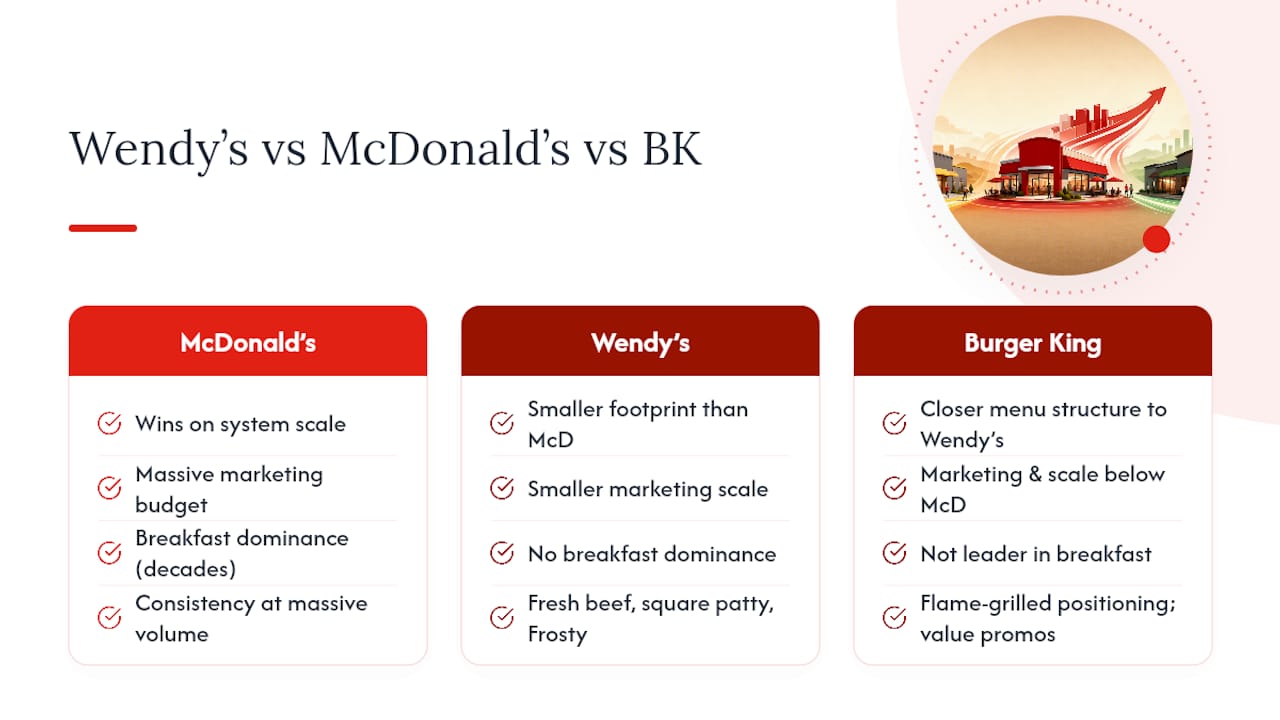
Burger King presents a closer comparison on menu structure, flame‑grilled positioning, value promotions, but Wendy’s fresh beef claim and signature items like the square patty and Frosty give it a more distinct product identity. Burger King’s recent turnaround efforts have leaned heavily on remodeling and value menus, a strategy that overlaps with Wendy’s reimaging push but without the same underlying supply chain differentiation to back it up.
The clearest contrast is philosophical. Wendy’s turnaround, branded internally as Project Fresh, is built around measured, quality‑first growth rather than aggressive discounting or footprint expansion for its own sake. That’s a narrower, more disciplined bet than either major competitor is making, and it’s also a riskier one if execution slips, since Wendy’s has less scale to absorb a misstep than McDonald’s does.
What Wendy’s owns that neither competitor can claim outright is the specific combination of fresh beef positioning and a franchise model disciplined enough to fund that positioning without diluting it through excessive discounting.
Sustainability and Corporate Responsibility as a Competitive Signal
Wendy’s food quality commitments, sourcing standards, and animal care practices function as more than compliance boxes. They reinforce the same “fresh” positioning that drives product differentiation, giving the sustainability narrative and the quality narrative a shared foundation rather than two separate initiatives competing for marketing attention.
That alignment matters because customers who care about sourcing transparency are often the same customers drawn to the fresh, never frozen claim in the first place. A disconnect between the two, say, aggressive sustainability marketing paired with inconsistent sourcing practices, would undermine both messages at once. Wendy’s documented commitments around North American beef sourcing keep the two narratives consistent rather than contradictory.
The competitive stance this creates is subtle but real: sustainability messaging doesn’t need to be a standalone campaign when it’s already embedded in the core product claim. That’s more efficient than building a parallel CSR narrative from scratch, and it avoids the credibility gap that shows up when a company’s sustainability marketing outpaces its actual sourcing practices.
The risk sits on the cost side. Sourcing standards that support both quality and sustainability claims tend to cost more to maintain than looser sourcing practices, which puts additional pressure on the same margin structure already strained by fresh supply chain logistics. Wendy’s is betting that customers will pay a small premium for both claims together, and so far that bet has held up better than pure discounting strategies pursued elsewhere in the category.
Menu Innovation: Testing Without Cannibalizing the Core
Wendy’s approach to new menu items leans toward measured testing rather than sweeping menu overhauls. Reporting on the company’s growth strategy describes a pattern of careful innovation: personalization options, breakfast expansion, and a developing beverage pipeline, introduced in ways designed to add incremental occasions without pulling attention away from core products like the Frosty and the square patty.
That discipline shows up in how the company handles trends like plant‑based options and limited‑time offers. Rather than chasing every dietary trend with a permanent menu addition, limited‑time offers let Wendy’s test consumer response at low risk, then decide whether an item earns a permanent spot. This keeps the core menu, the part carrying the fresh beef brand promise, stable while newer items absorb the experimentation risk.
Breakfast and beverage expansion represent the clearest strategic bet in this category. Both dayparts had been historically underdeveloped relative to competitors, and both offer growth without requiring Wendy’s to compete head‑on with McDonald’s on burger volume. It’s growth adjacent to the core rather than growth that risks diluting it.
The tradeoff is speed. A more cautious innovation cadence means Wendy’s sometimes lags competitors on fast‑moving trends, but it also means fewer costly menu failures and less risk of confusing the brand’s core quality positioning with short‑lived novelty items.
Geographic Expansion and Regional Preferences
Project Fresh’s 1,000‑net‑new‑restaurant target by 2028 isn’t just a growth number. It’s a bet on where new units land and how well regional menu and format decisions match local preferences. Franchise development deals tend to concentrate growth in markets where existing franchisees already have operational infrastructure, which means expansion often clusters around proven regional strongholds rather than spreading evenly.
Regional taste differences shape execution more than headline growth targets suggest. Beverage and breakfast expansion, for instance, may perform differently across a Rust Belt drive‑thru heavy market than in a denser urban footprint where walk‑in traffic and delivery integration matter more. Reimaging decisions also vary by market, since a store design that maximizes drive‑thru throughput in a suburban location doesn’t necessarily fit a smaller urban footprint.
The competitive advantage here is flexibility layered onto a consistent core. Wendy’s doesn’t change its fundamental product promise by region, the fresh beef commitment and signature items stay constant, but it can adjust format, daypart emphasis, and technology deployment pace to match regional demand patterns.
What This Means for Operators, Franchisees, and Investors
If you’re an operator, the fresh supply chain and reimaging incentives only pay off with disciplined execution at the store level. If you’re a franchisee, model reimaging costs against realistic AUV gains before committing capital. If you’re an investor, the practical next step is tracking FreshAI’s deployment pace and unit growth against the Project Fresh targets, not just headline same‑store sales.
— Benjamin
Go Deeper With BuyWendy’s Research
Buywendys turns the advantages covered here into models you can actually use. If the fresh beef supply chain and FreshAI rollout raise questions about how they’ll move Wendy’s numbers, the AI drive‑thru investor analysis breaks down what the technology’s throughput gains could mean for unit economics and franchisee margin.
For a broader read on how Project Fresh’s unit growth and EBITDA targets translate into valuation upside or downside, the Wendy’s stock bull vs bear case walks through both scenarios with the specific KPIs to track quarter over quarter. And if you’re trying to figure out how the franchise royalty structure actually supports free cash flow, restaurant royalty models explains the mechanics in plain terms.
Start by checking the latest unit opening counts and FreshAI deployment updates against the targets covered in this analysis, then use these reports to build your own view on where Wendy’s stands today.
Sources
- AI innovation in fast food: Wendy’s FreshAI shows improved efficiency at drive‑thru
- Wendy’s — what we value: food and quality
- Wendy’s growth playbook leans on careful innovation
- Wendy’s U.S. president: the CEO burger battles exposed a truth every brand leader needs to hear
- Wendy’s doubles down on marketing effectiveness as part of turnaround
FAQ
What Is Wendy’s Biggest Competitor?
McDonald’s is Wendy’s largest competitor by scale and revenue, while Burger King competes most directly on menu positioning and value promotions. Wendy’s differentiates from both through its fresh, never frozen beef claim and signature items like the Frosty.
Why Is Wendy’s Stock Sometimes Under Pressure?
Wendy’s stock has faced pressure tied to execution concerns around Project Fresh milestones, franchisee capital constraints for reimaging, and broader sensitivity to commodity cost swings in its fresh beef supply chain. These are operational and macro factors rather than a single isolated event.
Who Is Wendy’s Target Market?
Wendy’s core customers are value‑conscious adults roughly in their late twenties through forties who want food quality above basic fast food without casual‑dining prices, alongside a growing focus on Gen Z customers responsive to the brand’s social media voice.
What Are Wendy’s Key Marketing Strategies?
Wendy’s combines a distinct, culturally engaged social media voice with a shift toward marketing effectiveness and customer segmentation, moving from viral moments alone toward measured return on marketing investment.
Is FreshAI a Real Competitive Advantage or Just a Pilot Program?
Early testing shows meaningful throughput gains, but the rollout is still expanding beyond initial markets, making it an improving advantage rather than a fully proven one at systemwide scale.
Recommended
- Wendy’s Gen Z Strategy: The Hidden Turnaround Lever Investors Should Watch
- Wendy’s Long-Term Growth Potential: 2026 Analysis
- Wendy’s International Strategy: Can Global Growth Change the WEN Stock Story?
- Wendy’s Store Experience vs. McDonald’s and Burger King: Layout, Cleanliness, Drive-Thru, Wi-Fi, Restrooms, and Investor Analysis