
An asset-light franchise model is a franchising structure where the franchisor scales its brand by licensing units to franchisees who fund the physical assets, while the franchisor earns revenue primarily through initial franchise fees and ongoing royalties on gross sales. This model suits capital-constrained entrepreneurs seeking lower upfront exposure, multi-unit operators targeting rapid geographic expansion, and institutional investors who value predictable royalty cash flows over volatile store-level margins.
TL;DR — Key benchmarks before you read further:
- Royalty rates in U.S. franchise systems typically run in the low single digits of gross sales, with marketing fund contributions adding a small additional portion
- Asset-light franchise opportunities often exist at relatively low total initial investment levels across sectors like home services, mobile auto care, tutoring, and residential cleaning
- The FTC Franchise Rule requires franchisors to deliver a Franchise Disclosure Document (FDD) at least 14 days before any signing or payment — this is your primary regulatory reference
- FDD Item 7 discloses estimated startup costs; Item 19 discloses financial performance representations — both are non-negotiable reading before any commitment
Table of Contents
- How does an asset-light franchise model actually work?
- What characteristics define a truly asset-light franchise?
- What do you gain and what do you trade away with an asset-light approach?
- Which U.S. sectors use asset-light franchising most, and what does it cost to enter?
- What does the money actually look like? Unit economics and break-even math
- How do you vet an asset-light franchise opportunity before committing?
- If you’re a franchisor: how do you move toward an asset-light model?
- What does the investor lens reveal about asset-light franchise returns?
- Is the asset-light franchise model right for you? A verdict and next steps
- Key Takeaways
- Why asset-light franchising is compelling — and where to stay cautious
- Useful sources and further reading
How does an asset-light franchise model actually work?
The franchisor and franchisee occupy clearly separated roles. The franchisor owns and licenses the brand, intellectual property, operating systems, and support infrastructure. The franchisee funds the physical build-out, equipment, initial inventory, and working capital, then operates the unit under the franchisor’s standards.
Revenue mechanics for the franchisor:
- Initial franchise fee: A one-time payment at signing, typically a moderate upfront fee for lower-investment concepts, though quick-service restaurant (QSR) brands may charge more
- Ongoing royalties: A percentage of gross sales paid weekly or monthly — the core recurring revenue stream
- Marketing fund contributions: Pooled into a system-wide or regional fund the franchisor administers
- Variable rents or equipment leases: Some franchisors sublease real estate or equipment to franchisees, though BCG research notes that fixed rent creates long-term liabilities and variable rents tied to revenue better align incentives between both parties
The operational sequence runs: franchisor recruits a candidate → delivers the FDD (at least 14 days before signing, per FTC rules) → awards territory → franchisee executes build-out → unit opens → franchisee reports gross sales and remits royalties.
How this differs from asset-heavy or company-owned models:
- In a company-owned model, the franchisor bears all CapEx, reports average unit volume (AUV) on its own income statement, and captures full store-level margin
- In an asset-light franchise arrangement, CapEx sits on the franchisee’s balance sheet; the franchisor’s income statement shows royalty and fee revenue with minimal depreciation drag
- Margin profiles differ sharply: franchisors in asset-light systems often report higher operating margins on their corporate P&L, while franchisees absorb occupancy, labor, and equipment costs at the unit level
What characteristics define a truly asset-light franchise?
Not every franchise marketed as “low-cost” is genuinely asset-light. These observable hallmarks help you distinguish the real thing.
Operational hallmarks:
- Low or no dedicated real-estate footprint (home-based, mobile, or third-party production facilities)
- Centralized technology platforms for ordering, reporting, and customer management
- Standardized SOPs that can be trained and audited remotely
- Minimal proprietary equipment requirements — franchisees source from approved vendors rather than buying proprietary hardware from the franchisor
Contractual hallmarks:
- Royalty-based revenue as the franchisor’s primary income line
- Franchisor balance sheet carries little or no owned property, plant, or equipment tied to franchised units
- Franchisee-supplied CapEx and working capital fund all unit-level assets
- Territory rights granted contractually rather than through real-estate control
Behavioral hallmarks:
- Rapid unit-count growth relative to corporate headcount
- Heavy investment in training systems, field audits, and franchisee support teams
- Franchisor-provided marketing toolkits and lead-generation platforms, because franchisees lack the scale to build these independently
Sector illustrations: a residential cleaning franchise operates from a franchisee’s home office with branded supplies and a scheduling platform — no storefront needed. A mobile auto detailing chain requires a van and equipment the franchisee purchases; the franchisor provides the booking system and brand. A tutoring franchise may use rented classroom space the franchisee leases independently. In hospitality, brands like Marriott and Hilton collect management and franchise fees while property owners fund the physical asset — a textbook illustration of the model at scale.

What do you gain and what do you trade away with an asset-light approach?
Advantages
- Faster geographic expansion: — Because franchisees fund each unit, the franchisor can open locations across multiple markets simultaneously without waiting to accumulate capital
- Capital redeployment: EY research finds that asset-light models enable companies to redeploy freed capital into brand investment, R&D, and digital innovation — treating the model as an offensive growth strategy rather than simple cost reduction
Disadvantages
- Governance and quality-control risk: — When franchisees own the assets, the franchisor’s enforcement leverage is contractual rather than operational. Brand standards can erode when audit systems are weak
Pro Tip: When evaluating royalty structures, favor systems where the royalty rate is variable or tiered against franchisee revenue rather than a flat percentage applied from day one — this alignment reduces the risk of franchisee failure in the early ramp-up period and protects the franchisor’s long-term royalty stream.
Which U.S. sectors use asset-light franchising most, and what does it cost to enter?
Asset-light franchise structures are most prevalent where the core value is a system, brand, or technology platform rather than a physical facility. The sectors below consistently produce low-capital-entry opportunities in the U.S. market.
Sector overview:
- Home services (cleaning, pest control, lawn care): — Franchisees operate from home or a small depot; the franchisor provides scheduling software, brand, and marketing templates. Many concepts fall under $100,000 in total initial investment
Investment range callouts:
FranchiseMaven’s analysis makes a critical point: a low entry cost is only a genuine advantage when the franchisor provides strong technology, marketing support, and a clear path to multi-unit growth. A cheap entry fee with weak support infrastructure is a liability, not a bargain.
Statistic callout: FDD Item 7 and Item 19 are the definitive sources for actual startup costs and financial performance data for any specific franchise system. No investment range estimate — including those above — substitutes for reviewing the FDD of the specific opportunity you are evaluating.
What does the money actually look like? Unit economics and break-even math
Understanding the financial architecture of an asset-light franchise requires mapping every cost layer before modeling returns.

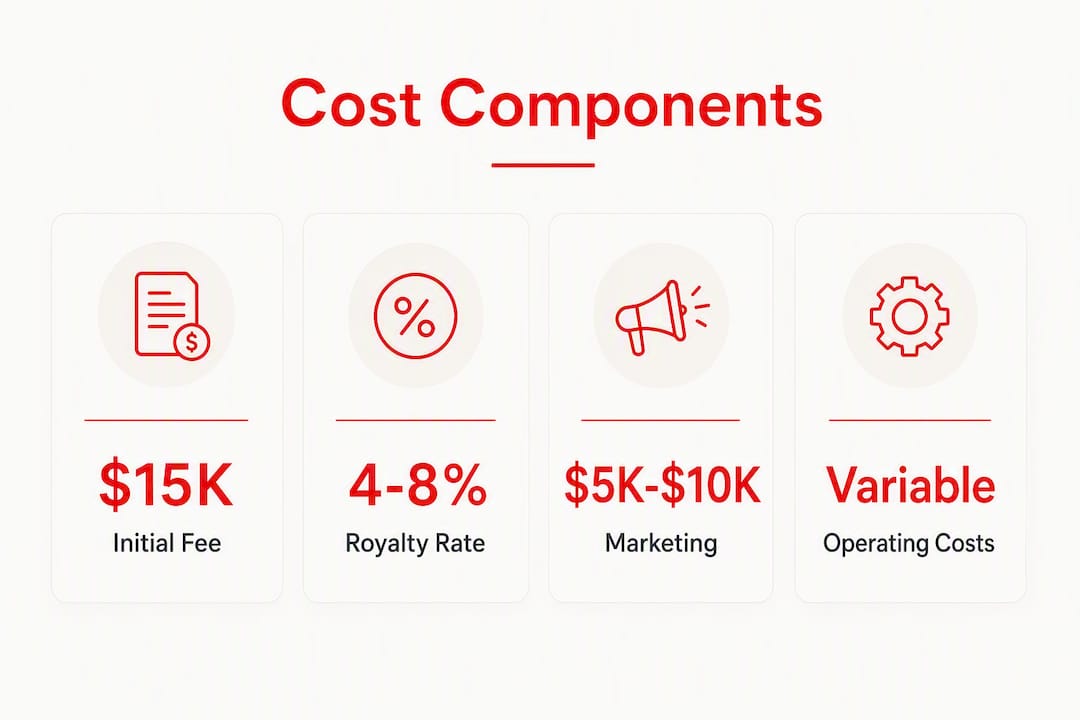
Typical cost components
| Cost Component | Typical Range / Notes |
|---|---|
| Initial franchise fee | $15,000 (varies widely by brand and sector) |
| Build-out / leasehold improvements | — (near zero for home-based; higher for education centers) |
| Equipment and vehicle | — depending on sector |
| Royalty rate (ongoing) | 4%–8% of gross sales |
| Marketing fund contribution | 1%–4% of gross sales |
| Local operating costs (labor, insurance, fuel, software) | Varies by sector and geography |
Worked example: a home services franchise
Assume a residential cleaning franchise with the following conservative inputs:
- Total initial investment: — $90,000 (franchise fee $35,000 + equipment $15,000 + working capital $40,000)
If AUV grows to $280,000 in Year 2 with the same cost structure, the payback period compresses to roughly 18 months from opening. This sensitivity to AUV is why stress-testing the revenue assumption matters more than any other single variable.
For a QSR context, Buywendys’s analysis of Wendy’s franchise margins and FDD disclosures demonstrate how technology investments — including AI-driven ordering systems — can materially shift unit-level labor costs and margin profiles, a dynamic that applies across franchise sectors, not just fast food.
Pro Tip: When stress-testing a franchise business plan, run three AUV scenarios: base (franchisor’s Item 19 median), downside (20% below median), and severe downside (40% below median). If the severe downside scenario still leaves enough cash flow to service debt and cover living expenses, the unit economics are defensible. If it doesn’t, increase your working capital reserve before signing.
Industry guidance consistently notes that asset-light franchisees under-invest in marketing and customer acquisition — redirecting funds that would have gone into equipment into lead generation is often the difference between a unit that ramps quickly and one that stalls.
How do you vet an asset-light franchise opportunity before committing?
Due diligence on a franchise opportunity is a structured process, not a checklist you complete in an afternoon. The sequence below reflects how professional franchise attorneys and experienced multi-unit operators approach it.
Step-by-step due-diligence checklist
- Initial screening: Confirm the franchise is registered in your state (required in registration states including California, New York, and Maryland, among others). Check the SBA’s franchise resources and the franchisor’s Item 1 (business description) and Item 20 (outlet summary) in the FDD
- Request the FDD: The FTC Franchise Rule mandates delivery at least 14 days before signing or payment. Never waive this window — use every day of it
- Review Item 19 (financial performance representations): — Not all franchisors include Item 19 data. If a franchisor omits it, ask directly why — and treat the omission as a yellow flag requiring deeper franchisee interviews to compensate
Questions to ask the franchisor
- What is the median gross revenue for franchisees open more than 24 months?
Red flags to watch for
- Evasive or incomplete answers to Item 19 questions
- Franchisee turnover above 10% annually in Item 20
- Required purchases from the franchisor at above-market prices (check Item 8)
- Large undisclosed local marketing obligations not reflected in the FDD’s Item 6 fee schedule
- Marketing claims about AUV that exceed Item 19 representations — verbal claims are not legally binding
Tulane’s franchise business model primer reinforces that FDD Item 19 and Item 7 are the two most critical documents for cost and revenue validation — a point every experienced franchise attorney will echo.
If you’re a franchisor: how do you move toward an asset-light model?
Transitioning from company-owned operations to a franchised, asset-light structure requires more internal investment than most operators anticipate. The brand quality that made the company-owned model work does not transfer automatically to franchisees.
Transition roadmap
- Clarify which assets are truly strategic: — Identify what the brand owns that franchisees cannot replicate — proprietary recipes, software, customer data, supplier relationships. These stay centralized
- Structure contracts with variable, revenue-linked fees: — As BCG’s research on asset-light governance notes, fixed rent obligations create the long-term liabilities that undermine the model’s capital efficiency. Variable rents and tiered royalties align incentives
Internal capabilities to develop before large-scale franchising
- SOP maturity: — Every operational process documented, version-controlled, and accessible via a franchisee portal
BCG’s analysis identifies three smart-control techniques that preserve the benefits of asset ownership without owning assets: controlling key inputs (ingredients, technology, data), establishing genuine win-win supplier relationships, and maintaining a small number of company-owned units to set performance benchmarks and test new initiatives. For franchise operations technology, ksign.co’s franchise solutions illustrate how technology platforms can formalize the division of responsibilities between franchisors and franchisees, reducing governance friction at scale.
What does the investor lens reveal about asset-light franchise returns?
For investors evaluating franchise companies as equity or debt positions, the asset-light structure produces a distinct risk-return profile that differs materially from vertically integrated operators.
EY’s research on asset-light strategies finds that shifting fixed costs into variable cost structures and redeploying capital into core competencies — brand, technology, and digital infrastructure — can increase Total Shareholder Return (TSR) by improving capital efficiency. The mechanism is straightforward: lower CapEx per unit means higher free cash flow per dollar of revenue, which compounds into superior returns on equity over time when the royalty stream is stable.
This TSR advantage comes with a specific risk substitution. The franchisor trades CapEx volatility for execution risk: the royalty stream is only as stable as franchisee performance, which depends on SOP robustness, franchisee capitalization, and local market conditions. An investor in a franchise company is effectively underwriting the quality of the franchisor’s franchisee selection and support systems, not just the brand.
Investor metrics to request and monitor
- Royalty revenue as a percentage of system-wide sales: — Measures the franchisor’s take rate; declining ratios may signal franchisee concessions or royalty waivers
For investors tracking Wendy’s (NASDAQ: WEN) specifically, Buywendys’s analysis of franchise margin and FreshAI economics shows how technology deployment at the unit level can shift franchisee labor costs and AUV, directly affecting the royalty stream’s durability. The broader investor framework for analyzing restaurant franchise stocks is covered in Buywendys’s restaurant stock valuation metrics guide.
Is the asset-light franchise model right for you? A verdict and next steps
The model fits some investor and entrepreneur profiles well and others poorly. The decision depends on your capital position, operational appetite, and return expectations.
Decision map by reader profile:
- Solo owner-operator (first franchise): — Asset-light reduces financial risk but does not reduce operational demands. Choose a sector where your skills translate directly to franchisee execution, and ensure the franchisor’s training program is substantive
Prioritized next steps:
Timing expectations: From signing a letter of intent to unit opening, asset-light franchises typically run 60–180 days depending on build-out complexity. Home-based and mobile concepts can open in 30–60 days. Break-even timelines vary widely, but well-capitalized franchisees in strong asset-light systems often reach operational break-even within 12–24 months of opening.
For investors tracking the franchise sector’s performance and stock-level implications, Buywendys’s fast food industry stock trends guide provides ongoing analysis of how franchise model structures translate into equity returns across the sector.
Key Takeaways
The asset-light franchise model delivers capital efficiency and scalability for franchisors and lower entry costs for franchisees, but only when franchisor support systems, franchisee capitalization, and royalty structures are properly aligned.
| Point | Details |
|---|---|
| Core revenue mechanics | Franchisors earn initial fees and royalties (typically 4%–8% of gross sales) while franchisees fund all unit-level CapEx. |
| Entry cost range | Genuine asset-light opportunities exist under $150,000; FDD Item 7 is the authoritative source for any specific system’s actual costs. |
| Top investor metric | Average unit volume (AUV) trend is the single most important leading indicator of royalty revenue durability. |
| Primary regulatory step | Request the FDD at least 14 days before signing, per the FTC Franchise Rule; review Item 19 for financial performance data. |
| Key risk to manage | Franchisee under-capitalization and weak SOP enforcement are the most common causes of asset-light system failures. |
Why asset-light franchising is compelling — and where to stay cautious
Asset-light franchising is one of the more elegant structures in business finance: the franchisor builds a royalty stream on other people’s capital, and the franchisee gets a proven system without building a brand from scratch. The capital efficiency argument is real, and EY’s research on TSR improvement through variable cost structures gives it rigorous support.
The caution worth stating plainly: the model’s elegance on paper can obscure serious operational fragility. When a franchisor grows unit count rapidly without investing proportionally in training, audit systems, and franchisee support, the royalty stream looks healthy until it doesn’t. Franchisee failures tend to cluster, and a wave of closures in a single market can damage brand perception in ways that take years to repair. The governance investment required to run an asset-light system well is not small — it is simply less visible on the balance sheet than a building.
For investors, the implication is that the quality of a franchisor’s franchisee selection process and field support infrastructure matters as much as the royalty rate itself. A system with a 6% royalty and 95% franchisee renewal rates is worth more than one with a 7% royalty and 15% annual franchisee turnover. The numbers to request are in the FDD. The judgment about what they mean requires the kind of analytical framework that separates informed investors from those reacting to headline unit counts.
Useful sources and further reading
These primary sources support the analysis in this article and provide the authoritative documents you need for your own due diligence.
- A Consumer’s Guide to Buying a Franchise — Federal Trade Commission: — Use this to understand the FTC Franchise Rule, the FDD delivery timeline (14-day rule), and your rights as a prospective franchisee before signing anything
- SBA Franchise Resources — U.S. Small Business Administration: Use this for state registration requirements, SBA loan eligibility for franchise purchases, and initial screening guidance
- How Asset-Light Strategies and Models Can Boost Business Growth — EY: — The primary research source for TSR improvement and capital redeployment arguments; use this when building an investor thesis around franchise company equity
- When “Asset Light” Is Right — BCG: — BCG’s framework for smart-control techniques, variable rent structures, and governance tradeoffs; essential reading for franchisors planning a transition
- The Franchise Business Model — Tulane SOPA: — A structured primer on franchise types and FDD review; useful for readers new to the business-format franchise model
- Introduction to the Franchise Business Model — International Franchise Association: The IFA’s overview of how franchising works across industries; a reliable starting point for sector research
- Wendy’s Franchise Cost & Economics — Buywendys: A detailed walkthrough of how to read a real QSR franchise’s FDD, with Item 7 and Item 19 analysis applied to a major U.S. brand
- Wendy’s FreshAI Economics: Franchise Margin & Fee Analysis — Buywendys: Analysis of how AI-driven technology at the unit level affects franchise margins and royalty stream durability — a case study applicable beyond the QSR sector