Table of Contents
- Executive Summary
- QSR Franchise vs. Corporate Ownership Models
- Impact of AI Drive-Thru on Operating Margins
- Fast Food Digital Transformation ROI
- Operating Model Comparison: Efficiency vs. Growth Trade-Offs
- Supply Chain Resilience and Strategic Adaptation
- Labor Model Sustainability and Operational Risk
- Key Takeaways for Long-Term Growth
- Frequently Asked Questions
Last Updated: September 17, 2026
Executive Summary
Fast food operators face a critical strategic choice between two distinct fast food operating models: pursue aggressive growth through franchising, or maintain tighter control via company-owned stores. The decision shapes everything from capital efficiency to competitive positioning. Franchising accelerates market penetration and reduces balance-sheet risk, but sacrifices direct margin capture and operational consistency. Company ownership preserves profitability per unit and brand control, but demands substantial capital and management overhead. (Source: U.S. Bureau of Labor Statistics data)
Emerging technologies, particularly AI-driven drive-thru systems, are reshaping this calculus. Digital transformation investments now determine which operating model generates sustainable returns. For investors evaluating fast food stocks, understanding these trade-offs is essential to assessing long-term value creation.
Buy Wendy’s tracks how these strategic decisions impact franchise valuations and shareholder returns. This guide breaks down the core operating models, their financial implications, and the role of technology in determining winners.
QSR Franchise vs. Corporate Ownership Models
The franchise model and corporate ownership represent fundamentally different approaches to scaling a quick-service restaurant brand. Each carries distinct capital structures, unit economics, and growth trajectories.
Franchising transfers capital expenditure to franchisees while the corporate entity collects royalties and fees. A franchisee typically invests capital to open a single location, covering buildout, equipment, and initial working capital. The franchisor retains the brand, supplies the operational playbook, and receives a percentage of gross revenue as royalties plus fees for marketing and technology.
Corporate ownership means the parent company funds construction, equipment, and operations directly. This approach preserves 100% of unit-level profit but concentrates capital intensity and operational risk on the balance sheet.
Capital Structure and Unit Economics
Franchising is fundamentally an asset-light model. The franchisor avoids the largest capital expense, real estate and buildout, while maintaining brand standards through franchise agreements. This structure enables rapid expansion without proportional debt growth.
Corporate stores demand significant upfront capital. A company-owned location requires significant development capital. Over a portfolio of hundreds or thousands of stores, this becomes a material constraint on growth speed and financial flexibility.
The unit economics differ sharply. A corporate store generates higher absolute profit per unit because the parent captures 100% of operating margin after labor, food, and rent. A franchised unit generates lower absolute profit for the franchisor, typically royalties as a percentage of revenue, but requires zero operating capital and minimal ongoing labor.
For a store generating annual revenue, an operating margin yields profit. A franchisor collecting royalties captures a portion with no operational involvement. A corporate operator captures the full profit but must amortize development cost, manage staff, and absorb operational volatility.
Scalability and Market Penetration
Franchising accelerates market penetration dramatically. Franchisees self-fund expansion, so the franchisor can grow unit count without exhausting capital. A brand can enter new markets, test locations, and build density far faster than a corporate-only model permits.
Corporate ownership prioritizes profitability per unit over unit count. The operator selects high-performing sites, invests in premium locations, and captures all margin upside. Growth is methodical and capital-constrained.
Market penetration strategy shapes competitive positioning. Fast expansion via franchising can establish brand presence and customer loyalty before competitors enter a region. Slower, more selective corporate growth concentrates resources on highest-return locations.
| Model | Capital per Unit | Royalty/Fee | Operating Margin Capture | Growth Speed | Risk Profile |
|---|---|---|---|---|---|
| Franchising | Franchisee bears | 5-7% royalty | Lower absolute | Fast | Distributed to franchisees |
| Corporate | Parent company | 100% (minus opex) | Higher absolute | Slower | Concentrated on balance sheet |
| Hybrid | Mixed | Blended | Blended | Moderate | Balanced |
Impact of AI Drive-Thru on Operating Margins
Artificial intelligence is reshaping labor economics and throughput in drive-thru operations. AI-powered ordering systems reduce labor dependency, accelerate order accuracy, and increase transaction velocity, all directly impacting operating margins.
Labor Cost Reduction and Throughput
AI drive-thru systems handle order-taking functions that traditionally required dedicated staff. A standard drive-thru lane typically employs one headset operator per shift. AI systems process orders through voice recognition, reducing labor headcount while maintaining or improving accuracy.
The throughput advantage compounds. AI systems process orders faster than humans, reducing wait times and increasing cars-per-hour through the drive-thru. Faster throughput drives higher revenue per lane without proportional labor cost increase.
Labor represents a significant portion of fast food operating costs. A reduction in drive-thru labor translates directly to margin expansion. For a location with annual revenue, a margin improvement equals incremental annual profit.
The technology also reduces ordering errors, which trigger remakes, waste, and customer dissatisfaction. Lower error rates improve food cost efficiency and customer retention.
Margin Expansion and Competitive Advantage
Operators deploying AI drive-thru systems gain a measurable margin advantage over competitors relying on traditional staffing models. This advantage compounds as labor costs rise and consumer expectations for speed increase.
For franchisees, margin expansion improves unit-level returns and franchisee profitability. For corporate operators, margin expansion flows directly to shareholder returns. Both benefit, but the impact cascades differently through each model.
Franchisors investing in AI technology can differentiate their brand, justify higher royalty rates, and attract franchisees seeking competitive advantage. Corporate operators gain direct margin upside plus the option to franchise higher-performing units at premium valuations.
Fast Food Digital Transformation ROI
Digital transformation encompasses takeout, delivery, mobile ordering, and loyalty programs. The return on these investments depends on execution, market saturation, and the operating model’s ability to capture incremental revenue.
Takeout and Delivery Channel Performance
Takeout and delivery channels have become non-negotiable for fast food operators. Consumers expect seamless ordering through multiple channels. Digital channels also reduce in-store congestion, improving drive-thru and counter throughput.
Takeout orders typically carry higher average ticket than drive-thru transactions because customers order for multiple people or add sides and beverages. Delivery orders command premium pricing to offset delivery fees and lower margins. Optimizing these revenue streams requires a nuanced understanding of how delivery versus dining models influence long-term profitability and customer retention.
The capital requirement for digital infrastructure is modest, primarily software development and integration with POS systems. The ongoing cost centers on delivery commissions and customer acquisition.
For franchisees, digital channels increase revenue without proportional labor cost increase. For corporate operators, digital channels improve unit-level economics and create data assets for marketing and menu optimization. Wendy’s Menu Tracker provides visibility into how menu performance varies across channels and locations, helping operators optimize their digital strategy.
Customer Data and Retention Economics
Digital ordering creates first-party customer data, purchase history, preferences, frequency, and lifetime value. This data fuels targeted marketing, personalized offers, and loyalty program optimization.
Loyalty programs drive repeat purchase and increase customer lifetime value.
Operating Model Comparison: Efficiency vs. Growth Trade-Offs
Each of these fast food operating models optimizes for different outcomes. Franchising prioritizes growth speed and capital efficiency. Corporate ownership prioritizes profitability per unit and brand consistency.
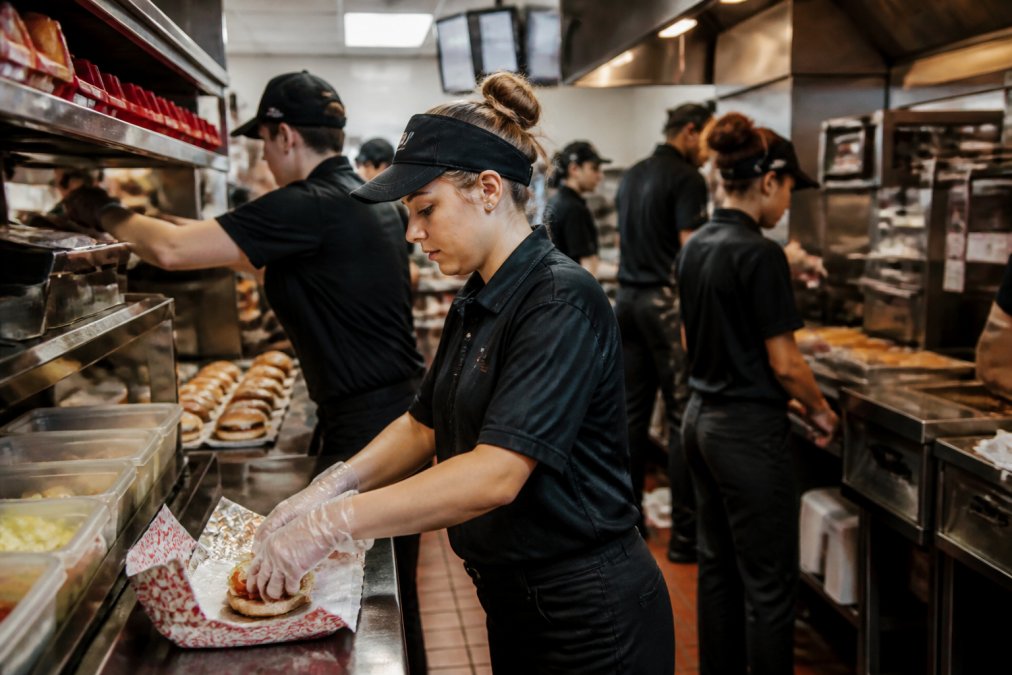
Asset-Light vs. Company-Owned Stores
Asset-light franchising enables rapid expansion and reduces balance-sheet use. The franchisor collects recurring royalties with minimal operational overhead. This model suits brands pursuing aggressive market penetration and geographic diversity.
Menu Engineering and Cost Structure
Menu engineering, optimizing item mix, pricing, and production efficiency, directly impacts operating margins. A simplified menu reduces labor complexity, food waste, and inventory carrying costs.
Supply Chain Resilience and Strategic Adaptation
Supply chain disruptions expose operating model weaknesses. Franchisees absorb supply shocks directly through food cost increases. Corporate operators can negotiate volume pricing, diversify suppliers, and absorb short-term margin compression.
Labor Model Sustainability and Operational Risk
Labor represents the largest variable cost in fast food operations. Wage inflation, turnover, and training costs directly pressure operating margins.
Key Takeaways for Long-Term Growth
Franchising accelerates growth and minimizes capital intensity but sacrifices margin capture and operational control. Corporate ownership preserves profitability and brand consistency but constrains growth speed and concentrates financial risk.
Frequently Asked Questions
What are the primary differences between QSR franchise and corporate ownership models?
Franchise models shift capital expenditure and operational risk to franchisees, enabling faster market penetration and lower corporate overhead. Corporate ownership provides direct margin capture and tighter operational control but requires higher upfront capital and management complexity. Franchise models typically generate royalty streams (a percentage of sales) with minimal capex, while corporate stores retain full profit margins but demand significant working capital and real estate investment. The choice affects stock valuation, dividend sustainability, and long-term growth trajectory.
How does AI-driven technology impact fast food operating margins?
AI drive-thru systems reduce labor costs, improve order accuracy, and increase throughput during peak hours. By automating order-taking and payment processing, operators reduce headcount dependency and improve ticket size through personalized menu recommendations. Margin expansion typically comes from lower labor per transaction, faster customer cycle times, and reduced order errors that damage brand perception. The technology also provides real-time operational data, enabling menu engineering and dynamic pricing strategies that further optimize unit economics.
What is the return on investment for fast food digital transformation?
Digital transformation ROI varies by channel. Takeout and delivery integration typically increase revenue per unit while expanding addressable market beyond dine-in capacity. Customer loyalty programs powered by digital ordering data improve retention rates and enable targeted promotions that drive repeat visits. Kitchen display systems (KDS) reduce labor friction and order fulfillment time, directly improving operational efficiency. The payback period depends on initial technology investment, but most operators can see positive unit-level returns through a combination of revenue growth and cost reduction.
Why do investors focus on asset-light models for fast food growth stocks?
Asset-light franchise models generate higher returns on invested capital (ROIC) because franchisees fund store development while the corporate entity captures recurring royalties with minimal capex. This structure improves free cash flow, supports dividend sustainability, and reduces balance sheet risk during economic downturns. From a stock perspective, asset-light operators demonstrate scalability, they can grow unit count and system-wide sales without proportional increases in debt or equity capital, which typically drives higher valuation multiples in the market.
How do labor costs influence the scalability of fast food business models?
Labor represents a significant portion of fast food operating costs, making it a critical lever for unit economics and scalability. Models that reduce labor complexity (through simplified menus, automation, or chefless operations) achieve higher margins and faster payback for franchisees, accelerating unit growth. Conversely, labor-intensive models face margin pressure during wage inflation cycles, limiting franchisee profitability and slowing expansion. AI and digital tools that reduce per-transaction labor costs directly improve the economic model’s attractiveness to new franchisees, enabling faster market penetration and competitive advantage.