Wendy’s charges a standard $50,000 Technical Assistance Fee, a 4% royalty that can climb to 6% under certain programs, and roughly 4% for advertising. Total estimated initial investment runs from $1,580,457 to $3,105,000 per the 2026 FDD, with minimum liquidity near $2,000,000 and net worth near $5,000,000 expected of applicants. The franchise agreement runs 20 years.
TL;DR:
- Franchisees pay a $50,000 technical assistance fee per restaurant, which is fixed for 20 years but reduced to $25,000 for certain non-traditional locations.
- Franchise fees are generally fixed and non-negotiable, but financing options and fee reductions for specific site types or multi-unit development may lower out-of-pocket costs.
- Lenders scrutinize these deals carefully, so potential franchisees should ensure they have substantial capital, detailed business plans, and prepare for significant ongoing expense commitments.
Table of Contents
- Wendy’s Franchise Costs at a Glance
- Detailed Breakdown of Upfront Costs and Initial Investment
- Ongoing Fees: Royalties, Advertising, Technology and Recurring Charges
- Minimum Financial Requirements and Financing Options
- How to Read the FDD: Items 6, 7 and 19
- What Wendy’s Looks for in Franchise Partners
- What Each Fee Actually Covers and Why It Matters
- How Wendy’s Fees Stack Up Against Other Fast Food Franchises
- Do Wendy’s Franchise Fees Increase Over Time?
- Are Wendy’s Franchise Fees Negotiable?
- Step-by-Step: Paying Each Fee and When It’s Due
- BuyWendy’s Perspective: What the Fee Structure Means for Investors
- Model the Economics Before You Commit Capital
- Sources
Wendy’s Franchise Costs at a Glance
Before digging into Item 7 line items, here’s the shorthand version of what an applicant actually pays and when:
- Technical Assistance Fee: $50,000 standard, charged per restaurant for the 20-year term.
- Application/post-approval fee: $5,000, due early in the process.
- Background check: $500 per person for each principal being screened.
- Training fee: $5,000, tied to certified operator training.
- Building, equipment, signage, pre-opening costs: the bulk of the investment range, varying by site type and market.
- Total estimated initial investment: $1,580,457 to $3,105,000, per the 2026 FDD summary.
- Ongoing royalties and marketing fees: roughly 4% and 4% of gross sales, respectively.
Development programs like FDP or REPP carry their own additional fees, varying by program and terms. Item 19 of the FDD is where actual unit-level financial performance gets disclosed, and it’s worth reviewing before you commit capital.
Detailed Breakdown of Upfront Costs and Initial Investment
The Technical Assistance Fee is a non-negotiable amount for a standard site. Wendy’s does reduce this to $25,000 for certain non-traditional locations, such as travel centers or airport concepts, according to the company’s own franchising page. This fee covers pre-opening support, training coordination, and access to Wendy’s operational systems. It is separate from, and paid before, the capital you’ll need for construction and equipment.
Item 7 of the FDD spells out the full initial investment picture. Real estate (whether leased or purchased), building construction, kitchen equipment, exterior signage, point-of-sale systems, initial inventory, and working capital to cover the first months of operation all stack on top of the Technical Assistance Fee.
| Cost Category | Estimated Range |
|---|---|
| Technical Assistance Fee | $50,000 ($25,000 for select non-traditional sites) |
| Application/post-approval fee | $5,000 |
| Background check (per person) | $500 |
| Training fee | $5,000 |
| Building, equipment, signage, pre-opening, working capital | Remainder of range |
| Total estimated initial investment | $1,580,457 to $3,105,000 |
That $1,580,457 to $3,105,000 range, drawn from the 2026 FDD, assumes a cash purchase scenario. Financed alternatives for the building, equipment, or Technical Assistance Fee lower the visible out-of-pocket number but add debt service that shows up later in your cash flow model. The spread between the low and high end mostly comes down to whether you’re buying land outright or leasing, and how construction costs run in your specific market.
Pro Tip: Don’t anchor on the low end of the investment range when budgeting. Urban infill sites and ground-lease deals routinely land closer to the high end once site work and permitting delays are factored in.
Ongoing Fees: Royalties, Advertising, Technology and Recurring Charges
Once the doors open, the fee structure shifts from one-time to recurring. The baseline royalty is 4% of gross sales, though Wendy’s franchising materials note it can run as high as 6% depending on restaurant type or development program. Advertising contributions add another similar single-digit percentage, split between national brand fund obligations and local marketing cooperatives.
- Royalty: 4% baseline, up to 6% under certain programs.
- Advertising/brand fund: approximately 4% of gross sales.
- Technology and point-of-sale support fees: charged separately from royalty.
- Audit, transfer, and renewal fees: applied situationally, not monthly.
Combined royalty and advertising obligations run close to a high single-digit percentage of gross sales before you account for rent, labor, or cost of goods, based on QSR Pro’s cost analysis. On a restaurant generating an average unit volume near $2 million, that translates to roughly $160,000 a year flowing to Wendy’s before a franchisee covers a single payroll check or utility bill. That’s the number every prospective owner needs baked into their pro forma from day one.
Minimum Financial Requirements and Financing Options
Wendy’s expects applicants to bring substantial real capital to the table, with minimum liquidity and net worth thresholds in the multimillion-dollar range for prospective operators, though exact thresholds can shift depending on the program and market.
Multi-unit capability is a significant consideration for applicants. Wendy’s has publicly emphasized growth through operators who can scale across several restaurants rather than run one location indefinitely.
- Confirm your liquid capital and net worth meet or exceed stated thresholds before applying.
- Explore SBA 7(a) or 504 loans, which QSR lenders use frequently for build-out and equipment financing.
- Compare landlord financing or leasing arrangements against outright real estate purchase.
- Assemble tax returns, personal financial statements, and a business plan lenders will request during underwriting.
Pro Tip: Lenders scrutinize QSR deals harder than typical retail leases because unit economics are public knowledge. Walk into financing conversations already knowing your projected debt service coverage ratio.
How to Read the FDD: Items 6, 7 and 19
Item 6 lists every fee Wendy’s can charge you, from the Technical Assistance Fee to smaller administrative charges. Item 7 lays out the full initial investment table, low to high, by category. Item 19 is where things get genuinely useful: it contains the Financial Performance Representation, meaning actual historical revenue and, in some years, profitability data from existing units.
- Item 6: the master fee list, including caps and ranges.
- Item 7: the investment table, broken into specific cost categories.
- Item 19: financial performance data, confirmed present in the 2026 FDD.
Ranges in Item 7 exist because construction and real estate costs vary by market, not because Wendy’s is being vague. Ask existing franchisees directly what their actual build-out came in at versus the FDD range, and ask Wendy’s development team how many Item 19 disclosed units match your target market’s demographics.
Pro Tip: Treat a franchise disclosure document that avoids specific dollar ranges, or one where a franchisor won’t connect you with existing owners, as a red flag worth walking away from.
What Wendy’s Looks for in Franchise Partners
Wendy’s has been explicit about favoring experienced, well-capitalized operators who can grow beyond a single unit. That preference shapes how applications get evaluated and which candidates move fastest through approval.
- Prior QSR or multi-unit restaurant management experience carries real weight.
- Development programs like FDP or REPP come with their own fee structures and performance obligations tied to opening schedules.
- Operators managing multiple units need centralized reporting systems and enough working capital to absorb one underperforming location without dragging down the portfolio.
Single-unit applicants aren’t excluded, but Wendy’s refranchising strategy makes clear that scale is the direction the system is pushing. Budgeting extra contingency capital improves your odds if you’re starting with one restaurant and hoping to add more later.
What Each Fee Actually Covers and Why It Matters
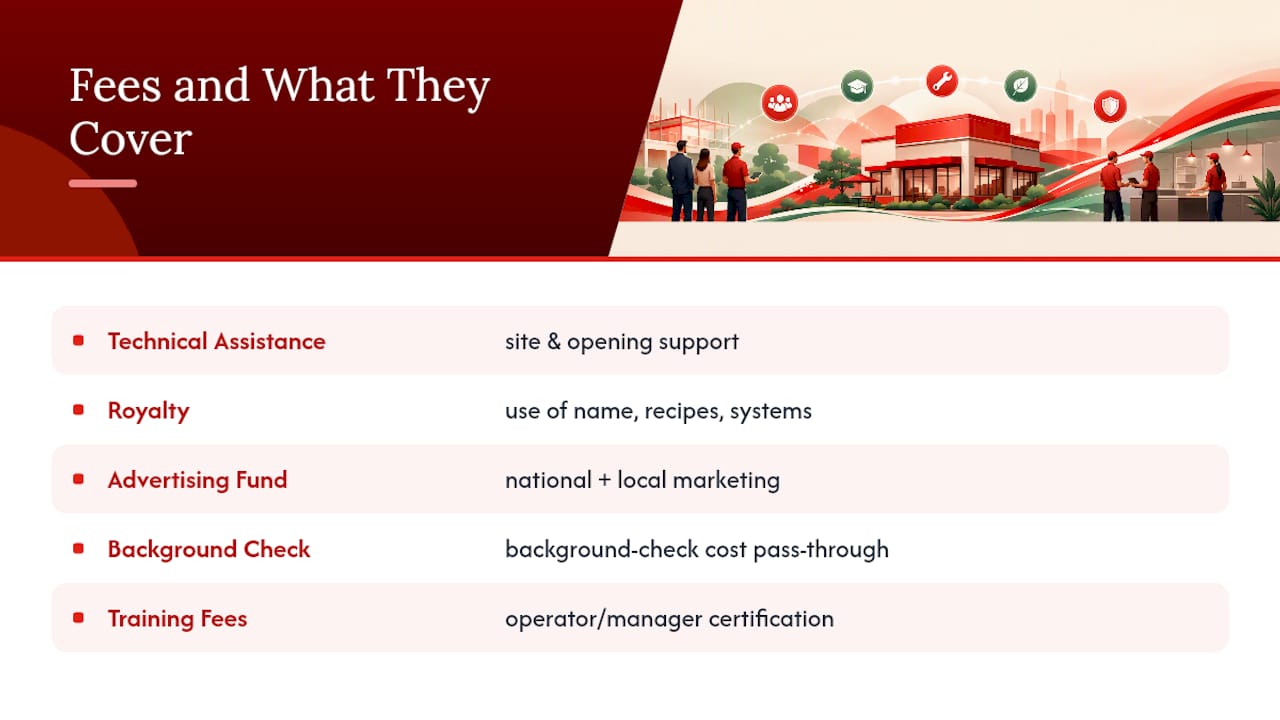
The Technical Assistance Fee isn’t a generic entry cost, and QSR operators increasingly rely on operational tools like digital signage for upsell promotions to boost unit economics. It funds the operational scaffolding Wendy’s provides before and during your opening window: site evaluation support, construction oversight, initial staff training coordination, and integration into Wendy’s supply chain and technology stack. Skip that support and you’re opening a restaurant with none of the operational playbook that makes the brand recognizable to customers.
The royalty, by contrast, is ongoing compensation for using the Wendy’s name, recipes, and operating systems indefinitely. It scales with your sales, so a slow month costs you less in royalty dollars, but a strong month means more of your gross revenue flows out the door. That’s the tradeoff every franchisee accepts: brand recognition and proven systems in exchange for a permanent slice of top-line revenue.
The advertising fund fee works differently. It’s pooled with contributions from every other franchisee to fund national campaigns, plus a local component you’ll spend within your own market. A single-unit owner can’t replicate the reach of national television and digital advertising alone, so the fund exists to give small operators marketing muscle they couldn’t otherwise afford.
Smaller fees, like the $500 background check reimbursement, are underwriting costs Wendy’s passes through rather than absorbs. Training fees fund the certification process new operators and managers go through before they’re allowed to run day-to-day operations. None of these fees are arbitrary. Each one maps to a specific service, and understanding that mapping helps you evaluate whether the total fee burden is reasonable for what you’re getting in return.
How Wendy’s Fees Stack Up Against Other Fast Food Franchises
Where Wendy’s stands out is the advertising fund. At roughly 4% of gross sales, that fee runs higher than many competitors, according to FranchiseDepth’s FDD data breakdown.
That combination changes how you should think about margin. A brand with a lower royalty but a heavier advertising assessment is effectively betting more heavily on brand-building to drive traffic, rather than pocketing more royalty revenue directly. For franchisees, that means your monthly fee outflow isn’t dramatically different from competitors even if the individual line items look different on paper.
Initial investment ranges also vary meaningfully across the fast food category depending on footprint size, drive-thru configuration, and whether double drive-thru lanes or dining rooms are required. Wendy’s investment range of $1,580,457 to $3,105,000 reflects a full-service format with dine-in seating, which tends to run higher than drive-thru-only concepts but lower than full-service casual dining franchise investments.
The real comparison point for investors isn’t which brand has the lowest sticker-price fee. It’s which fee structure produces the best unit-level return once you weigh royalty and advertising obligations against average unit volume and local market rent. Wendy’s brand fund spending, paired with a comparatively modest royalty, has historically supported strong same-store sales growth. That’s the tradeoff worth modeling before comparing raw percentages across brands.
Do Wendy’s Franchise Fees Increase Over Time?
The Technical Assistance Fee is fixed at signing for the full 20-year agreement term. It doesn’t escalate annually and isn’t tied to inflation adjustments during that period. Royalty and advertising fund percentages are similarly fixed contractually as a percentage of gross sales, so franchisees aren’t blindsided by a rate hike mid-term the way some retail lease structures allow for rent escalation clauses.
Where costs can shift is at renewal. When a 20-year agreement term expires, franchisees typically pay a renewal fee to continue operating under the Wendy’s brand, and Wendy’s may require facility upgrades or remodels to bring the restaurant up to current design and equipment standards as a condition of renewal. Those remodel costs, while not technically a “fee” in the traditional sense, function as a real capital outlay tied to staying in the system long term.

Transfer fees apply if a franchisee sells their restaurant to another operator during the term, compensating Wendy’s for underwriting the new owner and updating operational records. These fees are typically disclosed as fixed dollar amounts or percentages in Item 6 of the FDD rather than left open-ended.
The practical takeaway: your day-to-day fee percentages won’t move once you sign, but budget for renewal-related remodel costs and transfer fees as separate, periodic capital events rather than assuming your 20-year cost structure is entirely static.
Are Wendy’s Franchise Fees Negotiable?
Franchise fees at established, well-known brands like Wendy’s are largely standardized and contractually fixed, applied uniformly across new franchisees signing similar agreements. Wendy’s isn’t structured to haggle over its core fee schedule the way a smaller, growth-stage franchisor sometimes will.
That said, “non-negotiable” doesn’t mean “no flexibility exists.” The fee reductions built into non-traditional site categories, like the $25,000 Technical Assistance Fee for certain airport or travel center locations, function as a form of built-in program-based discounting rather than case-by-case negotiation. Multi-unit development agreements can also change the effective cost structure. Operators committing to open several restaurants under a development program sometimes access different fee arrangements than a single-unit applicant, though this comes bundled with performance obligations and opening deadlines that carry their own financial risk if missed.
Where there’s genuinely more room to maneuver is in financing structure, not franchisor fees. Negotiating with lenders on loan terms, working with landlords on tenant improvement allowances, or timing equipment purchases around vendor promotions can meaningfully reduce your effective out-of-pocket investment even though the franchisor’s fee schedule stays fixed. If a franchise sales representative implies core fees are open to discussion outside these structured programs, that’s worth double-checking against the actual FDD language rather than taking at face value.
Step-by-Step: Paying Each Fee and When It’s Due
Franchise fees don’t all come due at once, and understanding the sequence helps you plan cash flow rather than get caught short mid-process.
- Application submission: the $5,000 application/post-approval fee is typically due when your application advances past initial screening.
- Background check stage: the $500 per-person fee is paid as principals are screened during underwriting.
- Agreement signing: the $50,000 Technical Assistance Fee (or $25,000 for qualifying non-traditional sites) is due when you execute the franchise agreement.
- Pre-construction phase: deposits for equipment, signage, and site work begin, drawing down your working capital reserve.
- Training period: the $5,000 training fee is due as certified operator training is scheduled, ahead of your opening date.
- Pre-opening: remaining construction, inventory, and initial staffing costs are paid out in the weeks before doors open.
- Post-opening: royalty and advertising fund payments begin as a percentage of weekly or monthly gross sales, typically remitted on a recurring schedule set by Wendy’s accounting systems.
Budget for a gap between when major fees are due and when revenue starts covering them. Most new franchisees need three to six months of working capital set aside beyond construction costs to bridge that opening period comfortably.
BuyWendy’s Perspective: What the Fee Structure Means for Investors
Wendy’s asset-light model means royalties and rent, not company-operated margins, drive a meaningful share of corporate cash flow. For readers modeling this further, Wendy’s franchise economics breaks down how these figures roll into corporate valuation.
— Benjamin
Model the Economics Before You Commit Capital
Reading the FDD tells you what Wendy’s charges. It doesn’t tell you what those fees mean for franchisee returns or how the royalty structure translates into corporate earnings and dividend capacity for shareholders.
Buywendys built its FDD summaries and valuation tools specifically to close that gap. Instead of parsing Item 7 tables alone, you get the fee data connected directly to unit economics, AUV trends, and what they imply for Wendy’s stock. If you’re weighing franchise ownership against a stock position, or trying to understand how royalty revenue supports Wendy’s dividend, start with the franchise cost and economics breakdown and the restaurant stock analysis guide to see how the numbers connect to investor decisions.
This article is general information, not a substitute for advice from a qualified financial advisor. Consult a qualified financial professional about your own circumstances before acting on anything here.
Sources
- Wendy’s Franchise Costs & Fees – 2026 FDD Summary
- What It Actually Costs to Open a Wendy’s Franchise in 2026 | QSR Pro