Wendy’s is running a multi-year refranchising program under Project Fresh, and the practical routes into the system are acquiring existing franchise rights through a transfer or developing new units, including build-to-suit deals. Buyers need three numbers upfront: a $50,000 franchise fee for a 20-year term, minimum liquidity and net worth thresholds in the millions, and a realistic multi-month approval timeline before any deal closes.
TL;DR:
- Refranchising large multi-unit operators and focusing on newer locations with higher throughput can significantly improve Wendy’s system-wide efficiency and growth prospects.
- Converting company-operated units to franchisees generates a $50,000 fee per unit and a 4% to 6% royalty, boosting free cash flow and reducing capital expenditure needs.
- Buyers need at least $2 million in liquidity and a $5 million net worth, with approval timelines often lasting several months, especially for multi-unit deals.
- Larger, well-capitalized buyers like the Flynn Group dominate recent transactions, making single-unit deals more competitive and requiring thorough documentation.
- Geographic differences influence deal valuation, with high-traffic urban markets commanding premium prices and legacy locations incurring higher remodel costs.
Table of Contents
- Project Fresh and the Wendy’s Refranchising Strategy Today
- How Wendy’s Refranchising Changes Returns for Investors
- How Do You Buy or Develop a Wendy’s Franchise?
- What Does It Cost to Buy a Wendy’s Franchise?
- What Kind of Operator Does Wendy’s Want?
- Recent Wendy’s Refranchising Transactions
- How Refranchising Affects Existing Franchisees
- Do Refranchising Results Vary by Region?
- What Are the Risks in Wendy’s Refranchising?
- Training and Support After a Franchise Transfer
- Where Is Wendy’s Refranchising Strategy Heading?
- BuyWendy’s Analyst Perspective on Modeling Refranchising
- BuyWendy’s Resources for Refranchising Research
- Sources
Project Fresh and the Wendy’s Refranchising Strategy Today
Wendy’s announced Project Fresh in October 2025 as a strategic plan built around refranchising and system optimization. The goal is to shift the company’s revenue mix toward royalties and rent while freeing up capital to reinvest in brand and technology. That framing, sometimes referred to internally as One Wendy’s, treats company-operated restaurants as a shrinking category rather than a permanent fixture.
The market has responded with real transaction volume, not just corporate messaging.
- Large multi-unit operators are actively acquiring restaurant packages rather than waiting for smaller, one-off deals.
- Wendy’s has set a target of roughly 1,000 net new global restaurants by 2028, with about 300 of those net new units planned domestically.
- Development leans on the Global Next Gen design format, which the company says improves unit economics for new builds.
That combination, growth targets paired with active refranchising, tells you Wendy’s wants fewer company-run stores and more capital-efficient franchise units carrying the brand forward.
How Wendy’s Refranchising Changes Returns for Investors
Refranchising trades operating income for royalty and rent income, and that swap matters more than it sounds. A company-operated restaurant carries full exposure to labor costs, food inflation, and local competition. A franchised unit instead sends Wendy’s a royalty check, typically 4% to 6% of gross sales, plus rent in many cases, regardless of how thin the franchisee’s own margins run that quarter.
Statistic Callout: Wendy’s standard franchise fee for a 20-year term is $50,000 per restaurant, a figure that matters to investors because every unit converted from company-operated to franchised generates that fee plus a recurring royalty stream instead of a single P&L subject to store-level volatility.
The capital-light result is a lower capex burden and stronger free cash flow, which management can direct toward buybacks or dividends instead of remodels and equipment refreshes. That is not a new theory. Historical analyst modeling, including a Blackstone-authored proposal filed years ago, argued that converting company units to franchised ones and using the proceeds for share repurchases could meaningfully lift per-share value. Project Fresh is a modern version of that same lever, and readers modeling the effect should see our forecast and analysis for how it flows through the income statement.
How Do You Buy or Develop a Wendy’s Franchise?
Two paths exist, and they require different paperwork, capital timing, and risk tolerance.
- Start with networking, not paperwork. Many successful applicants first talk to existing multi-unit franchisees to identify units that may become available before a formal listing appears.
- Submit the Prospective Franchisee Questionnaire. This is Wendy’s intake step for both acquisition and new-development interest.
- For acquisitions, request the seller’s P&Ls, remodel obligations, and transfer terms. Buyers almost always inherit a commitment to bring the restaurant up to current brand standards, and remodel and FDP fees are common conditions of transfer.
- For new development, review the build-to-suit terms. Co-investment structures lower upfront capital requirements in exchange for higher royalties or rent over the life of the agreement.
- Connect with a preferred lender. Wendy’s maintains lender relationships to help qualified applicants finance both acquisitions and new builds.
- Expect several months minimum from application to close, longer for multi-unit packages that require additional financial underwriting.
Pro Tip: Before you submit anything formal, ask a current franchisee what their real remodel costs ran versus the estimate they were given. Actual numbers almost always beat the brochure figure.
What Does It Cost to Buy a Wendy’s Franchise?
Budgeting for a Wendy’s franchise means separating one-time entry costs from recurring obligations, and both categories carry real weight.
- Franchise fee: $50,000 for a 20-year term, paid per restaurant.
- Royalty fee: 4% to 6% of gross sales, varying by asset type and agreement.
- Additional costs: application fees, background check fees, and FDP (franchise development program) fees tied to remodels or new construction.
- Minimum liquidity: examples on the company’s own financial requirements point to roughly $2,000,000 in liquid capital for some opportunities.
- Minimum net worth: roughly $5,000,000 for the same class of opportunities.
| Requirement | Typical Figure | Applies To |
|---|---|---|
| Franchise fee | $50,000 | Per restaurant, 20-year term |
| Royalty fee | 4%–6% of gross sales | Ongoing, all franchised units |
| Minimum liquidity | ~$2,000,000 | U.S. applicants (example thresholds) |
| Minimum net worth | ~$5,000,000 | U.S. applicants (example thresholds) |
For a full breakdown straight from the Franchise Disclosure Document, our franchise cost and economics report walks through what the FDD actually discloses line by line.
What Kind of Operator Does Wendy’s Want?
Wendy’s has increasingly gravitated toward established multi-unit operators rather than first-time single-store buyers, and that preference shapes who gets approved.
- Back-office scale: operators who already run inventory systems, scheduling, and multi-site P&L tracking tend to move through approval faster. A resource like PantryHub’s guide to multi-location stock management illustrates the operational discipline larger buyers are expected to already have in place.
- Development experience: a track record of remodels or new builds signals you can meet the brand-standard commitments tied to transfers.
- Documentation readiness: a business plan, management team bios, audited financial statements, and proof of liquidity all need to be assembled before you apply, not after.
Common red flags include thin liquidity relative to the deal size, no documented multi-unit experience, and vague remodeling plans submitted late in the process.
Recent Wendy’s Refranchising Transactions
The clearest signal of market appetite is who is actually buying.
- The Flynn Group purchased 83 Wendy’s restaurants across New Jersey and Pennsylvania in August 2024, bringing its total Wendy’s holdings to 277 restaurants.
- That deal size, dozens of units in a single transaction, reflects a buyer pool dominated by large, well-capitalized multi-brand operators rather than individual first-time franchisees.
- Earlier refranchising waves at Wendy’s followed a similar pattern: bundled unit packages sold to operators already running other quick-service brands, often with remodel commitments attached as a condition of closing.
These transactions push pricing and expectations upward for smaller buyers. When a strategic operator like Flynn Group is willing to absorb dozens of units at once, sellers and Wendy’s corporate have less incentive to negotiate favorable terms on a single-unit deal, which means smaller applicants should expect competitive, well-documented offers to matter more than enthusiasm alone.
How Refranchising Affects Existing Franchisees
Current franchisees feel refranchising in ways that go beyond who owns the restaurant next door. As Wendy’s shifts more of the system into fewer, larger operator hands, the franchisee community becomes more concentrated, and that concentration changes the dynamics of local co-ops, advertising fund decisions, and even how much individual voice a small operator has in system-wide conversations.
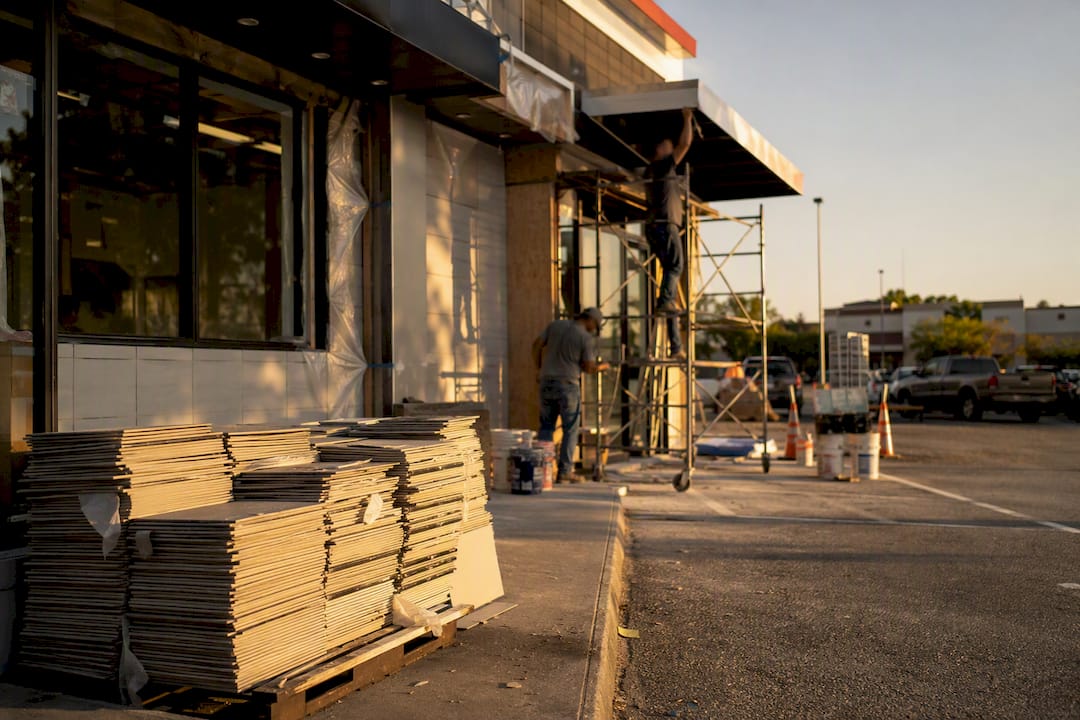
Existing franchisees near a newly acquired territory often see faster remodel activity nearby, since large operators like Flynn Group typically commit to brand-standard upgrades as part of their acquisition terms. That can lift the overall look and performance of a trade area, which benefits everyone competing for the same customers. It can also raise the bar: if a well-capitalized neighbor reimages three stores in a single year, older units nearby face pressure to keep pace or risk losing share.
There is a governance dimension too. As Wendy’s franchise base tilts toward fewer, larger operators, corporate decisions about marketing spend, menu rollouts, and technology mandates like FreshAI increasingly get shaped by conversations with a smaller number of very large stakeholders. Smaller, single-unit franchisees do not disappear from the system, but their relative influence on system-wide policy tends to shrink as the largest operators grow their footprint. That is a structural shift worth watching if you are evaluating whether to stay small or scale up within the system.
Do Refranchising Results Vary by Region?
Refranchising outcomes are not uniform across Wendy’s footprint, and geography plays a real role in how these deals price and perform. Dense urban and suburban corridors in the Northeast and Mid-Atlantic, where the Flynn Group’s recent acquisitions concentrated, tend to command premium pricing because real estate is scarce and drive-thru throughput is high. A restaurant generating strong average unit volume in a high-traffic New Jersey corridor simply commands a different multiple than a comparable unit in a slower-growth rural market.
Markets with older, legacy Wendy’s locations, many built decades ago under different design standards, often carry heavier remodel obligations as part of any transfer. That raises the effective purchase price even when the headline transaction number looks similar to a newer market’s deal. Buyers evaluating a legacy Midwest or Southern territory should budget more conservatively for capital expenditure than buyers looking at recently built Global Next Gen locations.
International markets add another layer of variation, since franchise structures, minimum investment thresholds, and development timelines differ by country and are governed by separate agreements outside the core U.S. franchising program. A prospective buyer targeting one of Wendy’s international markets should treat the U.S. cost figures in this article as a reference point, not a direct translation, and confirm local terms directly with the relevant regional franchisor before assuming U.S. thresholds apply.
What Are the Risks in Wendy’s Refranchising?
Refranchising is not risk-free for either side of the transaction, and treating it as a guaranteed win ignores real friction points.
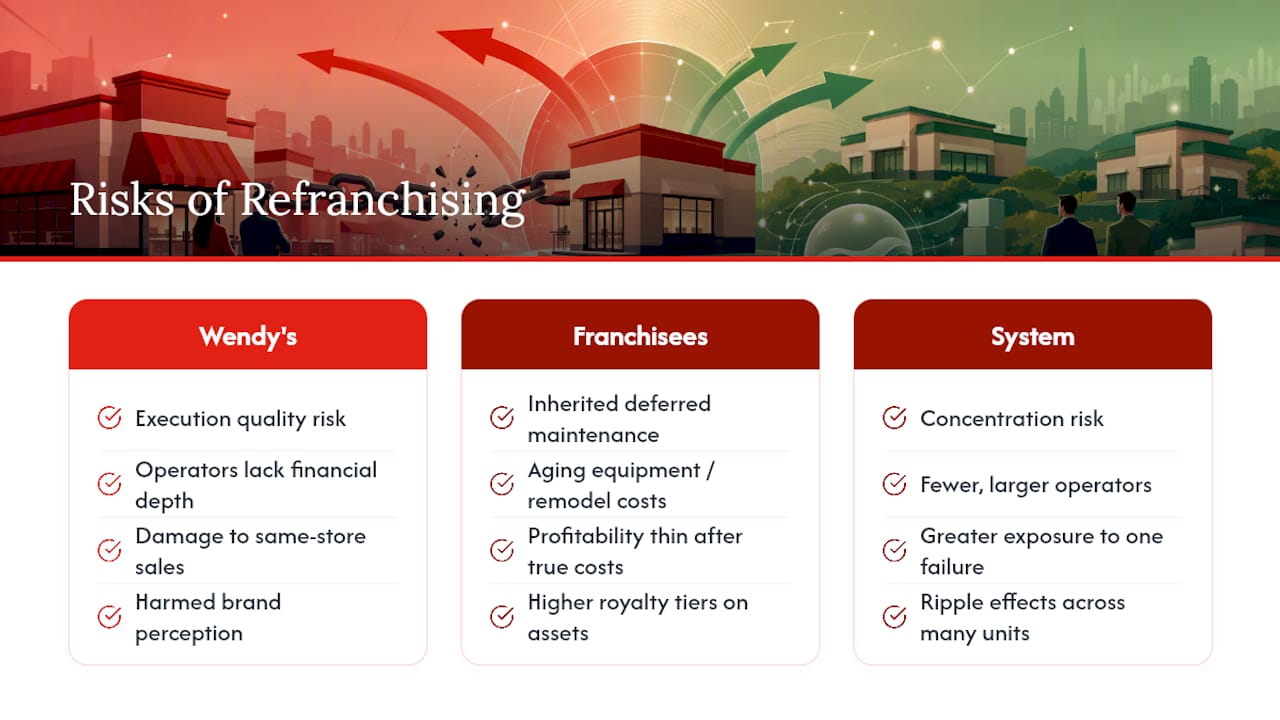
For Wendy’s, the biggest risk is execution quality. Selling units to operators who lack the financial depth or operational discipline to maintain brand standards can hurt same-store sales and brand perception in the exact markets the company is trying to strengthen. A rushed refranchising push that prioritizes deal volume over operator quality tends to show up later as inconsistent customer experience.
For franchisees, the risks run in a different direction. Buyers taking on transferred units often inherit deferred maintenance, aging equipment, or remodel obligations that were underestimated during due diligence. A franchise agreement that looked profitable on paper can turn thin once actual remodel costs, higher royalty tiers on certain assets, or unexpected repair needs hit the books. Financing risk compounds this: even with access to preferred lenders, a buyer who stretches liquidity to close a large multi-unit package has less cushion if a local market softens.
There is also concentration risk for the broader system. As more units land with fewer, larger operators, Wendy’s becomes more exposed to the financial health of a smaller number of very large franchise partners. If one major operator runs into financial trouble, the ripple effect across dozens or hundreds of units is larger than it would be under a more fragmented ownership base. That is a structural tradeoff Project Fresh accepts in exchange for cleaner royalty economics, and it is worth watching as the program matures.
Training and Support After a Franchise Transfer
Buyers acquiring transferred units or opening new ones under Project Fresh are not left to figure out operations alone. Wendy’s franchising process includes onboarding support tied to brand standards, operational training, and access to the same supply chain and marketing infrastructure that existing franchisees rely on. New owners of transferred units typically work through a transition period where remodel timelines, staff retention plans, and point-of-sale system updates get coordinated with corporate support teams.
Technology support has become a bigger part of that package as Wendy’s rolls out AI-driven tools like FreshAI in drive-thrus. Franchisees adopting these systems get implementation guidance rather than being handed hardware and left to self-train, since consistent execution across thousands of locations depends on standardized rollout. Our guide to FreshAI’s economics covers how that technology layer factors into day-to-day operations for a newly onboarded operator.
Ongoing support also includes access to preferred lender relationships for financing renovations or subsequent unit acquisitions, marketing co-op participation, and the operational playbooks that cover everything from labor scheduling to inventory management. The depth of that support matters more for transfer buyers than for brand-new franchisees, since transfer buyers often need to correct operational habits left over from the previous owner while simultaneously meeting Wendy’s current brand standards.
Where Is Wendy’s Refranchising Strategy Heading?
The long-term goal behind Project Fresh is a leaner corporate structure generating more predictable, higher-margin revenue through royalties and rent rather than the operating income of company-run stores. That shift positions Wendy’s more like a brand licensor and less like a restaurant operator, a model that tends to command different valuation treatment from investors who reward capital-light businesses with steadier cash flow.
Growth targets reinforce that direction. Adding roughly 1,000 net new global restaurants by 2028, with about 300 domestically, signals that Wendy’s wants system growth to come primarily through franchised development rather than company-funded expansion. Combined with continued refranchising of existing company-operated units, the long-run picture is a Wendy’s system where the vast majority of restaurants are owned and operated by franchisees, funded largely by franchisee capital, while corporate focuses resources on brand marketing, menu innovation, and technology platforms like FreshAI.
That strategic bet assumes franchisee demand stays strong enough to absorb both the refranchised units and the new development pipeline at prices that make sense for both sides. Recent transaction activity, including the Flynn Group’s expanded stake, suggests that demand currently exists among well-capitalized multi-unit operators. Whether that appetite holds steady through 2028 will determine if Project Fresh delivers the value-creation outcome Wendy’s is betting on.
BuyWendy’s Analyst Perspective on Modeling Refranchising
Modeling refranchising correctly starts with separating the units Wendy’s still operates from the ones generating royalty and rent income, then projecting each stream independently rather than blending them into one blurred margin figure. The assumptions that move a valuation the most are average unit volume for franchised stores, the effective royalty rate realized across the mix of agreements, and how much of the rent economics Wendy’s actually captures versus passes through in incentives.
FreshAI is the wildcard worth tracking closely. If it lifts throughput or lowers labor cost per transaction at the unit level, franchisees benefit directly, and Wendy’s benefits indirectly through healthier royalty bases and stronger renewal economics. That upside is not guaranteed, but it is the kind of incremental unit-economics lever that can matter more over a multi-year horizon than the headline refranchising percentage itself.
— Benjamin
BuyWendy’s Resources for Refranchising Research
Modeling a refranchising-driven business shift by hand is doable, but it is easy to miss how sensitive Wendy’s valuation is to a few key assumptions, especially royalty mix and unit growth pace. Buywendys built its research specifically to close that gap for readers evaluating WEN as an investment rather than as a franchise purchase.
Our Franchise Cost & Economics report translates the FDD into practical benchmarks so you can see what a franchised unit actually earns before you build your own model. The FreshAI economics brief breaks down how drive-thru automation shows up in franchise margins, and our fundamental analysis report puts refranchising in context alongside the rest of Wendy’s financial picture. If you are trying to decide whether the stock reflects this strategic shift yet, start with the Wendy’s stock bull vs bear case and see which side of the argument the current price actually supports.
Sources
- FAQs | Franchising | Wendy’s
- THE WENDY’S COMPANY LAUNCHES ‘PROJECT FRESH,’ A STRATEGIC PLAN TO DRIVE GROWTH AND ENHANCE VALUE CREATION
- Flynn Group Beefs Up Its Stake in Wendy’s
- How Wendy’s plans to outpace competitors with 1,000 new locations and $700M in EBITDA – QSR Magazine
- SEC filing — Blackstone analysis on refranchising (historical)