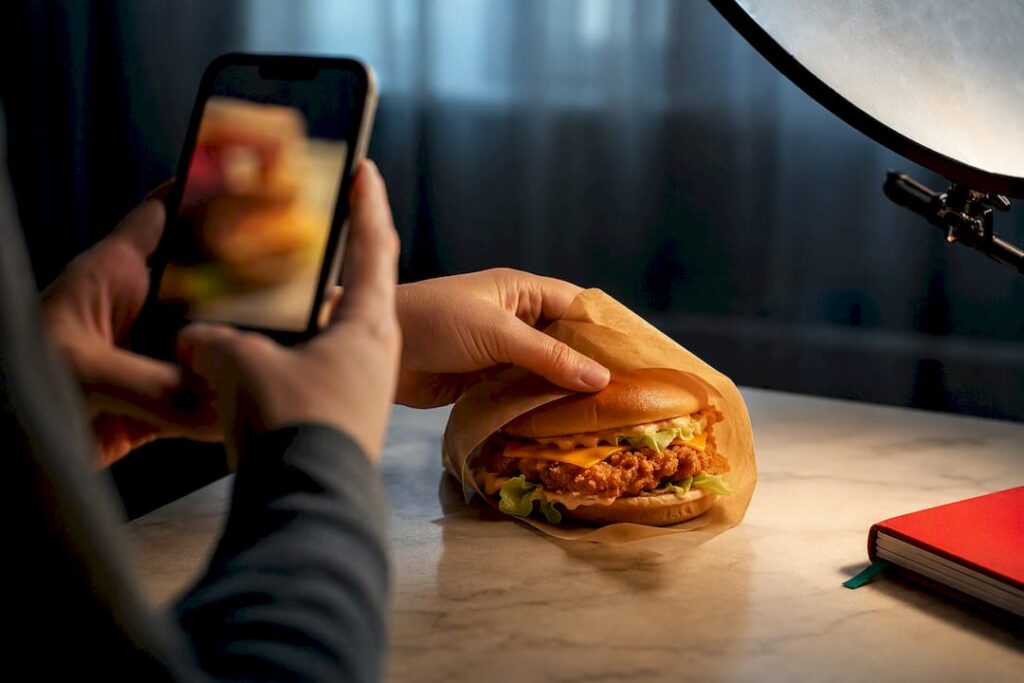
Wendy’s marketing strategy has shifted from viral sass and short-term price promotions toward a data-driven, brand-first model called Project Fresh. The plan leans on consumer segmentation, a governed social voice, digital loyalty mechanics, and menu-quality messaging to balance immediate traffic against long-term brand equity. The core levers are audience segmentation, a structured social media strategy, app-driven loyalty, focused product news, and measurement tied to same-store sales and digital penetration.
TL;DR:
- Wendy’s digital sales account for about 20.3% of total revenue, with a year-over-year increase of roughly 14.9%, indicating effective digital marketing investments.
- The brand’s segmentation approach targets occasion-driven, value-sensitive, culturally engaged, and drive-thru loyal customers, with tailored campaigns for each group.
- Operational consistency, especially through FreshAI drive-thru technology, is critical for maintaining brand promises of speed and accuracy across franchise locations.
- Rebuilding consumer trust relies on long-term perception improvements, monitored through brand-health scores, while digital and sales metrics provide short-term performance signals.
- Effective crisis management depends on pre-approved social governance structures, emphasizing transparency, speed, and operational reliability at franchise locations.
Table of Contents
- Wendy’s Marketing Goals and Brand Positioning
- Who Wendy’s Now Targets: Segmentation in Practice
- The Marketing Mix: Product, Price, Place, and Promotion
- Wendy’s Social Media Approach: Voice, Governance, and the Roast Campaign
- Digital Channels and Loyalty: App, Biggie, and Measurement
- Project Fresh and the Data-Driven Pivot
- Performance Signals and Metrics Marketers Should Watch
- Applying Wendy’s Approach: Lessons for Marketing Professionals
- BuyWendy’s Evidence and What It Means for Marketing Cadence
- Crisis Management and Reputation Strategy
- What Marketers and Analysts Should Watch Next
- BuyWendy’s Resources for Analysts Tracking Wendy’s Marketing Signals
- Sources
Wendy’s Marketing Goals and Brand Positioning
Project Fresh sets out three stated objectives: restoring category relevance, reasserting freshness and quality as differentiators, and rebuilding consumer trust after a stretch of value-war pricing pressure across the fast-food industry. Executives have framed this as balancing “sales overnight” with “brand over time.” Discounting still moves traffic in a given week, but company leadership has signaled that overreliance on promotions erodes the pricing power and perception the brand needs for durable growth, a tension detailed in reporting on how Wendy’s plans to reclaim relevance.
That framing shows up in the specific claims marketers now lean on in creative and PR:
- Fresh, never-frozen beef as a structural quality differentiator versus frozen-patty competitors.
- The square burger shape as a visual shorthand for “we don’t cut corners.”
- Ingredient provenance and menu simplification, reducing clutter around a smaller set of hero items.
- Chicken innovation as a second growth pillar alongside the core burger business.
The pivot matters because it changes what marketing is asked to prove. A promotion-led calendar is judged on weekly traffic. A brand-first calendar has to show up in slower-moving metrics: perception scores, repeat visitation, and pricing tolerance, which take quarters, not weeks, to move.
Who Wendy’s Now Targets: Segmentation in Practice
Wendy’s turnaround plan rests on a consumer segmentation study conducted with the marketing consultancy Creed UnCo, mapping when, why, and where different customer groups choose the brand rather than treating all guests as one undifferentiated market, according to coverage of Wendy’s marketing effectiveness investment. That segmentation replaces a one-size-fits-all national campaign with clusters defined by occasion and mindset rather than age bracket alone.
Practical segment attributes that inform creative and media buying include:
- Occasion-driven visitors, who choose Wendy’s for a specific craving (spicy chicken, Frosty) rather than habitual convenience.
- Value-sensitive frequent guests, whose visit frequency tracks closely with promotional pricing on the Biggie platform.
- Culturally engaged younger guests, who encounter the brand primarily through social content rather than television or coupons.
- Habitual drive-thru commuters, whose loyalty depends more on speed and consistency than on menu novelty.
Segmentation reshapes cadence too: instead of one campaign running for months, Wendy’s now calendars roughly eight distinct marketing periods a year, each tuned to a segment’s need and paired with a specific creative tone, from playful and topical to straightforwardly value-focused.
The Marketing Mix: Product, Price, Place, and Promotion
Wendy’s tactical execution across the classic 4Ps reflects the segmentation logic rather than a blanket national push.
Product. Menu strategy pairs limited-time offers, built to generate short bursts of news and social conversation, against a stable core menu (the Baconator, spicy chicken sandwich, Frosty) that anchors brand identity. Chicken innovation gets particular emphasis as Wendy’s tries to close a category gap with competitors that built dedicated chicken sub-brands.
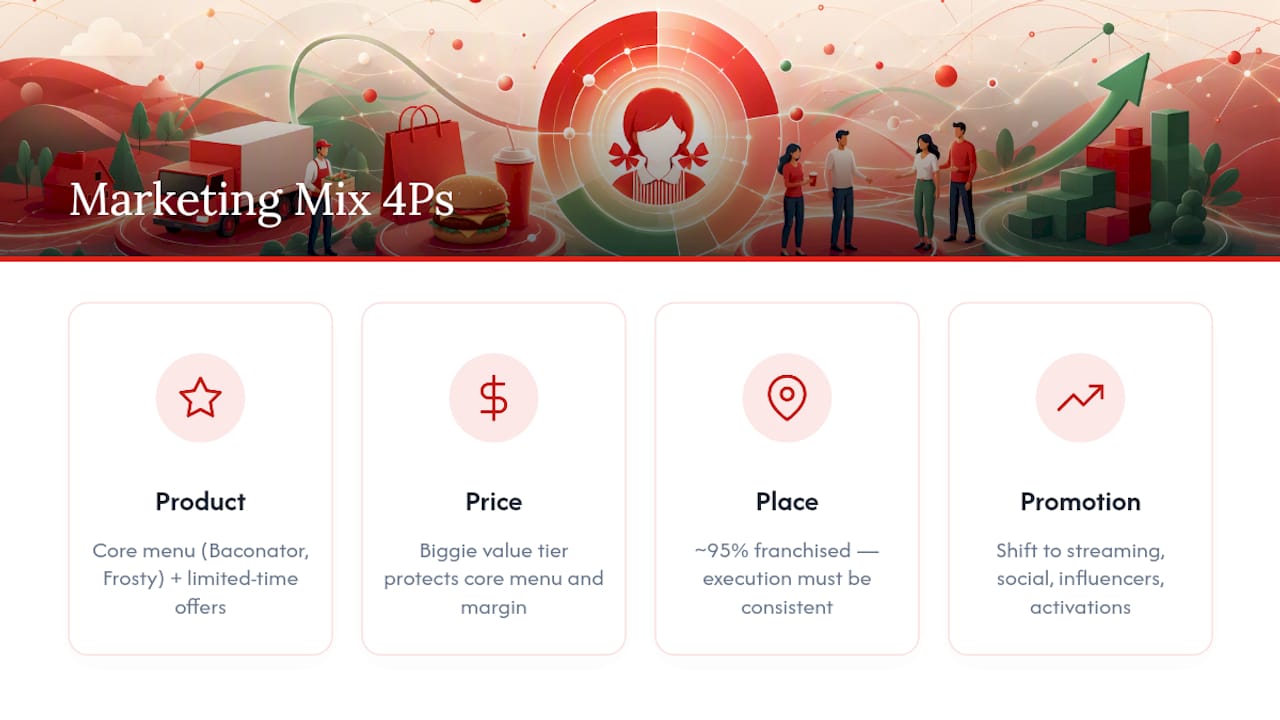
Price. The Biggie platform anchors Wendy’s value tier, giving budget-conscious guests a low entry price point without discounting the core menu directly. That separation lets Wendy’s compete on price where it needs to while protecting margin and quality perception elsewhere on the menu.
Place. Roughly 95% of Wendy’s locations operate under a franchised model, which means marketing promises about speed, freshness, or order accuracy only work if execution is consistent across thousands of independently operated restaurants. That consistency requirement is precisely why FreshAI drive-thru technology matters to marketers as much as to operators: a national ad campaign about fast, accurate service is only credible if the drive-thru experience backs it up store by store.
Promotion. Media allocation has shifted toward streaming, always-on social content, and culturally specific activations (gaming, music, pop culture) rather than a handful of expensive television flights. Influencer and experiential tie-ins now function as earned-media multipliers, a point QSR Magazine’s reporting on how Wendy’s is “outplaying” competitors frames as making each marketing dollar “feel like $3” through organic amplification rather than paid reach alone.
Wendy’s Social Media Approach: Voice, Governance, and the Roast Campaign
Wendy’s director of brand engagement strategy has described the brand’s social voice as resting on three pillars: deep consumer knowledge, an empowered team, and C-suite trust, according to an interview detailing how Wendy’s builds its social media personality. That governance structure is what lets the account respond in real time without every post routing through layers of approval.
- Consumer knowledge first. The team studies what fans already say about Wendy’s before deciding how to respond, rather than inventing a tone from scratch.
- An empowered team. Social staff can post reactive, in-the-moment content because leadership has pre-approved the brand’s boundaries.
- Executive trust. The C-suite tolerates occasional edge cases in exchange for cultural relevance that traditional advertising rarely achieves.
The Roast campaign, where Wendy’s invited followers to submit content for public, comedic roasting, is the clearest example of this governance in action. It converted a one-way broadcast into two-way participation, turning fans into unpaid creative contributors and generating sustained earned engagement well beyond the campaign’s paid media spend.
Platform tactics differ deliberately: X (formerly Twitter) carries the brand’s wit and reactive humor, TikTok carries creative short-form video built around trends and gaming culture, and Instagram leans more heavily on product storytelling and visual food content.
Pro Tip: Track engagement metrics and brand-health metrics separately. A viral moment can spike likes and shares while doing nothing for purchase intent or perceived quality, so treat the two as different dashboards, not one score.
Guardrails matter because reactive humor carries reputational risk; academic research on interactive food-brand campaigns shows engagement spikes reliably around such activations, but sustained brand health requires structure around the spontaneity, not just wit.
Digital Channels and Loyalty: App, Biggie, and Measurement
The Wendy’s app is the operational hub connecting marketing promises to measurable revenue. Its rewards program, gamified challenges, and a redesigned home screen are built to increase visit frequency, not just to digitize an existing transaction. Details on the mechanics driving that frequency are covered in a complete guide to the Wendy’s app.
Digital sales rose roughly 14.9% year-over-year in a recent reporting period and accounted for about 20.3% of total sales, based on company disclosures cited in coverage of Wendy’s marketing effectiveness push. That penetration rate matters to marketers because digital transactions carry first-party data that traditional drive-thru or counter orders never generate.
Measurement discipline follows three practices worth adopting broadly:
- Incrementality testing, comparing offer recipients against a held-out control group rather than assuming every redemption represents new revenue.
- Cohort analysis, tracking how a customer’s ordering frequency changes in the weeks following app enrollment.
- Lifetime-value modeling, connecting individual app offers to long-run customer value rather than judging each promotion in isolation.
A deeper breakdown of company-reported digital figures appears in Wendy’s digital sales analysis.
Project Fresh and the Data-Driven Pivot
Project Fresh is the operational name for Wendy’s broader turnaround, and it runs on two structural inputs beyond the segmentation study already discussed. The first is the consulting relationship with Creed UnCo, which extends past segmentation into a marketing-effectiveness framework known as R.E.D., an acronym for relevant, easy, and distinctive, used to screen creative concepts and media plans before they get funded.
- Relevant means creative has to connect to something the target segment already cares about, not a generic brand message.
- Easy means the message and the in-restaurant experience it promises have to be simple to understand and simple to deliver.
- Distinctive means the execution has to be ownable by Wendy’s specifically, not swappable with a competitor’s logo.
That screening process is why spend has shifted toward always-on social content and targeted streaming media rather than broad-reach television buys. It also explains why marketing news is now calendared in roughly eight discrete bursts a year instead of one continuous campaign, giving each segment a dedicated moment rather than diluting the message across all audiences at once, a structure detailed in Wendy’s relevance-reclaiming plan.
Performance Signals and Metrics Marketers Should Watch
Marketing claims mean little to analysts without financial corroboration, and Wendy’s public filings give three usable proof points.
Statistic Callout: Digital sales grew approximately 14.9% year-over-year and reached about 20.3% of total sales in a recent period, according to reporting on Wendy’s turnaround investment in marketing effectiveness. That is the single clearest quantitative signal that digital-first tactics are converting rather than just generating impressions.
Beyond digital penetration, three signals deserve regular tracking:
- Same-store sales trends, disclosed quarterly and the most direct read on whether brand repositioning is translating into visits.
- Ad fund revenue and ad spend trends, which show whether franchisee-funded marketing dollars are growing alongside the strategic shift.
- Brand-health benchmarks, including ACSI-style customer satisfaction scores tracked by Statista’s Wendy’s customer satisfaction data, useful for judging whether perception is actually improving, not just engagement.
Analysts should treat quarterly earnings calls and SEC disclosures, including figures in Wendy’s most recent 10-K filing, as the primary source for confirming whether marketing narrative and financial reality are moving together.
Applying Wendy’s Approach: Lessons for Marketing Professionals
Wendy’s playbook translates into a short set of transferable practices for teams outside the fast-food category.
- Build a segmentation-first creative calendar. Replace one long campaign with several shorter bursts, each keyed to a specific audience need and a moment of genuine news.
- Give social a documented voice framework, then trust it. A team that has to seek approval for every reactive post cannot compete culturally in real time.
- Balance promotion with brand-building deliberately. Treat discounting as a traffic tool and brand content as a pricing-power tool; measure them differently and fund both on purpose.
- Test incrementality before scaling any offer. A redemption rate alone does not prove new revenue; a control group does.
- Align operations before marketing overpromises. A campaign about speed or freshness fails the moment a customer’s actual visit contradicts it.
Pro Tip: Before greenlighting a splashy campaign, ask whether every location can actually deliver on its promise. Wendy’s pairing of FreshAI drive-thru technology with brand messaging about speed and accuracy exists precisely to close that gap between promise and delivery.
BuyWendy’s Evidence and What It Means for Marketing Cadence
Wendy’s marketing choices do not happen in a vacuum. A campaign has to drive measurable restaurant traffic, not just digital engagement, or franchisee support for ad-fund spending erodes over time, a dynamic explored in Wendy’s asset-light franchise model.
Several proof points support that read on the business:
- Free cash flow and EBITDA have remained resilient even as the industry absorbed value-war pricing pressure, an operational cushion detailed in Wendy’s long-term growth analysis.
- FreshAI drive-thru adoption signals an operational investment that directly supports the “speed and accuracy” claims marketing makes to consumers.
- Menu-level economics, including how Biggie pricing interacts with margin, are broken down in Wendy’s menu analysis.
Franchisee alignment, in short, is the invisible constraint shaping how aggressively Wendy’s can calendar promotions versus brand campaigns in any given quarter.
Crisis Management and Reputation Strategy
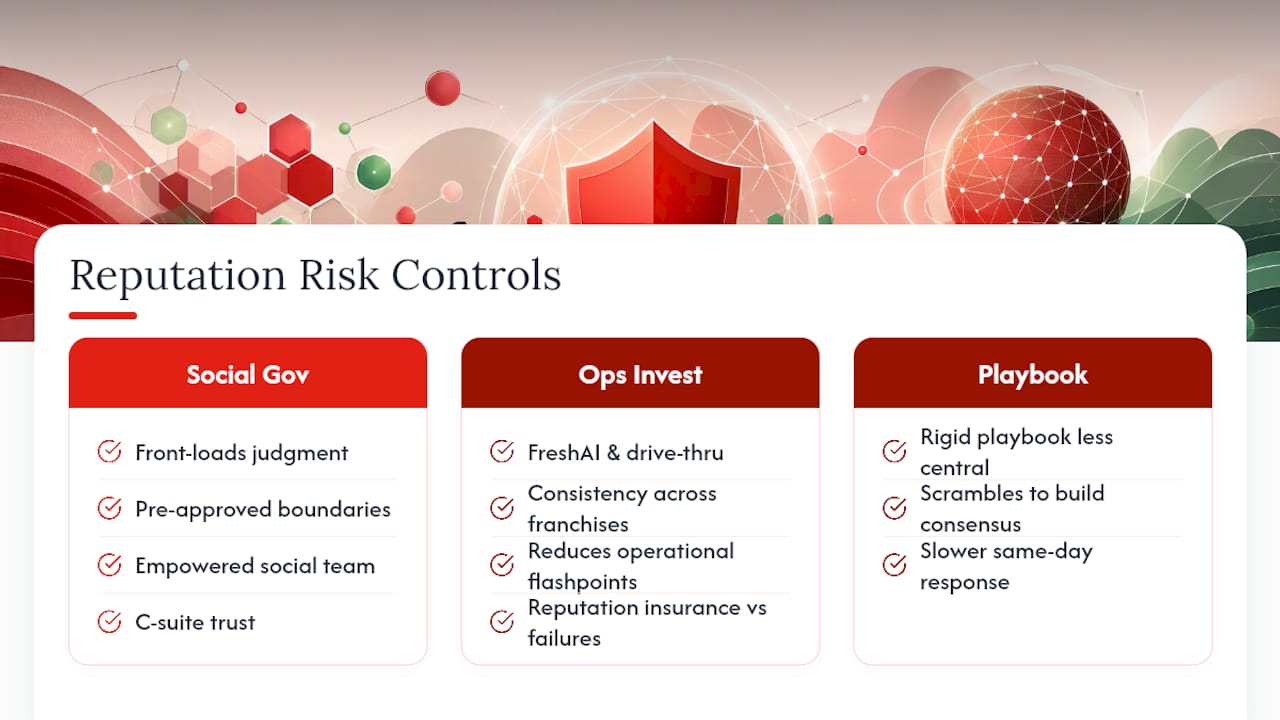
A brand that built its identity on unfiltered social wit inherits a specific reputational risk: the same voice that wins earned media on a good day can turn a misjudged joke into a headline on a bad one. Wendy’s approach to that exposure rests less on a rigid crisis playbook and more on the governance structure already built into its social operation, the same consumer knowledge, empowered team, and C-suite trust described earlier.
That structure matters because it front-loads judgment before a crisis rather than scrambling to build consensus during one. A social team with pre-approved boundaries can acknowledge a misstep, correct course, or simply go quiet, without waiting on a multi-layer sign-off process that would turn a same-day story into a multi-day one.
Reputation strategy also extends into operational consistency across franchised locations. A viral complaint about slow service or an inaccurate order lands directly on the brand’s national reputation even when a single independently owned restaurant caused it. That is part of why FreshAI and drive-thru consistency investments function as reputation insurance as much as efficiency plays: fewer operational failures mean fewer flashpoints for the social team to manage defensively.
The broader lesson for analysts is that reputation risk in a franchised system is structurally different from a corporate-owned chain’s. Marketing can promise consistency, but only operational investment can actually deliver it at scale, and the gap between the two is where reputational crises tend to originate.
What Marketers and Analysts Should Watch Next
The signal worth watching closest is whether store-level consistency actually catches up to the brand promises Project Fresh is making, because that convergence is what will show up in same-store sales inflection over the next several quarters. Marketing can generate attention faster than operations can generate trust.
My recommendation: track digital conversion cohorts quarter over quarter and benchmark them against comparable consumer-packaged-goods loyalty programs, not just other quick-service chains. That comparison will reveal whether Wendy’s app-driven loyalty is building durable habit or just capturing existing demand through a new channel.
— Benjamin
BuyWendy’s Resources for Analysts Tracking Wendy’s Marketing Signals
Marketing tactics only matter to investors when they translate into franchise traffic, ad-fund health, and digital revenue that shows up in filings, not just in social engagement numbers. Buywendys exists to close that gap: independent research connecting Wendy’s brand moves to the financial mechanics behind them.
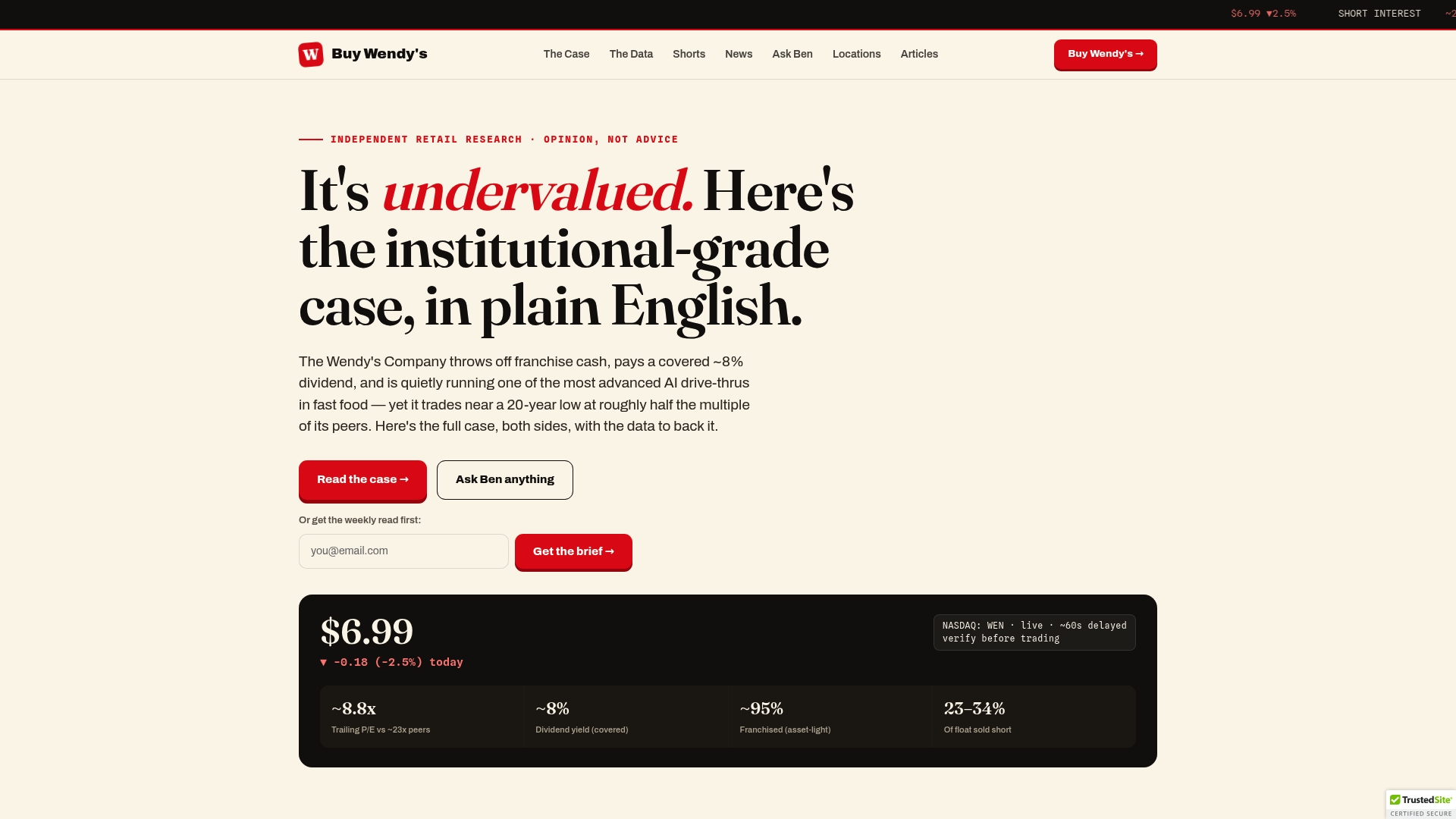
If you’re trying to figure out whether Project Fresh’s segmentation and digital push are actually moving the numbers that matter to shareholders, start with a restaurant stock analysis guide built specifically for investors evaluating Wendy’s and comparable quick-service names. It walks through how to weigh same-store sales trends, digital penetration, and franchise royalty economics against the marketing narrative, so you’re not taking a press release at face value. Read it before your next earnings call.
Sources
- How Wendy’s plans to reclaim relevance
- Wendy’s doubles down on marketing effectiveness as part of turnaround
- Wendy’s customer satisfaction in the U.S. (Statista)