
The near-term catalysts for Wendy’s stock split into two camps: headline speculation (the CFO hire, Trian’s take-private interest, meme-driven short squeezes) and fundamentals that determine whether any rally holds (same-restaurant sales, Project Fresh execution, dividend and buyback decisions). Traders should treat the speculative catalysts as trading opportunities and the fundamental ones as the real test. The next concrete checkpoints are the upcoming earnings call, any new 13D amendments from Trian, and fresh 8-K disclosures.
TL;DR:
- Wendy’s recent CFO appointment signals a focus on cost structure and capital allocation, but its impact depends on guidance and execution.
- Traffic declines in U.S. stores led Wendy’s to withdraw its 2026 outlook, making traffic stabilization crucial for a potential rally.
- Project Fresh store closures will temporarily hurt revenue but may improve profitability and system economics in the long run.
- The company’s dividend cut and debt maturities in 2028-2029 raise concerns about capital flexibility and refinancing risks if sales do not recover.
- Rumors of take-private interest have historically caused short-term share jumps, but confirmed filings are necessary to validate actual activist activity.
Table of Contents
- Recent Headline Catalysts Behind Wendy’s Stock Moves
- Operating Catalysts: Same-Restaurant Sales, Project Fresh, and Franchisee Economics
- Dividend, Buybacks, and Debt: The Capital-Allocation Catalysts
- What Do Activist Bids and Take-Private Rumors Signal?
- What to Watch Next: A Monitoring Checklist for WEN Catalysts
- Buywendys’ Analysis: Proprietary Thresholds for Trading WEN Catalysts
- Analyst Perspective: Trading WEN Through Catalyst Noise
- Resources: Tools to Model Wendy’s Stock Catalysts
- Selected Filings and Reporting to Read Next
- Sources
Recent Headline Catalysts Behind Wendy’s Stock Moves
Wendy’s named Steve Cirulis as chief financial officer, a hire that markets read as a signal the company is serious about fixing its cost structure and capital allocation. New CFOs at turnaround companies tend to trigger re-rating because they often arrive with a mandate to reset guidance, cut costs, or accelerate buybacks.
Around the same period, retail traders piled into WEN on reports tied to a “Save Wendy’s” campaign, driving a sharp single-day spike due to short sellers getting squeezed following the CFO announcement (https://finance.yahoo.com/markets/stocks/articles/wendy-soars-27-save-wendy-140654748.html). That kind of move is a liquidity event, not a fundamentals event.
Separately, reports that Nelson Peltz and Trian were exploring a possible take-private bid which pushed shares higher (https://fortune.com/2026/08/19/wendys-nelson-peltz-take-private-customers/) even before any formal filing.
- CFO hire: fundamentals-adjacent, watch for guidance commentary
- Meme/short-squeeze rallies: speculative, watch for fade risk
- Take-private rumors: speculative until a 13D or offer letter appears
Operating Catalysts: Same-Restaurant Sales, Project Fresh, and Franchisee Economics
Wendy’s Q2 2026 results showed U.S. same-restaurant sales and traffic declined significantly, prompting the company to withdraw its full-year 2026 outlook(https://www.irwendys.com/news/news-details/2026/THE-WENDYS-COMPANY-REPORTS-SECOND-QUARTER-2026-RESULTS/default.aspx). Traffic, not average check, is the variable that matters most in a franchised model, since royalty revenue tracks systemwide sales rather than store-level margins.
- Traffic trend reversal is the single metric that would validate a turnaround thesis faster than any single headline catalyst.
- Project Fresh closures, estimated in the hundreds of U.S. locations across 2025 and 2026 according to industry analysis, create a near-term revenue drag but should improve the average unit economics of the remaining system.
- Franchisee economics diverge from company-operated performance because franchisees absorb labor and food-cost pressure directly, while Wendy’s franchising support materials outline the operational standards franchisees must maintain.
- FreshAI drive-thru technology could move the needle on throughput and order accuracy, which matters more to check size than any single marketing campaign.
Readers who want a deeper walk-through of how to read these trends can use Buywendys’ guide to same-restaurant sales analysis.
Dividend, Buybacks, and Debt: The Capital-Allocation Catalysts
Wendy’s cut its quarterly dividend by half alongside the guidance withdrawal, a move coverage framed as a warning sign rather than a clean reset. Reinstating a larger payout would require sustained free cash flow growth, not just a single strong quarter.
- Dividend cut freed cash for Project Fresh reinvestment and debt service
- Buyback authorization status should be confirmed each quarter in the 10-Q
- Debt maturities clustering in 2028 and 2029 raise refinancing risk if rates stay elevated
- A guidance reinstatement would likely require two consecutive quarters of traffic stabilization
Pro Tip: Watch the free cash flow line before the headline EPS number. A licensing-heavy revenue model can post soft same-store sales and still generate resilient cash flow if royalty collection holds steady. Buywendys breaks this down further in its dividend safety analysis.
What Do Activist Bids and Take-Private Rumors Signal?
A 13D filing, a consortium rumor, or a wire-service scoop typically precedes a formal process by weeks or months, and the sequence usually runs from leak to informal premium pricing to eventual deal or collapse. Wendy’s shares jumped roughly 5% on one such report tied to Nelson Peltz’s take-private interest and a possible COO role revival.
- Premium math: past speculative episodes have moved shares single digits to double digits on unconfirmed reports alone
- Credible signal: a filed 13D amendment or named consortium partner
- Weak signal: anonymous sourcing with no filing to follow
The risk cuts both ways. Deals collapse, management changes get walked back, and traders who buy the rumor without a filing to anchor it often give back gains fast.
What to Watch Next: A Monitoring Checklist for WEN Catalysts
- Next quarterly earnings date and call commentary on traffic and guidance
- New 8-K filings covering executive changes or material agreements
- 13D/13G amendments from Trian or other holders
- 10-Q and 10-K updates on same-restaurant sales, closures, and debt schedules
- Short interest changes and unusual options activity around known catalyst dates
- Insider buying or selling disclosed in Form 4 filings
Pro Tip: Set your fundamentals threshold before the next print: two consecutive quarters of positive traffic growth is the bar that would materially upgrade the thesis from speculative to evidence-based. For a deeper breakdown of what to expect on the call, see Buywendys’ quarterly earnings guide.
Buywendys’ Analysis: Proprietary Thresholds for Trading WEN Catalysts
Wendy’s licensing-heavy structure means royalty revenue reacts to systemwide traffic losses faster than a company-operated chain’s store margins would. That makes the royalty-to-revenue ratio a priority indicator over headline same-store sales alone.
A short list of thresholds can be tracked before treating any catalyst as more than a trading event:
- Free cash flow trend across two consecutive quarters, not one
- Traffic inflection of any magnitude, since a flat quarter after a 12.5% decline is itself informative
- Buyback resumption paired with dividend commentary, which signals management confidence in cash generation
- Position sizing kept small until a 13D filing or earnings print confirms a fundamentals catalyst rather than a rumor
The royalty-to-revenue ratio tells you more about corporate resilience than the headline comp number ever will, because it isolates what actually flows to Wendy’s balance sheet regardless of franchisee-level pressure.
Exit triggers should be defined before entry: a failed guidance reinstatement or a collapsed take-private rumor are both reasons to reassess, not double down.
Analyst Perspective: Trading WEN Through Catalyst Noise
I would treat WEN as a special-situation trade right now, not a patient turnaround position, until traffic stabilizes for two full quarters. The activist interest and CFO hire are real catalysts, but they’re sentiment catalysts, not proof the franchise model has stopped losing customers. Size positions accordingly and follow Buywendys’ rolling coverage for filing-by-filing updates.
— Benjamin
Resources: Tools to Model Wendy’s Stock Catalysts
Modeling these catalysts by hand is tedious, and getting the royalty-to-revenue math wrong skews every downstream valuation call. Buywendys built a value investor’s guide to analyzing restaurant stocks specifically for readers who want a repeatable framework rather than reacting to each headline separately.
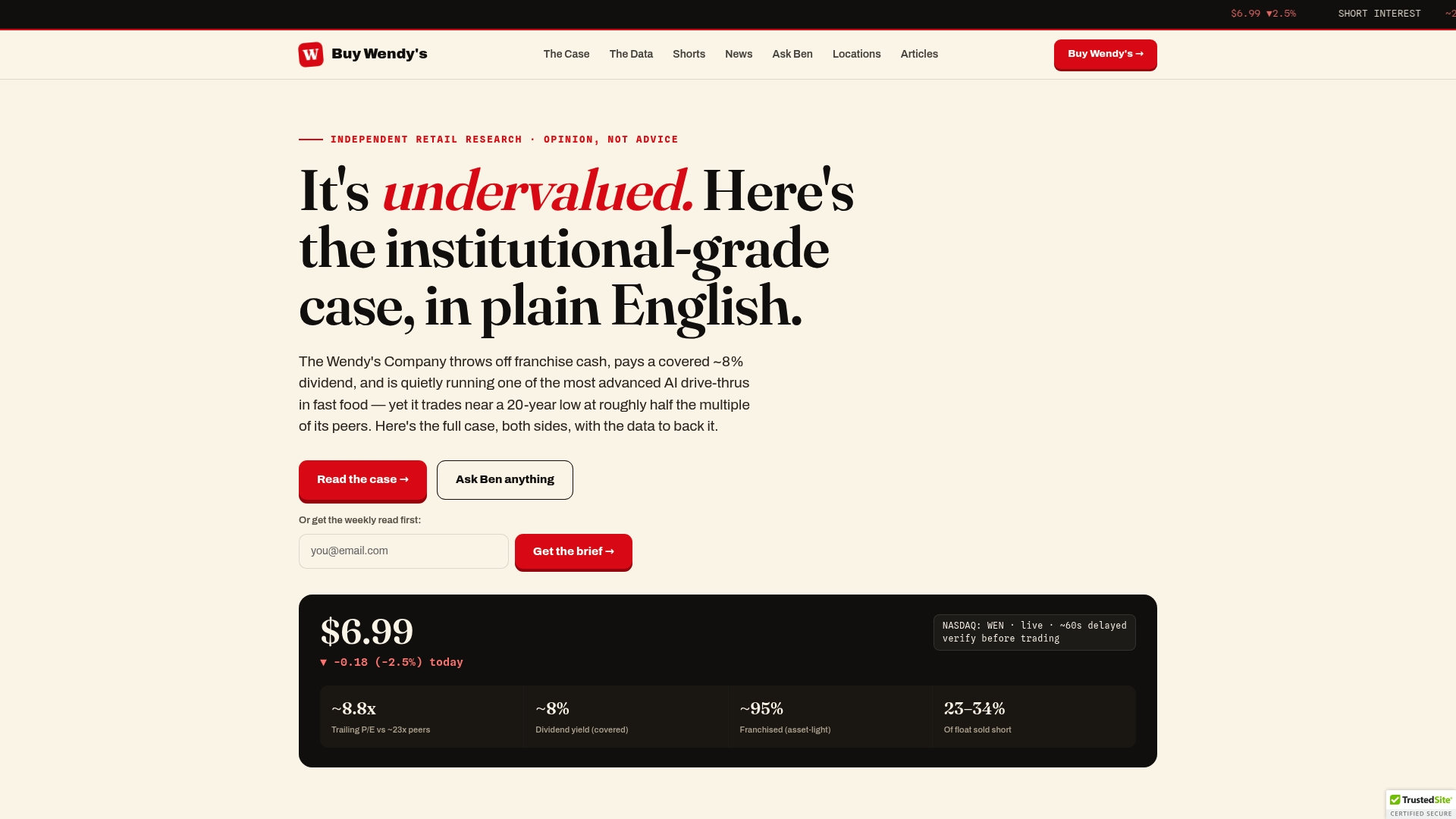
The guide walks through franchise-model cash flow, same-store sales interpretation, and how to weight speculative catalysts against confirmed filings. Use it to build your own thresholds before the next earnings print, and check back on Buywendys for updates as new 8-Ks and 13D amendments land.
Selected Filings and Reporting to Read Next
This article is general information, not a substitute for advice from a qualified financial advisor. Consult a qualified financial professional about your own circumstances before acting on anything here.
Sources
- The Wendy’s Company reports second quarter 2026 results
- Wendy’s just cut its dividend in half. Consider it a warning sign, not a reset.