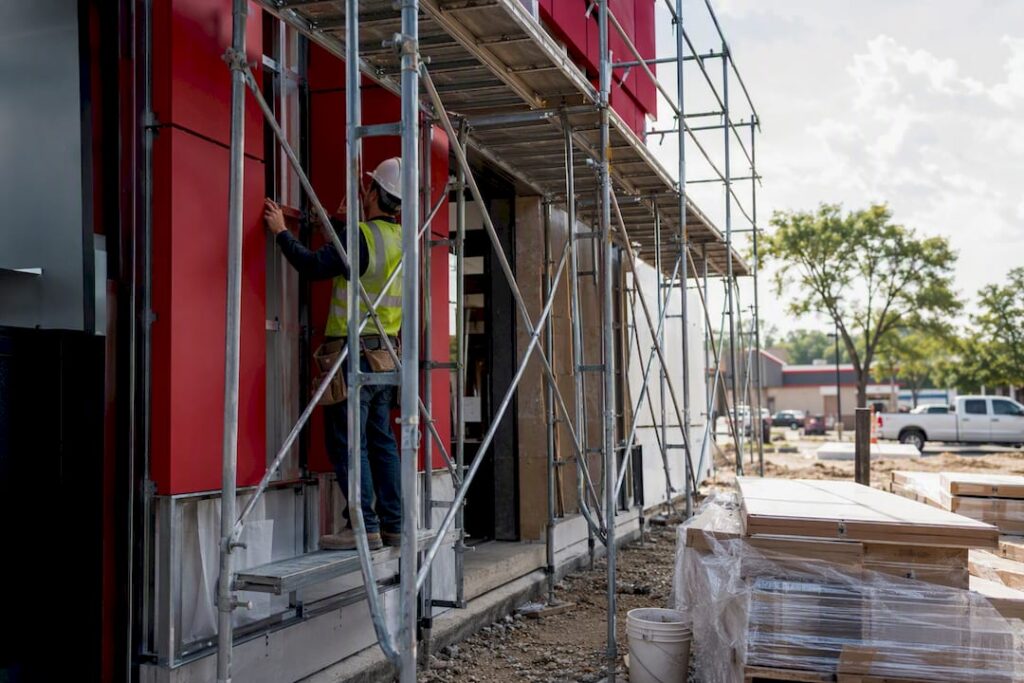
Wendy’s remodels can deliver real sales lift, but returns are conditional, not guaranteed. Company reporting points to standard remodels generating 10 to 20 percent sales gains and full rebuilds hitting 25 to 35 percent or higher, yet those averages hide meaningful variation by unit.
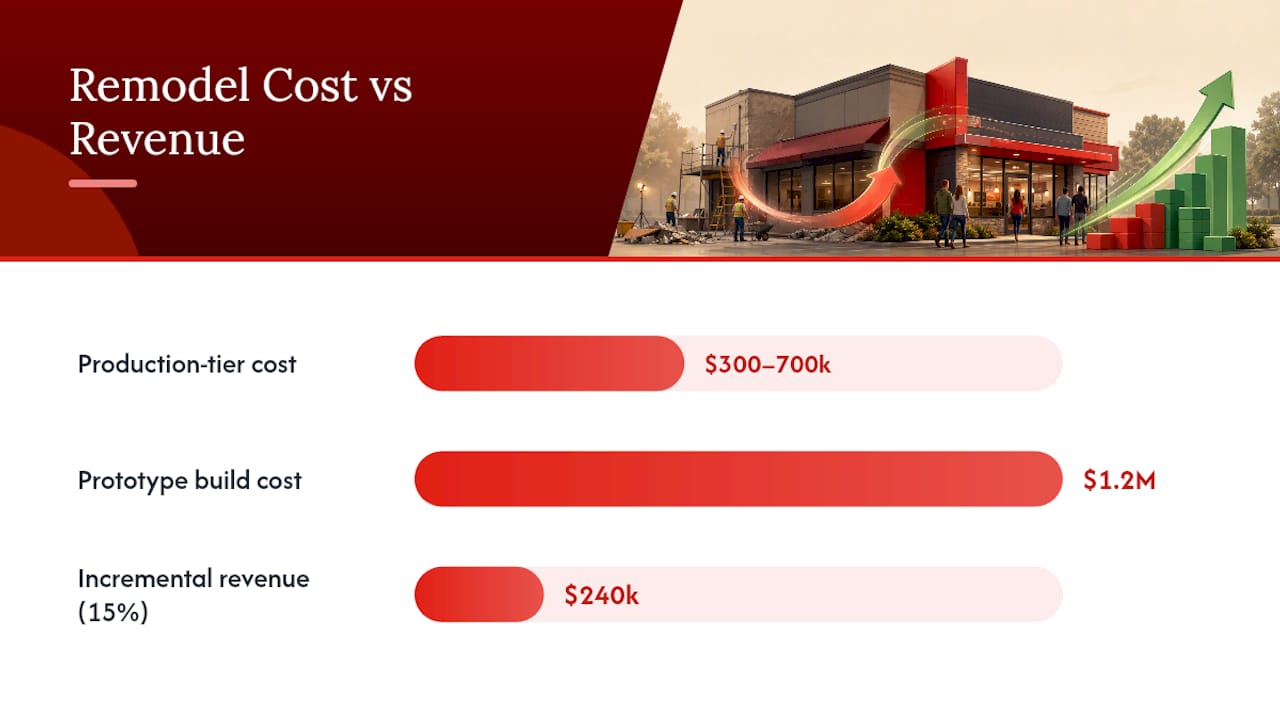
- Cost tiers matter: production-tier remodels run roughly $300,000 to $700,000, while the original prototype build cost about $1.2 million.
- The math shifts sharply based on a restaurant’s existing average unit volume (AUV), remodel scope, and whether the program is mandatory or voluntary.
- Franchisee litigation, including DavCo’s counterclaims, shows that lower-volume restaurants have sometimes seen little to no return on mandated upgrades.
Statistic: Standard remodels average a 10 to 20 percent sales lift according to trade reporting and company commentary, but that figure assumes a baseline AUV that many franchise locations don’t hit.
Key Takeaways
Wendy’s remodel returns depend far more on site-specific AUV and digital mix than on the company’s headline sales-lift percentages.
| Point | Details |
|---|---|
| Sales lift is conditional | Standard remodels report 10 to 20 percent lift, but that assumes an AUV near $1.6 million that many units don’t reach. |
| Cost tiers vary widely | Production remodels range from about $300,000 to $700,000, versus a $1.2 million prototype build cost. |
| Litigation reveals real risk | DavCo’s counterclaims show mandated remodels can produce no meaningful ROI for lower-volume restaurants. |
| Project Fresh shifts the model | Capital is moving toward a returns-based, site-specific approach rather than blanket mandates. |
| Digital mix drives kitchen ROI | High-Capacity Kitchen investment pays off mainly where digital order volume already strains throughput. |
Table of Contents
- What Are Wendy’s Remodel Programs and How Did They Evolve?
- What Sales Lifts and Costs Does Wendy’s Report for Remodels?
- What Did DavCo Argue in Its Remodel ROI Lawsuit?
- How Do You Calculate Expected ROI on a Wendy’s Remodel?
- Which Site Variables Change Remodel ROI the Most?
- How Does Project Fresh Change Remodel Economics Going Forward?
- What Should Franchisees Request Before Approving a Remodel?
- What Should Franchisees, Investors, and Analysts Do Next?
- Why Franchise Economics, Not Design Trends, Should Drive Remodel Decisions
- Sources
What Are Wendy’s Remodel Programs and How Did They Evolve?
Wendy’s remodel strategy has moved through three distinct phases, each reflecting a different theory about what drives sales at the unit level.
Image Activation launched as a system-wide reimaging initiative aimed at modernizing aging store designs and signaling brand relevance to a new generation of customers. It set the template for future rollouts but also became the flashpoint for franchisee litigation over ROI, discussed further below.
Global Next Gen followed with a digital-first layout built around throughput and mobile order pickup. The High-Capacity Kitchen option extends that design further, adding kitchen capacity for units where digital order volume strains the standard layout.
Project Fresh, announced in 2025, marks a strategic pivot: instead of top-down mandates, Wendy’s is emphasizing:
- A “One Wendy’s” collaborative model between the company and franchisees
- Capital reallocation away from certain build-to-suit programs
- A returns-based framework that prioritizes franchisee profitability over uniform design compliance
What Sales Lifts and Costs Does Wendy’s Report for Remodels?
Company materials and independent trade coverage give investors and franchisees the clearest available benchmarks, though they come with caveats worth reading closely.
Standard remodels report sales lifts in the 10 to 20 percent range, while full rebuilds push into 25 to 35 percent territory or higher. Those figures typically model against a baseline AUV near $1.6 million, which skews the math for lower-volume franchise units.
Prototype performance data filed with the SEC exhibit breaks results down by channel, including carryout, dine-in, and digital order gains, alongside capacity improvements from redesigned kitchen layouts. The same filing documents cost tiers:
- Prototype actual cost: about $1.2 million
- Tier I production estimate: $650,000 to $700,000
- Tier II production estimate: about $500,000
- Tier III production estimate: about $300,000
Statistic: The High-Capacity Kitchen is estimated to deliver nearly a 50 percent increase in kitchen output capacity versus the standard Global Next Gen design, a figure that matters most for high-digital-mix locations.
What Did DavCo Argue in Its Remodel ROI Lawsuit?
DavCo, one of Wendy’s largest franchisees, filed counterclaims arguing that Image Activation remodels were economically unfeasible for many lower-volume restaurants. The filing claimed certain mandated designs left no realistic path to positive return on investment for operators outside the highest-AUV trade areas.
The dispute surfaces concerns franchisees raise repeatedly across remodel cycles:
- Mandatory compliance deadlines with limited flexibility for site conditions
- High upfront capital requirements relative to unit-level cash flow
- Absence of site-specific ROI modeling before mandates take effect
For investors and franchisors, this kind of litigation carries real weight beyond legal fees. Disputes like this shape future policy, influence how aggressively new programs get mandated, and affect the company’s reputation with its own operator base.
How Do You Calculate Expected ROI on a Wendy’s Remodel?
Modeling remodel returns requires more than applying a company-reported average to your unit. Here’s a repeatable framework.
- Define scope and cost. Classify the project as a minor refresh, standard remodel, or full rebuild, then map it to the SEC exhibit’s tier estimates ($300K to $700K for production tiers, $1.2M for prototype-level builds).
- Choose a sales-lift scenario. Model three cases: conservative (low single digits), base (10 to 20 percent), and optimistic (25 to 35 percent), reflecting the reported ranges for standard remodels versus full rebuilds.
- Convert sales lift to incremental EBITDA. Apply a conservative incremental margin, since incremental sales often carry different product mix and labor intensity than existing volume.
- Layer in financing cost and disruption. Include construction-period sales loss and any debt service tied to remodel financing.
- Build a sensitivity table. Compare best, base, and worst-case payback periods side by side rather than relying on a single point estimate.
Statistic: A unit with $1.6 million AUV and a 15 percent base-case sales lift generates roughly $240,000 in incremental revenue. Whether that clears breakeven on a $500,000 Tier II remodel depends almost entirely on the incremental margin assumption you use.
Pro Tip: Always stress-test your model against margin compression and a digital conversion rate below what the prototype data suggests. Prototype units often operate under close corporate oversight that field locations can’t fully replicate.
For a deeper look at how these figures roll into company-wide forecasting, see Buywendys’ forecast and analysis.
Which Site Variables Change Remodel ROI the Most?
Two units with identical remodel scopes can post wildly different returns, and the gap almost always traces back to a handful of local variables.
AUV and trade-area density set the ceiling on achievable incremental sales. A store already running near capacity during peak hours has less room to capture a design-driven lift than one operating below its market’s potential.
Digital order mix determines whether a High-Capacity Kitchen investment pays for itself. Locations with heavy delivery and mobile pickup volume can justify the added capex; locations with modest digital penetration usually can’t. Labor and energy savings, including a roughly 6 percent annual energy reduction cited in some company materials, help the OPEX side of the ledger but rarely move the needle enough to rescue a weak sales-lift case on their own. Local rent, tax exposure, and new competitive openings nearby can extend payback timelines well beyond what a spreadsheet model predicts.
How Does Project Fresh Change Remodel Economics Going Forward?
Project Fresh signals the most significant shift in Wendy’s capital allocation philosophy in years, and it directly affects how future remodel decisions get made.
- The plan explicitly reallocates capital away from certain build-to-suit programs toward a more collaborative, One Wendy’s approach with franchisees.
- Investors should expect fewer blanket mandates and more site-specific or additive upgrades rather than uniform system-wide redesigns.
- Watch for reduced mandatory capex requirements, disclosed returns on completed projects, and rollout metrics as Project Fresh matures.
Project Fresh’s core premise is that franchisee profitability, not design uniformity, should drive where remodel capital gets spent next.
This is a meaningful departure from the Image Activation era, when compliance deadlines applied broadly regardless of unit-level economics.
What Should Franchisees Request Before Approving a Remodel?
Before signing off on any remodel commitment, request documentation that ties the project’s cost directly to your specific unit’s economics, not system-wide averages.
- Financial evidence: historical AUV, a projected post-remodel sales case specific to your trade area, and sensitivity analysis for margin and traffic assumptions.
- Operational evidence: prototype throughput data, digital pickup capacity figures, and any staffing model changes the redesign requires.
- Contractual terms: incentive payment timing, royalty waiver conditions, available lender programs, and any rollback clauses if performance targets aren’t met.
Watch for red flags: mandatory deadlines with no accompanying local ROI model, vague incentive language, and design rules applied uniformly regardless of trade-area characteristics.
Pro Tip: Ask specifically whether incentive payments are structured as upfront cash, royalty waivers, or deferred credits. The structure changes your effective payback period even when the headline incentive dollar amount looks identical.
Restaurant technology upgrades tied to remodels, from kiosks to order-management systems, are worth evaluating on their own merits too. This restaurant technology guide covers the broader landscape of throughput-focused equipment decisions relevant to kitchen capacity planning.
Franchisees and investors alike can strengthen their read on unit economics with Buywendys’ analysis of Wendy’s restaurant design and growth strategy, which tracks how design investment connects to reported financial performance. For a broader view of where Wendy’s stock sits amid these operational shifts, Buywendys’ bull versus bear case analysis breaks down what remodel economics mean for the investment thesis heading into 2026.
What Should Franchisees, Investors, and Analysts Do Next?
Each audience needs a different next step given what the evidence actually shows.
- Franchisees: Don’t approve a remodel based on system averages. Insist on a local ROI model and get financing terms, including waiver conditions, in writing before committing capital.
- Investors: Model sensitivity aggressively rather than anchoring on the optimistic 25 to 35 percent lift case, and track Project Fresh rollout metrics as they get disclosed.
- Analysts: Watch system-level adoption rates of High-Capacity Kitchen installations and press for disclosed post-remodel unit economics rather than relying on prototype-level figures alone.
Why Franchise Economics, Not Design Trends, Should Drive Remodel Decisions
The most overlooked point in most remodel coverage is that Wendy’s own reported averages were never meant to apply evenly across every unit. A 10 to 20 percent lift figure is a system-wide mean, and means hide the DavCo-style tail risk where lower-volume stores absorbed six-figure capex with no realistic path to breakeven.
Conventional advice treats company sales-lift data as a forecast. It’s better read as a ceiling under favorable conditions: high AUV, strong digital mix, and a trade area that supports the incremental traffic a redesign is supposed to attract. Franchisees who skip the local modeling step and lean on corporate averages are the ones most likely to end up in a dispute like DavCo’s.
What should change first is sequencing. Run the unit-level ROI model before negotiating financing, not after. Project Fresh’s tilt toward site-specific, returns-based investment gives franchisees more leverage to demand that modeling now than at any point since Image Activation launched.
— Benjamin
Wendy’s remodel returns hinge on matching the right design tier to the right unit economics, something Buywendys tracks closely through ongoing coverage of Wendy’s revenue growth drivers and franchise-level performance data. Investors weighing WEN against remodel-driven growth assumptions can find deeper modeling tools in Buywendys’ fundamental analysis report.
Sources
The figures and claims in this article draw on a small set of primary filings and trade reporting rather than secondhand summaries.
- Wendy’s Builds Upon Global Next Gen Restaurant Design with New Kitchen Innovation
- Exhibit: Prototype performance and tiered design strategy (SEC filing)
- Wendy’s Remodel Offers ‘No ROI,’ DavCo Counters in Lawsuit
- Wendy’s Remodels Are Generating Sales | Restaurant Finance Across America
Recommended
- The Only Wendy’s Franchisee Whose Books Are Open — and What They Show – Buy Wendy’s
- Nobody Is Buying Wendy’s Restaurants Anymore. Not Even From Each Other. – Buy Wendy’s
- Wendy’s Franchise Cost & Economics (2026): What the FDD Actually Says – Buy Wendy’s
- Wendy’s Won’t Tell You What a Franchise Earns. Its Own 10-K Just Did. – Buy Wendy’s