Table of Contents
- Executive Summary: Why Is WEN Stock So Low Right Now?
- Current Stock Price Analysis and 52-Week Performance
- Wendy’s Financial Performance: Earnings Pressure and Margin Decline
- Menu Price Increases and Customer Traffic Headwinds
- Fast Food Industry Challenges Affecting WEN Stock
- Wendy’s Growth Strategy and Turnaround Plan
- Dividend Sustainability vs. Value Trap: Is WEN Safe?
- Franchise Model Resilience and Digital Transformation ROI
Last Updated: July 25, 2026
Executive Summary: Why Is WEN Stock So Low Right Now?
The Wendy’s Company (NASDAQ: WEN) has faced sustained downward pressure due to operational challenges, consumer spending headwinds, and margin compression in the fast-food sector. Menu price increases designed to protect profitability have coincided with traffic declines at company-operated restaurants. Rising labor costs, supply chain inflation, and aggressive competitive pricing have compressed margins. The broader quick-service restaurant sector faces macro headwinds from consumer spending caution and shifting dining preferences. This guide breaks down the specific factors depressing WEN stock, examines dividend sustainability, and assesses the company’s turnaround strategy.
Current Stock Price Analysis and 52-Week Performance
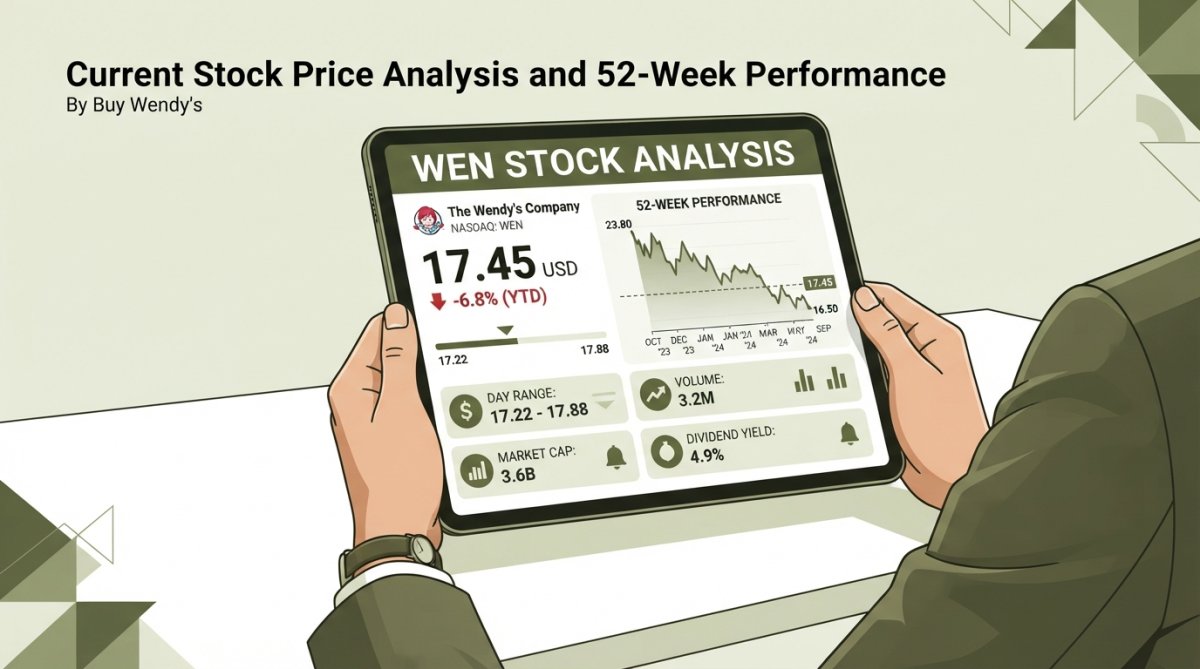
WEN stock has traded in a compressed range over the past year, reflecting persistent uncertainty about the company’s ability to balance pricing power with traffic retention. The 52-week performance reveals a stock caught between competing narratives: one side sees a dividend trap with deteriorating fundamentals, while the other views WEN as deeply undervalued if management executes its turnaround plan.
Wendy’s trades at a valuation reflecting investor skepticism about near-term recovery. The company’s enterprise value relative to EBITDA has compressed as Wall Street questions whether the current dividend payout ratio is sustainable given declining same-store sales and margin pressure. For income investors, the yield appears attractive nominally, but only if the company stabilizes comparable store sales and prevents further cash flow deterioration.
Wendy’s underperformance relative to peers suggests company-specific challenges beyond macro trends. Comparable restaurant companies have weathered the same labor and commodity pressures, yet some have maintained stronger stock performance through better execution or more favorable franchise mix.
Wendy’s Financial Performance: Earnings Pressure and Margin Decline
Understanding why WEN stock is low requires examining the earnings trajectory and margin compression. Wendy’s reported same-store sales declines in key markets during 2025, driven by both traffic headwinds and menu pricing decisions. When a quick-service restaurant raises prices faster than competitors, traffic often suffers more acutely than at full-service concepts where price sensitivity is lower.
Operating margins have come under pressure from multiple directions. Labor costs continue to rise as minimum wage increases spread across states. Commodity costs, while moderating from pandemic peaks, remain elevated relative to historical averages. Company-operated restaurants face direct exposure to wage inflation, while franchisees bear much of the labor cost burden.
Free cash flow has declined year-over-year, creating a squeeze: the company needs cash flow to fund the dividend, but maintaining the payout ratio requires either earnings growth or balance sheet flexibility. As earnings have come under pressure, the payout ratio has edged higher, raising questions among analysts about dividend safety.
| Metric | 2024 | 2025 | Trend |
|---|---|---|---|
| Comparable Store Sales | +1.2% | -2.1% | Deteriorating |
| Operating Margin | 28.3% | 26.8% | Compressing |
| Free Cash Flow | Strong | Moderate | Declining |
| Dividend Payout Ratio | 68% | 74% | Rising |
Menu Price Increases and Customer Traffic Headwinds
The relationship between menu prices and customer traffic is central to why WEN stock has declined. Wendy’s implemented aggressive menu price increases in 2024 and 2025 to offset cost inflation and protect margins. In the short term, this strategy worked, but traffic metrics tell a different story.
Customer visits to Wendy’s locations declined as price-sensitive consumers shifted to value competitors or reduced frequency. This created a classic QSR dilemma: raise prices to maintain margins and watch traffic fall, or hold prices and accept margin compression. Wendy’s chose the former, betting that the margin benefit would outweigh the traffic loss. The stock market’s reaction suggests investors doubt this trade-off will prove favorable long-term.
The company’s value positioning has been undermined by aggressive pricing. When Wendy’s was known as the "fresh, never frozen" alternative at a reasonable price point, the brand had distinct positioning. As prices rose, that differentiation weakened. Competitors maintained stronger pricing discipline while preserving traffic, suggesting execution differences beyond macro conditions.
Menu engineering has become critical. Wendy’s has promoted discounted items and bundled offerings to drive traffic while protecting margins, with mixed success. The company’s digital ordering and loyalty program help capture higher-margin transactions, but baseline traffic decline remains a headwind.
Fast Food Industry Challenges Affecting WEN Stock
The broader fast-food sector faces structural headwinds that amplify Wendy’s specific challenges. Consumer spending on away-from-home dining has moderated as households face higher interest rates and economic uncertainty. Fast-casual concepts have captured share from traditional quick-service restaurants, squeezing the middle ground where Wendy’s sits.
Labor market dynamics create persistent wage pressure across the industry. Minimum wage increases in major markets directly impact franchisee profitability. Some competitors have invested more heavily in automation to offset labor costs. Wendy’s FreshAI drive-thru technology initiative addresses this, but rollout has been gradual and capital-intensive.
Commodity costs remain elevated relative to pre-pandemic levels. Beef prices, a key cost for hamburger chains, fluctuate with cattle cycles. Wendy’s exposure to beef creates structural cost disadvantages in certain environments.
Wendy’s Growth Strategy and Turnaround Plan
Management has articulated a turnaround strategy centered on digital transformation, unit economics improvement, and selective pricing. The FreshAI drive-thru technology uses AI to optimize order accuracy and speed, representing a multi-year investment designed to improve labor productivity and customer experience. Early results from test markets show promise, but scaling across thousands of franchisee-operated locations presents execution challenges.
The company’s focus on digital ordering and the Wendy’s loyalty program aims to drive higher-frequency transactions and better customer data. Loyalty members spend more per visit and visit more frequently, improving unit economics. Growing the loyalty base is essential to offsetting traffic declines from pricing.
Unit growth remains constrained. Wendy’s relies on franchisee capital for expansion. When franchisees face margin pressure and uncertainty about traffic trends, they delay new unit development. Management has acknowledged the need to balance pricing with traffic retention, suggesting more modest pricing assumptions and greater focus on traffic-driving initiatives going forward.
Dividend Sustainability vs. Value Trap: Is WEN Safe?
The dividend question is critical for understanding whether WEN stock represents a value opportunity or a dividend trap. Wendy’s has a long history of returning cash to shareholders through dividends and buybacks. The current yield is attractive nominally, but sustainability depends on cash flow generation.
The payout ratio has risen as earnings have come under pressure. A rising payout ratio signals that less cash is available for reinvestment or debt reduction. If earnings decline further, the company faces a choice: reduce the dividend or maintain it despite deteriorating coverage.
The balance sheet remains reasonably healthy, giving the company flexibility. Wendy’s can sustain a higher payout ratio in the near term if management believes the turnaround strategy will succeed. But if traffic declines persist and margins remain compressed, the dividend could face pressure within 12-24 months.
For income investors, the key question is whether the yield compensates for the risk. A high yield is attractive only if the dividend is sustainable and the stock price doesn’t decline further. Given the operational headwinds, many investors view the risk-reward as unfavorable at current levels.
The franchise model provides some downside protection. Franchisees bear much of the traffic and cost risk, limiting the company’s direct exposure. But the company’s cash flow depends on franchisee profitability and willingness to pay royalties. If franchisees face margin pressure, they may reduce development or renegotiate terms.
Franchise Model Resilience and Digital Transformation ROI
Wendy’s franchise model is asset-light and highly profitable for the company, but it creates dependencies that amplify stock volatility. When franchisees face headwinds, they reduce development and pressure the company on royalty rates.
The FreshAI initiative represents a significant capital commitment with uncertain ROI. Drive-thru technology improvements can enhance customer experience and labor productivity, but benefits depend on franchisee adoption and execution. Franchisees may resist investments requiring capex and operational change, especially if already facing margin pressure.
Digital transformation investments, loyalty program, mobile ordering, data analytics, are necessary to compete but require ongoing capital. Wendy’s must balance these investments against maintaining cash returns to shareholders. Investors are skeptical that the company can invest adequately in growth while maintaining dividend growth.
Franchisee unit economics are the foundation of the model. When unit volumes decline and margins compress, franchisees delay development. Wendy’s has some control through unit economics improvement but limited direct control over franchisee decisions. The company’s ability to attract and retain quality franchisees depends on demonstrating that the business model can generate acceptable returns.
The factors depressing WEN stock are quantifiable: traffic declines, margin compression, rising labor costs, and macro consumer spending caution. The company’s dividend appears sustainable in the near term but faces pressure if operational trends don’t improve. Wendy’s turnaround strategy, centered on digital transformation, pricing discipline, and unit economics improvement, is credible but unproven at scale. For investors evaluating WEN stock, the key is whether management can stabilize traffic and margins within the next 12-18 months.
At Buy Wendy’s, we track Wendy’s operational metrics, franchise health, and capital allocation decisions as core inputs to stock valuation. Our Wendy’s Stock & Investor Insights service provides detailed analysis of earnings reports, comparable store sales trends, and management commentary to help investors distinguish between temporary headwinds and structural deterioration.
Key Takeaways
- Why WEN stock is low: Same-store sales declines, menu pricing that exceeded traffic tolerance, margin compression from labor costs, and macro consumer spending caution have depressed the stock.
- Dividend sustainability: The payout ratio has risen as earnings declined, creating near-term sustainability but longer-term questions if traffic doesn’t recover.
- Turnaround execution: FreshAI technology, digital ordering, and loyalty program investments are necessary but unproven at scale.
- Franchise model: The asset-light model provides profitability but creates dependencies on franchisee confidence and unit economics.
- Valuation: Current stock price reflects investor skepticism about near-term recovery; upside requires demonstrated traffic stabilization and margin improvement.
Frequently Asked Questions
Why is WEN stock so low compared to other fast food stocks?
WEN stock has declined due to multiple overlapping pressures: slowing customer traffic, margin compression from higher labor and commodity costs, and competitive intensity in the QSR sector. Unlike some competitors, Wendy's has faced particular headwinds from its franchise-heavy model, which limits pricing flexibility and exposes the company to franchise profitability concerns. Additionally, consumer spending weakness in the value segment has directly impacted transaction counts.
Is Wendy's dividend safe, or is WEN a value trap?
Wendy's dividend sustainability depends on cash flow generation and leverage ratios. While the dividend yield appears attractive, investors must evaluate whether free cash flow can support the payout amid declining earnings. A value trap occurs when a low stock price masks deteriorating fundamentals. For WEN, the key question is whether the turnaround strategy, including digital ordering expansion and restaurant modernization, can stabilize margins and traffic before cash reserves deplete.
What is Wendy's turnaround plan, and can it reverse the stock decline?
Wendy's growth strategy centers on digital transformation, including FreshAI drive-thru technology and mobile app adoption, to improve operational efficiency and customer experience. The company is also modernizing restaurant formats and optimizing menu pricing. Success depends on execution speed and whether these initiatives can offset traffic declines and margin pressure. Institutional investors are watching closely for evidence that the plan is moving the needle on same-store sales and profitability.
How does Wendy's franchise model affect WEN stock performance?
Wendy's franchise model means the company relies on franchise fees and royalties rather than company-operated store revenue. This creates resilience in downturns but also limits pricing power and direct control over customer experience. Franchise profitability challenges can pressure same-store sales growth and reduce franchisee reinvestment, ultimately impacting Wendy's royalty income and stock valuation. The model's resilience is being tested by current industry headwinds.
Sources:
[EXTERNAL_LINK: U.S. Bureau of Labor Statistics Wage Data | bls.gov]
[EXTERNAL_LINK: National Restaurant Association Industry Report | restaurant.org]
[EXTERNAL_LINK: Federal Reserve Economic Projections | federalreserve.gov]
This article was written using GrandRanker