
The Wendy’s Company reported long-term debt of $2,662 million and a current portion of long-term debt of $78,163 thousand in its fourth-quarter and full-year 2025 results, with total liabilities of $4,775 million. Third-party aggregators peg total debt closer to $4.12 billion and net debt near $3.67 billion once cash and lease liabilities get folded in differently than the company’s own presentation. The gap between those two framings matters for anyone modeling Wendy’s debt maturity, since it changes what “current” obligations actually look like.
The nearest structural test is the anticipated repayment date on the 2018–2022 Class A-2 note series, several of which cluster in the 2026 to 2028 window, ahead of legal final maturities that stretch into the 2040s and 2050s. Refinancing risk right now reads as manageable rather than alarming. Wendy’s just termed out $450 million of new notes in December 2025, and franchise royalty cash flow continues to service the securitization structure. The sections below unpack the actual tranche-by-tranche schedule.
Key Takeaways
Wendy’s near-term debt maturity risk stays manageable because the securitization structure spreads principal across staggered anticipated repayment dates rather than a single balloon obligation.
| Point | Details |
|---|---|
| Current portion is small | Only $78,163 thousand of long-term debt is classified as due within 12 months. |
| Two maturity dates per tranche | Anticipated repayment dates (2026 to 2032) sit well before legal final maturities (2048 to 2055). |
| Series 2025-1 reset the schedule | The $450 million, 5.422% notes issued December 2025 retired older, higher-cost debt. |
| Contingent exposure adds up | Lease guarantees of roughly $94 to $98 million and letters of credit near $28 to $29 million sit outside the core notes. |
| Buywendys tracks the detail | Buywendys’s valuation model and fundamental analysis report break the tranche schedule down for direct use in investor models. |
Table of Contents
- Wendy’s Debt Snapshot: The Numbers Analysts Model First
- Wendy’s Debt Maturity Schedule By Tranche and Year
- How the Wendy’s Funding Securitization Structure Works
- Assessing Refinancing Risk on Wendy’s Debt Obligations
- Wendy’s Contingent Obligations Beyond the Balance Sheet
- Reading Wendy’s SEC Filings for Debt Modeling
- What Market Summaries Miss About Wendy’s Debt Structure
- Prioritizing What to Watch on Wendy’s Debt Risk
- Model Wendy’s Debt Schedule With Buywendys’s Research Tools
- Frequently Asked Questions About Wendy’s Debt Maturity
- Sources
Wendy’s Debt Snapshot: The Numbers Analysts Model First
| Line item | Amount | Source note |
|---|---|---|
| Long-term debt (gross) | $2,662 million | Company IR, Q4/FY 2025 results |
| Current portion of long-term debt | $78,163 thousand | Company IR, Q4/FY 2025 results |
| Total liabilities | $4,775 million | Company IR, Q4/FY 2025 results |
| Total debt (third-party estimate) | ~$4.12 billion | SharesGrow quarterly balance sheet |
| Net debt (third-party estimate) | ~$3.67 billion | SharesGrow quarterly balance sheet |
A few things jump out once you sit with these rows. The current portion of long-term debt, at $78,163 thousand, is small relative to total debt. That is a direct function of the securitization structure, which spreads scheduled principal reduction across anticipated repayment dates rather than concentrating it in a single balloon payment.
- The gap between company-reported long-term debt (~$2.66 billion) and the third-party total debt figure (~$4.12 billion) usually reflects how each source treats finance leases, operating lease liabilities, and revolver draws.
- Net debt matters more than gross debt for covenant headroom, since restricted cash held by the securitization trustee is not always freely available to the parent.
- Debt/EBITDA benchmarks calculated from company filings will diverge from those built on aggregator totals. Reconcile the two before you trust either one.
Pro Tip: If you want an apples-to-apples leverage ratio, rebuild the table with operating lease liabilities added back to debt on both sides. Wendy’s FDD and franchise economics disclosures help you separate franchise-level lease exposure from corporate-level obligations.
Wendy’s Debt Maturity Schedule By Tranche and Year
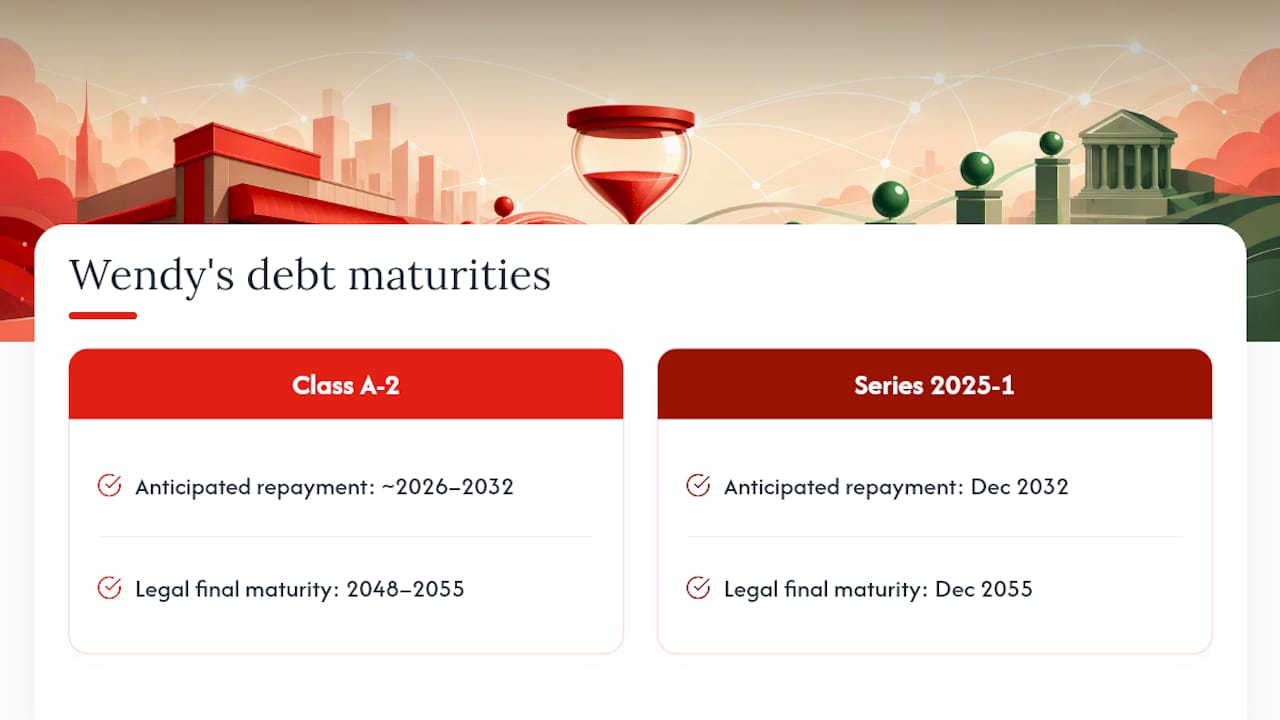
The Master Issuer, Wendy’s Funding, LLC, has issued Class A-2 notes across multiple series dated 2018 through 2022, plus the 2021-1 Class A-1 variable funding facility and the new Series 2025-1 notes. Anticipated repayment dates for the older series fall mostly between 2026 and 2032, while legal final maturities extend out to 2048 through 2055.
| Tranche | Principal outstanding | Anticipated repayment date | Legal final maturity | Rate | Secured status |
|---|---|---|---|---|---|
| Class A-2 (2018–2020 series) | Varies by series | 2025–2028 | 2048–2050 | Fixed, series-specific | Securitized, franchise/license cash flows |
| Class A-2 (2022-1 series) | Varies by series | 2032 | 2048 through 2055 | Fixed, series-specific | Securitized |
| 2021-1 Class A-1 (variable funding facility) | Drawn amount varies | Revolving | 2048 through 2055 | Floating, facility fee-based | Securitized, letters of credit backed |
| Series 2025-1 Class A-2 | $450 million | December 2032 | December 2055 | 5.422% fixed | Securitized |
Wendy’s Funding closed the $450 million Series 2025-1 offering in December 2025 at a 5.422% fixed coupon, using proceeds to retire prior series and the company’s legacy 7% debentures. That single transaction reset a meaningful chunk of the near-term maturity wall.
The dollar amount coming due inside the next 12 months, per the current portion of long-term debt line, is in the tens of millions of dollars. Extending the window to 24 months pulls in additional Class A-2 tranches approaching their anticipated repayment dates, though the exact figure depends on which 2018–2020 series the trustee schedules for that window.
- Restricted cash held by the securitization trustee and reserve accounts inside the structure offset a portion of near-term principal, reducing the parent’s need to tap corporate cash.
- Historical context from Macrotrends’ long-term debt series shows the debt load has stayed within a fairly narrow band over the past several years, which argues against a sudden leverage spike.
How the Wendy’s Funding Securitization Structure Works
Wendy’s Funding, LLC operates as a bankruptcy-remote Master Issuer, issuing senior secured notes backed by franchise royalty payments, license fees, and net rental income rather than by the parent company’s general credit. The Wendy’s SPV Guarantor, LLC sits alongside this entity in the structure, and this segregation is the reason Wendy’s debt maturity analysis differs so much from a typical corporate bond schedule. Noteholders get paid from a specific, contractually defined revenue stream, not from whatever cash the parent happens to have on hand that quarter.
Class A-2 notes and the 2021-1 Class A-1 facility share several structural features:
- Monthly or quarterly payment frequency tied to collections from franchisees and licensees.
- A two-tier maturity concept: an anticipated repayment date, when the company intends to refinance or repay, and a legal final maturity years later as a backstop.
- Additional interest accrual if a series is not refinanced by its anticipated repayment date. One indenture exhibit specifies a floor of 5.00% per annum in certain circumstances, tied to Treasury yields plus a margin.
- Reserve accounts and rapid amortization triggers that divert cash flow to noteholders if system-wide sales fall below specified thresholds tested on defined measurement dates.
The December 2025 Omnibus Amendment modified the Base Indenture and related servicing agreements, giving the company somewhat more flexibility around debt incurrence tests. Most of that flexibility only takes effect after specified implementation dates, so it is not an immediate loosening of covenant terms.
Pro Tip: Watch for indenture language referencing a “debt service coverage ratio” or “quick ratio” tested on rolling measurement dates. A breach doesn’t trigger default outright, but it can divert cash into a rapid amortization account, which is the earliest real warning sign of stress in this structure.
Assessing Refinancing Risk on Wendy’s Debt Obligations
Refinancing risk on Wendy’s current obligations looks manageable, not urgent, based on the pattern of recent issuance and the structural cash flow behind the notes. That the deal got done at all, and used to retire older, higher-cost debentures, is itself a signal of continued market access.
A simple sensitivity framework helps here. If franchise-level EBITDA softens due to slower same-store sales, the reserve accounts and trustee-held cash provide a buffer before any rapid amortization trigger activates. If Treasury yields rise meaningfully before the next anticipated repayment date, the additional interest floor becomes the relevant cost comparison against refinancing at prevailing spreads. Analysts modeling scenarios in Wendy’s free cash flow should run both paths.
Metrics worth tracking on a recurring basis:
- Operating cash flow trends relative to scheduled debt service across the tranche schedule.
- Franchise royalty growth, since that revenue stream directly backs the securitized notes.
- Trustee reserve account balances, disclosed periodically in filings.
- Letters of credit outstanding against the 2021-1 Class A-1 facility.
Same-store sales trends and execution against strategic initiatives play directly into this picture, since slower franchise cash flow makes refinancing tougher at attractive spreads.
Wendy’s Contingent Obligations Beyond the Balance Sheet
Filings disclose letters of credit outstanding of roughly $28 to $29 million against the 2021-1 Class A-1 facility, plus lease guarantees in the range of $94 to $98 million tied to formerly company-operated restaurants now run by franchisees. These guarantees extend to 2045 in some cases, a long tail of contingent exposure that rarely shows up in headline leverage discussions.
- Lease guarantees: roughly $94 to $98 million, extending as far out as 2045.
- Letters of credit: roughly $28 to $29 million against the variable funding facility.
- Filings distinguish “probable” losses, which get recorded as liabilities, from merely “possible” ones, which stay in footnote disclosure only.
The $94 to $98 million in lease guarantees represents the single largest contingent item outside the securitized notes themselves, and it should factor into any effective-leverage calculation, even though the recorded liability was not material as of late 2025.
Reading Wendy’s SEC Filings for Debt Modeling
Pulling the maturity and covenant data yourself takes four steps:
- Open the most recent 10-K or 10-Q and go straight to the long-term debt footnote for the tranche-by-tranche balance table.
- Check subsequent events and any recent 8-K filings for new issuances or amendments, like the December 2025 Omnibus Amendment.
- Read the guarantees and commitments footnote for letters of credit, lease guarantees, and purchase commitments.
- Pull the indenture and supplement exhibits directly from EDGAR if you need the exact additional-interest formula or rapid amortization trigger language.
A quick net debt calculation: take total debt from the liabilities table, subtract cash and equivalents, and cross-check against the current portion of long-term debt to isolate what is truly due inside 12 months. Indenture exhibits and the omnibus amendment text live in the exhibit index of the relevant 8-K filing on EDGAR, not in the main body of the 10-K.
What Market Summaries Miss About Wendy’s Debt Structure
Most surface-level coverage treats Wendy’s debt as a single number and stops there. That misses the mechanics that actually drive risk: trustee reserve balances, the linkage between rapid amortization triggers and restaurant-level sales tests, and the two-tier maturity structure that separates an anticipated repayment date from a legal final maturity decades later.
The real signal isn’t the headline debt figure. It’s whether franchise royalty collections are comfortably outpacing scheduled debt service heading into each anticipated repayment date, and whether trustee reserves are building or draining quarter over quarter.
One chart worth building: franchise royalty collections plotted against scheduled debt service by tranche, updated quarterly. That comparison surfaces stress before a rapid amortization trigger actually fires. Forward-looking scenario work like this involves real uncertainty, and readers wanting a deeper, downloadable model should look at Buywendys’s fundamental analysis report for the full build.
Prioritizing What to Watch on Wendy’s Debt Risk
Check trustee reserve balances and letters of credit outstanding monthly; they move slowly but signal stress early. Track same-store sales cadence and EBITDA against forecast every quarter, since both feed directly into covenant headroom. Flag upcoming measurement dates and anticipated repayment dates on a rolling calendar.
Income-focused investors should weight trustee reserve trends and dividend coverage most heavily. Growth-focused investors should watch execution on strategic initiatives, since that determines whether refinancing stays cheap.
Model Wendy’s Debt Schedule With Buywendys’s Research Tools
Buywendys gives you the tranche-level detail that a single balance-sheet line item can’t. Rather than reconstructing anticipated repayment dates and legal final maturities from raw EDGAR exhibits, you get them organized alongside the franchise cash flow figures that actually secure the notes.
A few things worth checking out directly:
- The Wendy’s stock valuation model guide walks through integrating debt schedules into a full valuation build.
- The fundamental analysis report includes scenario work on refinancing costs versus free cash flow repayment.
- The franchise economics breakdown helps you separate the cash flows backing the securitization from corporate-level obligations. For a broader lens on how franchise cash flow gets evaluated, Compass Business Acquisitions’ guide to evaluating franchise acquisition opportunities is a useful outside reference.
Start with the valuation model guide if you want to plug these maturity figures straight into a working spreadsheet today.
Frequently Asked Questions About Wendy’s Debt Maturity
When does Wendy’s debt mature?
Wendy’s debt maturity follows a two-tier structure. Older Class A-2 series have anticipated repayment dates between roughly 2026 and 2032, with legal final maturities extending to 2048 through 2055. The new Series 2025-1 notes carry an anticipated repayment date of December 2032 and a legal final maturity of December 2055.
What is Wendy’s net debt right now?
Company-reported long-term debt stands at $2,662 million, while third-party aggregators calculate net debt near $3.67 billion once cash, revolver draws, and lease liabilities get factored in differently. The gap comes down to methodology, not a factual dispute.
What happens if a Class A-2 note isn’t refinanced by its anticipated repayment date?
This raises the cost of the note without triggering default.
What backs Wendy’s securitized notes?
Franchise royalty payments, license fees, and net rental income collected through the Wendy’s Funding, LLC structure, segregated from the parent company’s general corporate cash flow.
Where should I look first to model Wendy’s debt repayment plan?
Start with the long-term debt footnote in the most recent 10-K or 10-Q, then check the guarantees and commitments footnote and any recent 8-K filings for amendments or new issuance.
This article is general information, not a substitute for advice from a qualified financial advisor. Consult a qualified financial professional about your own circumstances before acting on anything here.
Sources
- THE WENDY’S COMPANY REPORTS FOURTH QUARTER AND FULL YEAR 2025 RESULTS AND PROVIDES 2026 OUTLOOK
- R15.htm — Securitization and Class A-2 note descriptions (Wendy’s filings)
Recommended
- Wendy’s Is Not Overleveraged: Correcting StockStory’s $4.12 Billion Debt Figure – Buy Wendy’s
- Wendy’s Investor Presentation Explained: Page-by-Page Analysis for WEN Stock Investors – Buy Wendy’s
- Wendy’s Quarterly Earnings Breakdown: A 2026 Guide – Buy Wendy’s
- Wendy’s Quarterly Earnings Breakdown: A 2026 Guide