
A restaurant sale leaseback converts owned property into immediate, non-dilutive capital while you continue operating the site under a long-term lease. For credit-worthy operators with stable unit economics, it is one of the most capital-efficient financing tools available — cap rates in the QSR segment have generally run in ranges that translate to 13–15x EBITDA multiples, and Bob Evans raised $197 million from a single portfolio transaction.
A sale-leaseback typically makes sense when:
- You need capital to pay down high-cost debt or fund new unit development
- You want to fund remodels, technology upgrades, or a bolt-on acquisition without issuing equity
- Your unit economics are stable and your credit profile is strong enough to support a long-term lease obligation
Avoid it when:
- Unit-level margins are thin or volatile — the fixed lease rent will not flex in a downturn
- Your operating business trades at a higher multiple than the real estate, eliminating the arbitrage benefit
Key Takeaways
A restaurant sale leaseback is most valuable when stable unit economics, a specific capital use, and a credit profile strong enough to support a 15–20-year lease obligation all align simultaneously.
| Point | Details |
|---|---|
| Non-dilutive capital tool | SLBs convert owned real estate into cash without issuing equity or adding traditional debt. |
| QSR multiples of 13–15x | Strong QSR credits typically see SLB multiples in the 13–15x EBITDA range, creating arbitrage vs. operating business valuations. |
| Fixed-cost risk is permanent | The lease obligation does not flex in downturns — stress-test rent coverage before committing. |
| Bob Evans benchmark | A 143-property portfolio generated $197 million under a 20-year master lease, illustrating institutional-scale pricing. |
| Run a competitive process | Engaging multiple buyers through an SLB advisor consistently produces tighter cap rates and better lease terms than single-buyer negotiations. |
Table of Contents
- How does a restaurant sale leaseback transaction actually work?
- Why do restaurants use sale leasebacks? Primary benefits and use cases
- What deal economics and lease terms should you expect in U.S. restaurant SLBs?
- Who buys restaurant real estate, and what do they look for?
- What can operators learn from real U.S. sale-leaseback transactions?
- What are the real risks of a restaurant sale leaseback?
- How do you prepare and execute a sale leaseback? Timeline, advisors, and costs
- What does the current market mean for restaurant SLB pricing?
- Is a sale leaseback the right move? A decision checklist and alternatives
- The case for doing less, not more, with sale-leaseback proceeds
- Sources
How does a restaurant sale leaseback transaction actually work?
The mechanics are straightforward, though the legal and financial documentation is not. You sell the fee-simple interest in your restaurant property to an investor, then simultaneously execute a long-term lease that lets you keep operating the site. Ownership transfers; operations do not.
The typical step sequence:
- Valuation and pricing: An appraiser or SLB advisor establishes the property’s fair market value, which is then translated into a cap rate and a purchase price.
- Purchase agreement: Buyer and seller negotiate price, lease form, and closing conditions. The lease is negotiated in parallel, not after.
- Simultaneous closing: The deed transfers and the lease is executed on the same day. You walk out of closing as a tenant, not an owner.
- Long-term lease execution: The lease, typically a triple-net (NNN) structure, governs your obligations for the next 15–20+ years.
Key terms you will encounter:
- Cap rate: The buyer’s required yield, expressed as annual rent divided by purchase price. A 6% cap rate on a $2 million property implies $120,000 in annual rent.
- NNN (triple-net) lease: You pay base rent plus property taxes, insurance, and maintenance. Most restaurant SLBs use NNN or absolute-net structures.
- Master lease: A single lease document covering multiple properties, common in portfolio transactions.
- Corporate guarantee: The operating entity (or parent company) guarantees lease obligations, which is a key underwriting factor for buyers.
- Multiple arbitrage: The gap between the real estate’s implied valuation multiple and the operating company’s enterprise multiple — often the primary financial rationale for doing the deal.
Long-term leases of 15 years or more with renewal options are standard, preserving your site control even after ownership transfers.
Why do restaurants use sale leasebacks? Primary benefits and use cases
The core appeal is liquidity without dilution. Unlike a private equity raise, an SLB does not require you to give up equity or accept a new governance partner. Unlike a bank term loan, it does not add a liability to your balance sheet in the traditional sense — under ASC 842, the lease creates a right-of-use asset and a corresponding lease liability, but the proceeds land as cash.
Primary benefits:
- Non-dilutive capital: Proceeds go directly to the operator without issuing new shares or surrendering ownership of the operating business.
- Balance sheet improvement: Paying down high-cost debt with SLB proceeds reduces interest expense and can improve leverage ratios.
- Multiple arbitrage: This is the most underappreciated benefit. QSR sale-leasebacks frequently trade at 13–15x EBITDA multiples, with some transactions north of 16x. If your operating business is valued at 7–9x EBITDA, selling real estate at a 15x implied multiple and redeploying that capital into the operating business creates a meaningful value spread.
- Growth capital: Proceeds fund new unit development, remodels, technology investments (point-of-sale systems, drive-thru AI), or acquisitions.
- Shareholder returns: Public chains have used SLB proceeds for share buybacks and dividend support.
Where operators typically deploy proceeds:
- Retiring high-yield debt or revolving credit balances
- Funding a pipeline of new locations without drawing on existing credit facilities
- Financing system-wide remodel programs that franchisors require
- Acquiring additional franchise territories or competing operators
Pro Tip: Before committing proceeds to a specific use, model the after-rent free cash flow at each location. The rent created by the SLB is a permanent fixed cost — the capital use must generate returns that exceed it.
What deal economics and lease terms should you expect in U.S. restaurant SLBs?
Benchmarks matter here because buyers and advisors will quote cap rates, and you need to translate those into real financing costs before you can compare an SLB to a bank loan or a high-yield note.
| Parameter | Typical Range / Structure |
|---|---|
| Initial lease term | 15–20 years (some transactions 20+ years for large portfolios) |
| Renewal options | 4–6 options of 5 years each, at tenant’s election |
| Rent escalations | Fixed annual steps (1.5%–2%) or CPI-linked, capped at 3% |
| Cap rate range (QSR) | Varies by credit and location; translates to 13–15x EBITDA implied multiple |
| Lease structure | Absolute NNN or modified NNN; tenant responsible for taxes, insurance, maintenance |
| Corporate guarantee | Required for most institutional buyers; franchisee-level guarantee accepted by some private buyers |
Over a 20-year initial term, total rent obligation is $3 million before escalations.
Accounting and tax note: Under U.S. GAAP (ASC 842), a qualifying sale-leaseback removes the property from your balance sheet and recognizes a gain on sale (subject to certain conditions). The gain is taxable in the year of sale, which can create a significant current-year tax liability. Depreciation deductions on the sold property disappear, replaced by rent expense. Consult a tax advisor before closing — the timing of the tax hit relative to proceeds deployment is a material planning item.
Pro Tip: Negotiate renewal options aggressively. Each 5-year option you secure at a pre-set rent cap is worth real money if the property appreciates or if you need to sell the operating business later — a buyer of your restaurant company will pay more for a site with long remaining lease term and favorable renewal rights.
Who buys restaurant real estate, and what do they look for?
The buyer universe for restaurant SLBs spans several distinct categories, each with different underwriting priorities and negotiation flexibility.
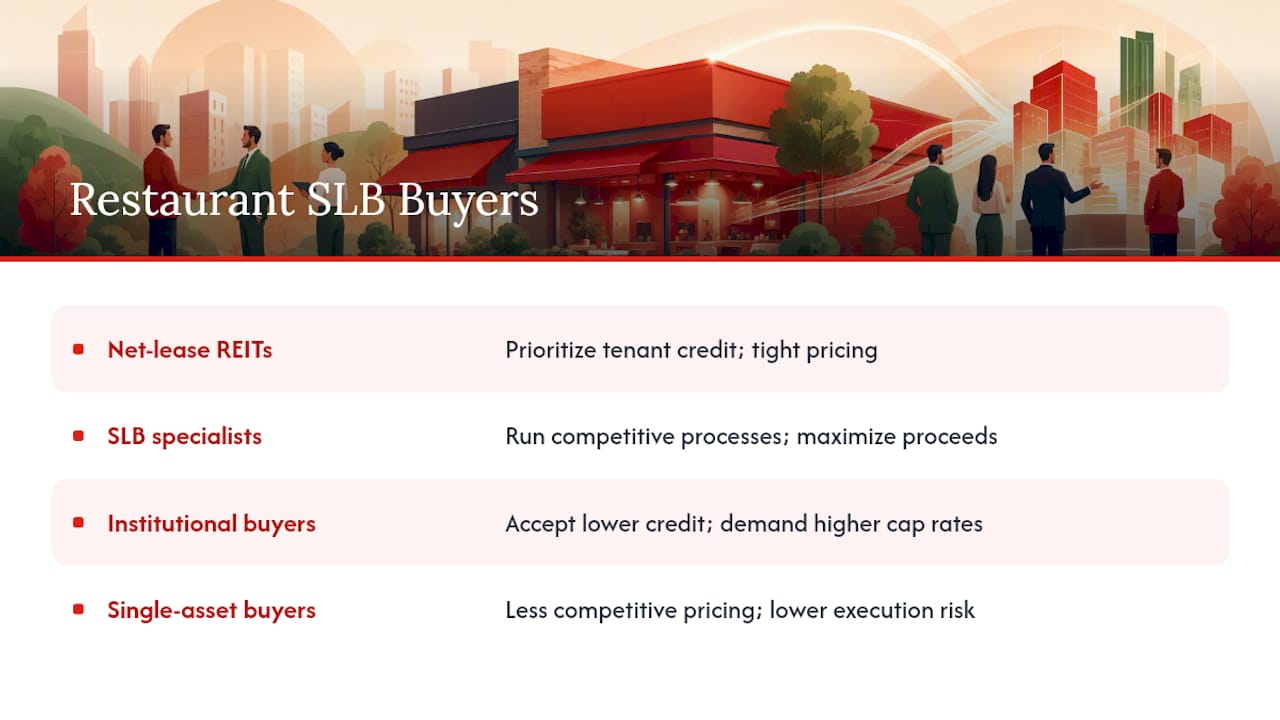
Net-lease REITs are the most active institutional buyers. They prioritize tenant credit quality, portfolio diversification, and lease term length. Essential Properties Realty Trust (EPRT) and National Retail Properties (NNN) are two of the most frequently cited buyers in the restaurant net-lease space. Both trade on the NYSE and deploy capital continuously into single-tenant net-lease assets, including QSR and casual dining properties. Their underwriting is rigorous — investor focus on tenant credit and portfolio cash flow means weak unit economics will either kill a deal or reprice it materially.
Sale-leaseback specialists and advisors occupy a different role. Firms like SLB Capital Advisors and Mesirow Realty Sale-Leaseback act as intermediaries, running competitive processes to maximize seller proceeds and structure favorable lease terms. SLB Capital Advisors has noted continued appetite from both net-lease REITs and private buyers into 2026, with operators using proceeds for technology upgrades, remodels, and growth. ZEL Capital Partners focuses on smaller and mid-market restaurant portfolios, where the REIT market is less competitive and private buyers can move faster.
Institutional private buyers — family offices, private equity real estate funds, and insurance company accounts — often accept slightly lower credit thresholds than REITs but require higher cap rates to compensate. They can close faster and with less documentation friction, which matters when timing is critical.
Single-asset buyers are typically local or regional real estate investors. They are most relevant for operators with one or two properties in strong markets. Pricing is less competitive than a marketed portfolio process, but execution risk is lower.
Practical note on buyer type and negotiation: REIT buyers move methodically and require full diligence packages, but their pricing in a competitive process is often the tightest (lowest cap rate, highest proceeds). Private buyers offer speed and flexibility on lease terms but may price wider. Running a dual-track process — marketing to both simultaneously — is standard practice for portfolios above five properties.
What can operators learn from real U.S. sale-leaseback transactions?
Three transactions illustrate the range of deal size, structure, and strategic rationale operators encounter in practice.
Red Robin: debt reduction through tranched dispositions
Red Robin executed multiple sale-leaseback tranches, including a reported $24 million transaction covering 10 properties, as part of a broader program to reduce leverage and fund operational improvements. The tranched approach allowed the company to manage tax exposure and market timing rather than selling the entire portfolio at once.
Lesson: A tranched SLB program gives operators flexibility to test pricing, manage tax liability across fiscal years, and avoid flooding the market with supply that could widen cap rates on later tranches.
Bob Evans: portfolio scale unlocks institutional pricing
Bob Evans completed a sale-leaseback of 143 restaurant properties generating approximately $197 million in proceeds under a master lease structure with an initial term of roughly 20 years and multiple renewal options. The scale of the portfolio attracted institutional buyers capable of absorbing the full transaction, and the master lease simplified ongoing administration.
Lesson: Portfolio transactions above 50 properties typically attract REIT-level pricing and master lease structures. If you have a large owned portfolio, aggregating properties into a single marketed process almost always produces better economics than selling piecemeal.
Taco Bell and Zaxby’s: smaller portfolios are viable
Smaller operators are not locked out of the market. A seven-property Taco Bell portfolio transacted at approximately $18 million, and a six-property Zaxby’s portfolio at approximately $13.4 million. Both deals demonstrate that mid-market and smaller franchise operators can access institutional SLB capital, particularly through specialist advisors who aggregate buyer interest for smaller pools.
What these examples signal collectively:
- Buyer appetite exists across deal sizes, from single properties to 143-unit portfolios
- Proceeds deployment (debt paydown, growth capex) drives the strategic rationale in every case
- Master lease structures and long initial terms are standard at institutional scale
- The cautionary counterpoint: fixed lease loads from SLBs have contributed to financial distress in other restaurant chains when sales declined, underscoring the need for stress-testing before execution
What are the real risks of a restaurant sale leaseback?
The upside is well-documented. The downside deserves equal attention, because the lease obligation created by an SLB is permanent, fixed and senior to almost every other financial decision you will make at that location.
Core risks to evaluate:
- Fixed-cost burden in downturns: Rent does not flex when same-store sales decline. A 10% revenue drop at a location with a high rent-to-sales ratio can turn a profitable unit into a cash drain. Fixed lease obligations from SLBs can become a heavy burden in downturns and have contributed to distress in restructurings across the restaurant sector.
- Loss of real estate upside: Once sold, you no longer benefit from property appreciation. In high-growth markets, this can be a material opportunity cost over a 20-year lease term.
- Restrictive covenants: Absolute-net leases often include restrictions on subletting, assignment, and change of control. Selling your operating business later may trigger landlord consent requirements or lease termination rights.
- Credit and guaranty exposure: A corporate guarantee on a master lease ties your parent entity’s credit to every location in the portfolio. A single-unit default can trigger cross-default provisions across the entire lease.
- Operational constraints: Maintenance responsibilities under NNN leases fall entirely on the tenant. Capital expenditure for roof, HVAC, and structural repairs remains your cost even though you no longer own the asset.
- Expansion plan impact: Long lease terms with limited assignment rights can complicate future franchise territory sales, brand conversions, or portfolio restructurings.
Red-flag clauses to negotiate out: Absolute-net lease language with no landlord contribution to structural repairs; change-of-control provisions that give the landlord termination rights on a business sale; default remedies that accelerate the entire remaining lease obligation rather than allowing cure periods.
Reviewing restaurant investment risk factors before committing to a long-term lease obligation is a useful pre-transaction discipline, particularly for operators in markets with softening traffic trends.
How do you prepare and execute a sale leaseback? Timeline, advisors, and costs
Execution quality matters as much as pricing. A poorly run process produces a lower purchase price, worse lease terms, and a longer timeline.
Preparation checklist:
- Three years of audited or reviewed financial statements for the operating entity
- Unit-level P&L statements (trailing 12 months minimum, 24 months preferred)
- Property surveys, title reports, and Phase I environmental assessments for each site
- Current rent rolls if any properties carry existing ground leases or subleases
- Appraisals or broker opinions of value for each property
Advisors to engage and their roles:
- SLB advisor / real estate investment banker: Runs the competitive marketing process, structures the lease, and negotiates with buyers. Fee models vary — typically a success fee of 0.5%–1.5% of gross proceeds for mid-market transactions.
- Corporate counsel: Drafts and negotiates the purchase agreement and lease. Expect $50,000–$150,000 in legal fees for a portfolio transaction.
- Tax advisor: Models the gain recognition, depreciation recapture, and installment sale options. This is not optional — the tax liability on a $197 million transaction is material.
- Appraiser (MAI-certified): Provides independent valuation support. Required by most institutional buyers and by GAAP for gain recognition.
Typical timeline from mandate to close:
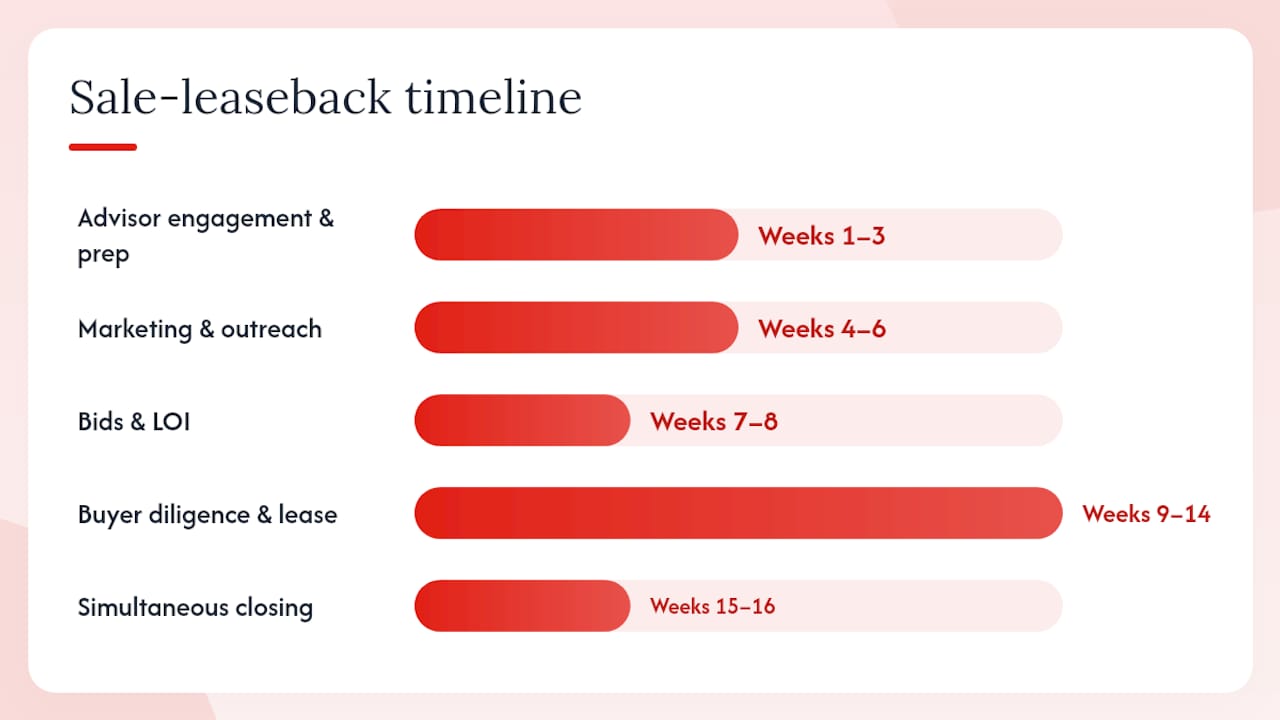
- Weeks 1–3: Advisor engagement, data room preparation, property diligence package assembly
- Weeks 4–6: Marketing process, buyer outreach, initial bids
- Weeks 7–8: Best and final offers, LOI execution with lead buyer
- Weeks 9–14: Buyer diligence, lease negotiation, title and environmental review
- Weeks 15–16: Simultaneous closing
Pro Tip: Run a parallel process with at least three to five buyers. A single-buyer negotiation almost always produces a wider cap rate (lower proceeds) and less favorable lease terms than a competitive bid. Your advisor’s primary value is managing that competitive tension.
Statistic context: SLB Capital Advisors notes that sale-leaseback activity in the restaurant sector is expected to remain solid into 2026, with net-lease REITs and private buyers both actively deploying capital into restaurant portfolios.
What does the current market mean for restaurant SLB pricing?
The rate environment of 2022–2024 created an unusual dynamic that still shapes pricing. Interest rates rose sharply during that cycle, while restaurant net-lease cap rates increased by a smaller amount. That asymmetry means SLB financing remained cost-competitive with bank debt and high-yield notes for many operators — the implied cost of capital embedded in a restaurant SLB was often lower than the marginal cost of new debt.
Current market signals:
- Net-lease REITs including EPRT and NNN remain active acquirers of restaurant real estate, with restaurant portfolios representing a meaningful share of their acquisition pipelines
- Private capital (family offices, insurance accounts) has filled gaps where REIT pricing has been selective, particularly for smaller portfolios and franchisee-level credits
- QSR multiples of 13–15x remain the benchmark for strong credits, with weaker credits pricing wider
- Investor appetite for restaurant real estate is supported by the sector’s long lease terms and the essential-service nature of QSR and fast-casual formats
For operators considering QSR investment dynamics, the same cap-rate compression that benefits SLB sellers also affects how investors price the underlying operating businesses — a connection worth modeling before deciding how to deploy proceeds.
Is a sale leaseback the right move? A decision checklist and alternatives
Before engaging an advisor, run through this checklist to assess fit.
Decision checklist:
- Do you own the fee-simple interest in at least one restaurant property? (Ground leases do not qualify for a standard SLB.)
- Is your operating entity’s credit profile strong enough to support a 15–20-year lease guarantee?
- Are unit-level margins stable enough that the new rent obligation does not create negative cash flow under a stress scenario?
- Do you have a specific, value-accretive use for the proceeds — not just general liquidity?
- Have you modeled the tax liability from gain recognition and confirmed the after-tax proceeds justify the transaction?
- Does your growth plan require capital that is not available at acceptable cost from bank debt or equity?
If you answered “no” to any of the first three, an SLB is likely premature. Address the underlying credit or margin issue first.
Alternatives and when they typically beat an SLB:
- Mortgage refinancing: Lower transaction cost, no lease obligation created, retains real estate upside. Best when you need modest liquidity and have significant equity in the property.
- Asset-backed loan (ABL) or equipment financing: Faster execution, no property sale required. Best for short-term working capital needs.
- Preferred equity: Non-dilutive to common equity, no fixed lease created. Best when the operating business has strong cash flow and the investor accepts a preferred return rather than a lease.
- Partial monetization (ground lease): Sell the land only, retain the building. Preserves some real estate upside and reduces the implied rent obligation. Less common but available in select markets.
For operators evaluating restaurant stock valuation metrics alongside capital structure decisions, the multiple arbitrage argument for SLBs is most compelling when the operating business trades at a significant discount to the real estate’s implied multiple.
The case for doing less, not more, with sale-leaseback proceeds
The conventional advice on restaurant sale leasebacks focuses almost entirely on the upside: unlock capital, fund growth, reduce leverage. That framing is not wrong, but it consistently understates the discipline required on the proceeds side of the transaction.
The operators who have gotten into trouble with SLBs — and there are documented cases across the casual dining segment — did not fail because the transaction was structured badly. They failed because the capital raised was deployed into uses that did not generate returns sufficient to cover the new fixed rent obligation. The lease is permanent. The growth initiative may not be.
The multiple arbitrage argument is real, but it only creates value if the proceeds are reinvested at a return above the implied cost of the lease.
The negotiation advice in this article — competitive processes, renewal options, rent escalation caps — matters, but it is secondary to the capital allocation decision. If the locations stay cash-flow positive, the lease obligation is manageable. If they go negative, you have just converted a flexible balance sheet into a fixed-cost machine at exactly the wrong moment.
The market is active, buyer appetite is real, and the mechanics are well-understood. The question is not whether you can do a sale leaseback. The question is whether the specific use of proceeds justifies a 20-year fixed obligation on every property you sell.
This article is general information, not a substitute for advice from a qualified financial advisor. Consult a qualified financial professional about your own circumstances before acting on anything here.
Sources
External sources used in this article:
- Sale Leaseback Activity in the Restaurant Space
- Why Sale Leasebacks are an Attractive Capital Source for Quick‑Service Owner‑Operators
- Bob Evans Farms Completes Sale‑Leaseback of 143 Restaurant Properties for $197 Million (SEC exhibit)
- How sale leasebacks provide restaurant owners with capital to grow
- Red Robin sells 10 restaurants for $24M in sale‑leaseback deal
Buywendys analysis relevant to operators modeling SLB economics: