
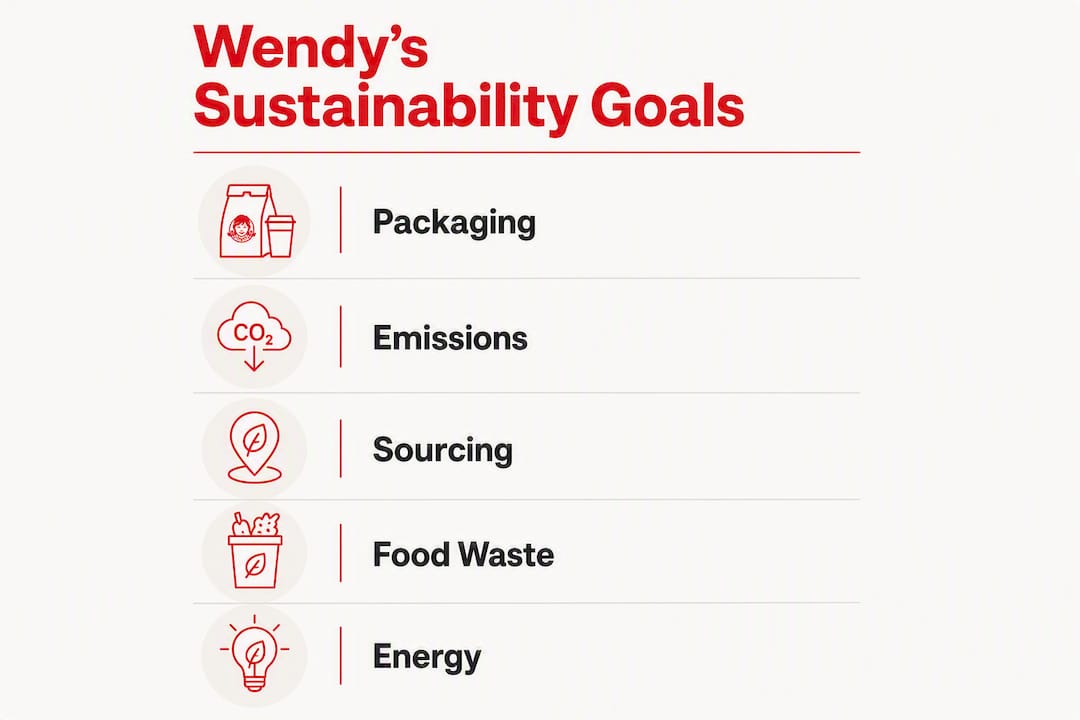
Wendy’s “Good Done Right” strategy organizes its corporate responsibility work into three pillars: Food, People, and Footprint. The Footprint pillar is where Wendy’s sustainability initiatives concentrate, covering packaging, climate, responsible sourcing, energy, and waste. As of the 2025 Corporate Responsibility Report, 77% of customer-facing packaging aligns with the company’s sustainable criteria, energy intensity for company operations has decreased compared to a 2012 baseline, and thousands of restaurants participate in the Wendy’s Energy Challenge.
The program’s core pillars and their primary validators:
- Packaging: aims to sustainably source all customer-facing packaging in the U.S. and Canada by 2026, with NextGen Consortium membership for packaging innovation
- Climate: Scope 1/2 and Scope 3 emissions targets aligned with the Science Based Targets initiative (SBTi), including a FLAG (forest, land and agriculture) target added in 2024
- Responsible sourcing: No-deforestation commitments for beef, fiber, palm oil, and soy; supplier engagement across 20,000+ protein sites
- Energy and operations: Wendy’s Energy Challenge across franchised and company-owned restaurants; corporate-office pilots
- Food waste: 50% food loss and waste reduction target by 2030, supported by AI-driven inventory forecasting through a Palantir partnership
Third-party validators include SBTi for emissions targets, SFI and FSC for fiber packaging, RSPO for palm oil, and How2Recycle for packaging labeling.
Table of Contents
- What are Wendy’s formal sustainability goals and timelines?
- How much progress has Wendy’s actually made?
- How has Wendy’s changed its packaging?
- How does Wendy’s approach sustainable beef and supply-chain sourcing?
- What is Wendy’s doing on energy, waste, and restaurant operations?
- How does Wendy’s verify its sustainability claims?
- What do Wendy’s environmental efforts mean for investors?
- Key Takeaways
- Why Wendy’s sustainability progress deserves careful scrutiny
- Useful sources and where to read more
What are Wendy’s formal sustainability goals and timelines?
Wendy’s has published specific, time-bound commitments across five areas: packaging, emissions, sourcing, food waste, and water. Understanding the scope of each target matters because some apply only to U.S. and Canadian operations while others are global, and some are absolute reductions while others are intensity-based.

Packaging. The headline goal is to sustainably source all customer-facing packaging in the U.S. and Canada by 2026. Wendy’s defines “sustainable” through five criteria: recycled content, material reduction, restricted-substance compliance, recyclability or compostability or reusability, and no-deforestation sourcing.
Emissions. Wendy’s holds SBTi-validated near-term targets for Scope 1 and 2 emissions and Scope 3 emissions. In 2024, the company updated those Scope 3 targets to add a FLAG target, which specifically addresses emissions from forest, land, and agriculture activities. This addition is significant because beef production drives the majority of Wendy’s Scope 3 footprint.
Sourcing. Wendy’s has committed to no deforestation across its highest-risk primary commodities: beef, fiber used in paper packaging, palm oil, and soy. The company targets responsible sourcing of its top-priority food categories by 2030.
Food loss and waste. A 50% reduction in food loss and waste by 2030, aligned with the global Food Loss and Waste Protocol.
Key deadlines at a glance: 2025 deforestation progress milestone for high-risk commodities; 2026 packaging goal; 2030 FLAG/Scope 3 reductions, responsible sourcing, and food-waste targets.
One important distinction: the packaging and energy targets are primarily scoped to U.S. and Canadian company-operated and franchised restaurants, while the SBTi emissions targets cover the global system. Investors and advocates should read each target’s scope carefully before drawing system-wide conclusions from restaurant-level data.
How much progress has Wendy’s actually made?
Wendy’s publishes annual progress reports that allow year-over-year comparison. The table below summarizes the most material metrics from recent reporting periods.
| Metric | Target | Base Year | Current Progress |
|---|---|---|---|
| Customer-facing packaging aligned to sustainable criteria | 100% by 2026 | N/A | 77% |
| Energy intensity reduction (company operations) | Ongoing reduction | 2012 | 17% reduction |
| Restaurants in Wendy’s Energy Challenge | System-wide adoption | N/A | 3,700+ |
| Protein supplier sites evaluated for animal care | Ongoing | N/A | 20,000+ |
| In-scope supplier volume evaluated for sustainability | Ongoing | N/A | 39% |
The packaging figure deserves context. At 77% alignment with 2026 as the deadline, Wendy’s needs to close a 23-percentage-point gap in roughly one reporting cycle. That is achievable if the remaining formats are already in transition, but it is not a certainty. The company’s own reports acknowledge traceability limitations for fiber sourcing and mixed certification levels for palm oil, which are the categories most likely to hold back the final percentage points.
The 39% supplier volume evaluation figure also warrants attention. It means that while Wendy’s has evaluated protein supplier sites numbering in the tens of thousands for animal care standards, less than half of in-scope supplier volume has been assessed against the full sustainability performance framework. Progress on that metric will be a meaningful signal in future reports.
How has Wendy’s changed its packaging?
The packaging program is the most visible element of Wendy’s eco-friendly practices for consumers. The 2026 reporting period confirmed the completion of two specific transitions: clear plastic drink cups that are widely recyclable in the U.S. and Canada are now in all restaurants, and SFI-certified fry cartons and chili cups have been rolled out across both markets. Six packaging formats have achieved SFI certified sourcing, and recycled content has been incorporated into select packaging.
Wendy’s evaluates new packaging against five criteria:
- Recycled content: Preference for post-consumer or post-industrial recycled material
- Material reduction: Lightweighting or right-sizing to reduce total material use
- Restricted substances: Compliance with chemical safety standards
- End-of-life pathway: Recyclable, compostable, or reusable in practice, not just in theory
- No-deforestation sourcing: SFI, FSC, or PEFC certification for fiber; RSPO for palm oil
The practical trade-offs are real. Packaging that performs well for hot, greasy food items tends to require coatings or laminates that complicate recyclability. Wendy’s approach, consistent with its NextGen Consortium membership, is to validate alternatives through phased rollouts and third-party certifications rather than switching materials wholesale and discovering performance failures at scale. How2Recycle labeling on packaging helps consumers identify which items belong in curbside bins versus landfill.
Pro Tip: When you pick up a Wendy’s order, check the How2Recycle label on cups and cartons. The label tells you whether the item is accepted in most curbside programs or requires a drop-off location. You can also verify a specific item’s recyclability at How2Recycle’s website before discarding.
For delivery orders, packaging choices are constrained by the need to maintain food temperature over longer hold times, which is why some delivery-specific formats may lag the in-restaurant rollout on sustainability criteria.
How does Wendy’s approach sustainable beef and supply-chain sourcing?
Beef is Wendy’s most significant sourcing challenge from both a carbon and a land-use perspective. The company’s approach combines procurement commitments with field-level programs, recognizing that purchasing policy alone cannot drive landscape-scale outcomes without direct producer support.
Wendy’s responsible sourcing priorities cover four high-risk commodities:
- Beef: No-deforestation commitment; engagement with the U.S. Roundtable for Sustainable Beef (USRSB) and Canadian Roundtable for Sustainable Beef; participation in the Legacy Landscapes Program (started 2025) and the AgSpire Fresh Resilience Beef Cattle Program to support ranchers on grazing, water quality, and land stewardship
- Palm oil: RSPO certification and traceability actions where certified supply is available
- Fiber (paper packaging): SFI and FSC certified sourcing; no-deforestation sourcing requirement
- Soy: No-deforestation commitment; traceability work in progress
The supplier evaluation program is substantial in scale. Wendy’s has assessed more than 20,000 protein supplier sites against its Animal Care Standards Program, and 39% of in-scope supplier volume has been evaluated for broader sustainability performance metrics. The gap between site-count coverage and volume coverage reflects a common challenge in complex supply chains: large-volume suppliers are easier to engage directly, while the long tail of smaller sites requires more time and resources to assess.
The Legacy Landscapes Program and AgSpire partnership represent a shift from purely procurement-based levers toward on-the-ground producer support. These programs aim to improve grazing practices, water quality, and soil health at the ranch level, which addresses the root causes of land-use emissions rather than just certifying outcomes after the fact. Traceability from ranch to restaurant remains a work in progress across the industry, and Wendy’s reports acknowledge that limitation directly.
What is Wendy’s doing on energy, waste, and restaurant operations?
Energy efficiency is the area where Wendy’s has the most concrete, auditable progress. The a reduction in energy per square foot for company operations versus the 2012 baseline is a meaningful figure because it is intensity-based, meaning it accounts for changes in restaurant count and size. More than 3,700 restaurants now participate in the Wendy’s Energy Challenge, a program that tracks and benchmarks energy consumption across both company-owned and franchised locations.
Key operational sustainability programs include:
- Wendy’s Energy Challenge: — System-wide energy benchmarking and reduction program across 3,700+ restaurants
The Palantir partnership is worth noting for investors tracking QSR profitability metrics: AI-driven inventory forecasting reduces both food waste and food cost simultaneously, which means the sustainability benefit and the margin benefit point in the same direction.
On food waste, Wendy’s 50% reduction target by 2030 is ambitious relative to current industry norms. The Palantir forecasting tool addresses one of the primary drivers of restaurant-level food waste, which is over-ordering and over-preparation. Progress against the 2030 target has not yet been reported in percentage terms, so this remains a watch item for the next reporting cycle.
Renewable energy transition plans are referenced in Wendy’s climate commitments but specific renewable energy sourcing percentages are not publicly listed in current reporting. The SBTi-aligned Scope 1 and 2 targets imply a pathway that will require renewable energy sourcing at scale, particularly for franchised locations, which represent the majority of the system.
How does Wendy’s verify its sustainability claims?
Transparency is the mechanism that separates credible corporate sustainability programs from marketing copy. Wendy’s uses several overlapping verification layers.
Primary reporting assets:
- Annual Corporate Responsibility / Progress Reports (the 2024 and 2025/2026 report PDFs are the primary documents)
- Wendy’s CSR website pages covering footprint, packaging, climate and energy, and nature
- The “Advancing Our Good Done Right Strategy” summary document published alongside the annual report
Third-party validators and frameworks:
- SBTi: Validates Wendy’s near-term Scope 1/2 and Scope 3/FLAG emissions targets against the 1.5°C pathway
- SFI / FSC / PEFC: Fiber packaging certifications confirming responsible forestry sourcing
- RSPO: Palm oil certification and traceability standard
- How2Recycle: Packaging labeling program that independently verifies recyclability claims
- NextGen Consortium (Closed Loop Partners): Industry collaboration on packaging innovation and recyclability infrastructure
How to verify Wendy’s claims yourself:
- Download the most recent Corporate Responsibility Report PDF from Wendy’s CSR pages and locate the specific metric in the data appendix, not just the narrative section.
- Cross-reference packaging certification claims against SFI’s and FSC’s public certificate databases, which list certified suppliers by name.
- Check SBTi’s public target dashboard to confirm Wendy’s targets are listed as validated and note the validation date.
- For RSPO, verify Wendy’s membership and sourcing model (certified, mass balance, or book-and-claim) on RSPO’s public member database.
- For the Energy Challenge, note that restaurant-level energy data is aggregated; individual restaurant performance is not publicly disclosed.
Common data gaps to watch for: fiber traceability below the mill level, soy traceability in complex supply chains, and the distinction between “certified sourcing” (a chain-of-custody standard) and “certified volume” (actual certified material in the product). Wendy’s reports are generally transparent about these limitations, which is itself a positive signal.
What do Wendy’s environmental efforts mean for investors?
Wendy’s sustainability progress translates into investor-relevant risk and opportunity across three dimensions: supply-chain resilience, operating cost, and ESG scoring.
Improved supplier evaluation coverage and no-deforestation commitments reduce exposure to commodity shocks driven by land-use regulation, deforestation-linked trade restrictions, and reputational events tied to specific sourcing regions. The 39% supplier volume evaluation figure means that exposure is not yet fully mapped, but the trajectory is toward greater visibility. Investors tracking Wendy’s quarterly earnings should note that commodity cost volatility is one of the primary margin risks in the QSR model, and traceability investments are a partial hedge against that risk.
On operating cost, the energy efficiency program has a direct OPEX benefit. A 17% reduction in energy intensity since 2012 across company operations represents real cost avoidance, and the Energy Challenge extends that logic to franchised locations, which affects franchisee unit economics and, by extension, royalty revenue stability.
Investor checklist for monitoring Wendy’s sustainability progress:
- Packaging alignment percentage: Watch for movement from 77% toward 100% in the 2026 reporting cycle. A stall below 90% would signal supply-chain or performance constraints.
- FLAG/Scope 3 progress: The 2024 addition of a FLAG target is the most material new commitment. Look for baseline disclosure and first-year progress in the next annual report.
- Supplier evaluation coverage: Track whether the 39% in-scope volume figure increases meaningfully, particularly for beef suppliers.
- Food waste reduction: The 2030 target has no interim percentage reported yet; the first quantified progress disclosure will be a key data point.
- SBTi validation status: Confirm targets remain listed as validated on SBTi’s public dashboard after any target updates.
Pro Tip: For land-intensive food companies, the metrics most correlated with long-term operational risk are Scope 3/FLAG emissions progress and supplier traceability coverage, not Scope 1/2 reductions. Scope 1/2 is largely within direct corporate control; Scope 3 and supply-chain traceability expose the business to regulatory and reputational risks it cannot manage unilaterally. Prioritize those figures when reading Wendy’s ESG disclosures.
For a deeper view of how sustainability metrics fit into the broader financial picture, Buywendys’s analysis of Wendy’s investor presentation covers how corporate disclosures translate into the metrics that institutional investors track.
Key Takeaways
Wendy’s “Good Done Right” strategy has produced measurable progress on packaging and energy, but supply-chain traceability and food-waste reduction remain the critical gaps that will define the program’s credibility through 2030.
| Point | Details |
|---|---|
| Packaging at 77%, target 100% by 2026 | Wendy’s must close a 23-point gap in one reporting cycle; SFI-certified fry cartons and clear recyclable cups are already complete. |
| Energy intensity down 17% since 2012 | More than 3,700 restaurants participate in the Energy Challenge, extending efficiency gains across the franchised system. |
| Supplier evaluation at 39% of in-scope volume | Over 20,000 protein sites assessed for animal care, but less than half of in-scope volume has been evaluated for full sustainability metrics. |
| SBTi validates emissions targets including FLAG | The 2024 addition of a FLAG target covers forest, land, and agriculture emissions, the largest share of Wendy’s Scope 3 footprint. |
| Verify claims through primary sources | Annual report PDFs, SBTi’s public dashboard, and SFI/FSC certificate databases allow independent verification of key metrics. |
Why Wendy’s sustainability progress deserves careful scrutiny
The narrative around fast food sustainability tends to split into two camps: uncritical celebration of incremental progress and blanket dismissal of corporate ESG programs as marketing. Neither position serves consumers, advocates, or investors particularly well.
What the data actually shows is a company that has made genuine, verifiable progress on the metrics it controls most directly: packaging certification and energy intensity. Both have third-party validation mechanisms, and both show consistent improvement over multi-year baselines. That is not nothing in a system of roughly 7,000 restaurants operating under a predominantly franchised model, where corporate mandates require franchisee buy-in to translate into system-wide outcomes.
The harder question is whether the supply-chain commitments will hold up. The 39% supplier volume evaluation figure and the acknowledged traceability gaps for fiber and soy suggest that Wendy’s visibility into its own supply chain is still incomplete. The FLAG target addition in 2024 is the right move, but it is also the beginning of a multi-year process, not a solved problem. Investors and advocates who want to hold the company accountable should focus less on the packaging headline and more on whether Scope 3/FLAG progress gets quantified in the next two annual reports.
The Palantir partnership for inventory forecasting is an underappreciated detail. Reducing food waste through predictive analytics is one of the few sustainability levers that simultaneously improves margin, which means franchisee adoption is more likely than for programs that impose costs without financial return. That alignment of incentives is what makes it a more durable intervention than a voluntary recycling program.
The program’s framing as “continuous improvement” rather than a fixed endpoint is both honest and strategically useful. It sets expectations appropriately while preserving flexibility to update targets as science and supply-chain conditions evolve. The SBTi validation gives that flexibility a credible constraint.
Useful sources and where to read more
The sources below are the primary documents for verifying Wendy’s sustainability claims. Each serves a slightly different audience need.
- Wendy’s 2025 Corporate Responsibility Report (PDF): The most current full report; best starting point for consumers and sustainability advocates who want the complete data appendix and year-over-year comparisons.
- Advancing Our Good Done Right Strategy (PDF): A summary document covering 2025/2026 progress; useful for investors who want a faster read of headline metrics and program updates.
- Wendy’s 2024 Corporate Responsibility Report (PDF): The prior-year report; essential for tracking year-over-year progress and understanding the context for the 2024 FLAG target addition.
- Wendy’s CSR landing page: The central hub for all corporate responsibility topics; best entry point for readers who want to navigate to specific pillars (Food, People, Footprint).
- Sustainable packaging page: Detailed breakdown of packaging criteria, format-by-format progress, and NextGen Consortium membership; most useful for sustainability advocates focused on packaging specifically.
- Nature page: Covers no-deforestation commitments, commodity-level sourcing actions, and partnership programs including Legacy Landscapes and USRSB; best for supply-chain and land-use focused readers.
- Corporate office sustainability initiatives: Energy intensity data, Energy Challenge participation figures, and corporate-office pilot programs; most relevant for investors tracking operational efficiency metrics.
For investors who want to connect Wendy’s sustainability disclosures to financial analysis, Buywendys covers the best platforms for Wendy’s stock data and provides ongoing coverage of operational and ESG developments as they appear in quarterly and annual disclosures.
Recommended
- Wendy’s Investor Presentation Explained: Page-by-Page Analysis for WEN Stock Investors – Buy Wendy’s
- Wendy’s Investor FAQ Reviewed: What WEN Stock Investors Should Know – Buy Wendy’s
- Wendy’s New Leadership Team: Robert Wright, Steve Cirulis, and the Turnaround Plan for WEN Stock – Buy Wendy’s
- Wendy’s Stock Fundamental Analysis Report 2026