Drive-thru AI adoption has crossed the production threshold at major quick-service restaurant chains, and the competitive gap between early adopters and laggards is widening. Voice AI in drive-thru services has moved from controlled pilots to enterprise-scale rollouts, with Taco Bell, Wendy’s, and McDonald’s all operating systems across hundreds of locations. The core metrics that determine whether a deployment creates real value are containment rate (the share of orders completed without human intervention) and remake rate, not raw accuracy scores.
- Operators should prioritize a structured 60–90 day single-lane pilot with containment and remake rate as primary KPIs before committing capital to a chain-wide rollout.
- Investors should track disclosure language in quarterly filings for containment percentages, pilot-to-scale ratios, and any mention of labor reallocation tied to AI throughput gains.
Table of Contents
- Where is drive-thru AI adoption right now?
- How do production voice-AI systems actually work?
- What ROI levers should operators and investors model?
- Where does drive-thru AI break, and what are the real risk vectors?
- How should operators structure a pilot and select a vendor?
- Which vendors lead, and what do the case studies show?
- What does the adoption trajectory look like through late 2026?
- What should investors and operators monitor in filings and dashboards?
- Wendy’s FreshAI: what the economics mean for franchise investors
- Key Takeaways
- The competitive window is narrower than most models assume
- Useful sources for further research
Where is drive-thru AI adoption right now?
Voice AI reached a significant share of U.S. restaurants by 2025, according to industry reporting, and the pace of enterprise rollouts accelerated through the first half of 2026. The following table maps the major chains by deployment status:
| Chain | Status | Deployment Scale | Vendor |
|---|---|---|---|
| Taco Bell | Production | hundreds of U.S. restaurants across multiple states | Omilia |
| Wendy’s | Production / expanding | Numerous locations | FreshAI |
| McDonald’s | Pilot / expanding | Hundreds of locations (ArchIQ) | ArchIQ |
| Dairy Queen | Pilot | Dozens of U.S./Canada locations | Presto |
| Yum Brands (system) | Production | Multi-million AI orders processed | Omilia (Taco Bell) |
Taco Bell’s rollout is the largest publicly confirmed deployment, with Omilia-powered voice AI now operating across more than 890 restaurants in 38 states. Operator statements from that rollout cite measurable improvements in order accuracy and employee retention, two metrics that matter differently to operators versus investors. McDonald’s ArchIQ system is processing drive-thru orders at 500+ locations, with reported pilot data showing roughly 90% order accuracy. Yum Brands has publicly noted that its Taco Bell AI systems have handled millions of orders, a scale that generates the training data needed for continuous model improvement.
How do production voice-AI systems actually work?
The technology stack in a production drive-thru AI system follows a defined sequence. A customer speaks into a lane-mounted microphone array; edge hardware captures the audio and filters ambient noise from traffic, kitchen equipment, and adjacent lanes. That audio passes to an automatic speech recognition (ASR) layer, which converts speech to text. A natural language processing (NLP) engine then extracts intent and entities, mapping the spoken order to specific menu items, modifiers, and quantities. The assembled order pushes to the point-of-sale (POS) system and kitchen display system (KDS) simultaneously, and the AI reads back a confirmation to the customer.
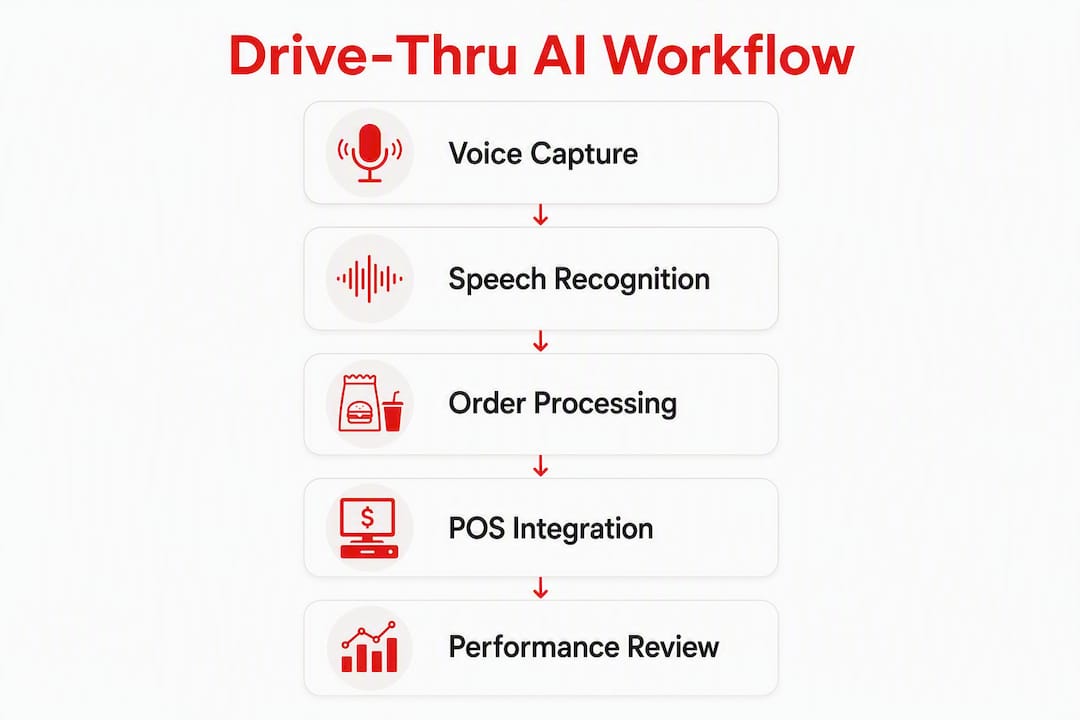
The critical concept here is containment: the percentage of orders the system completes from greeting to POS submission without a human employee intervening. Analysts note that accuracy matters less than containment because a system that achieves 90% word-level accuracy but still requires staff intervention on 40% of orders delivers minimal labor reallocation. High containment, typically above 85%, is the threshold at which meaningful labor recovery becomes possible.
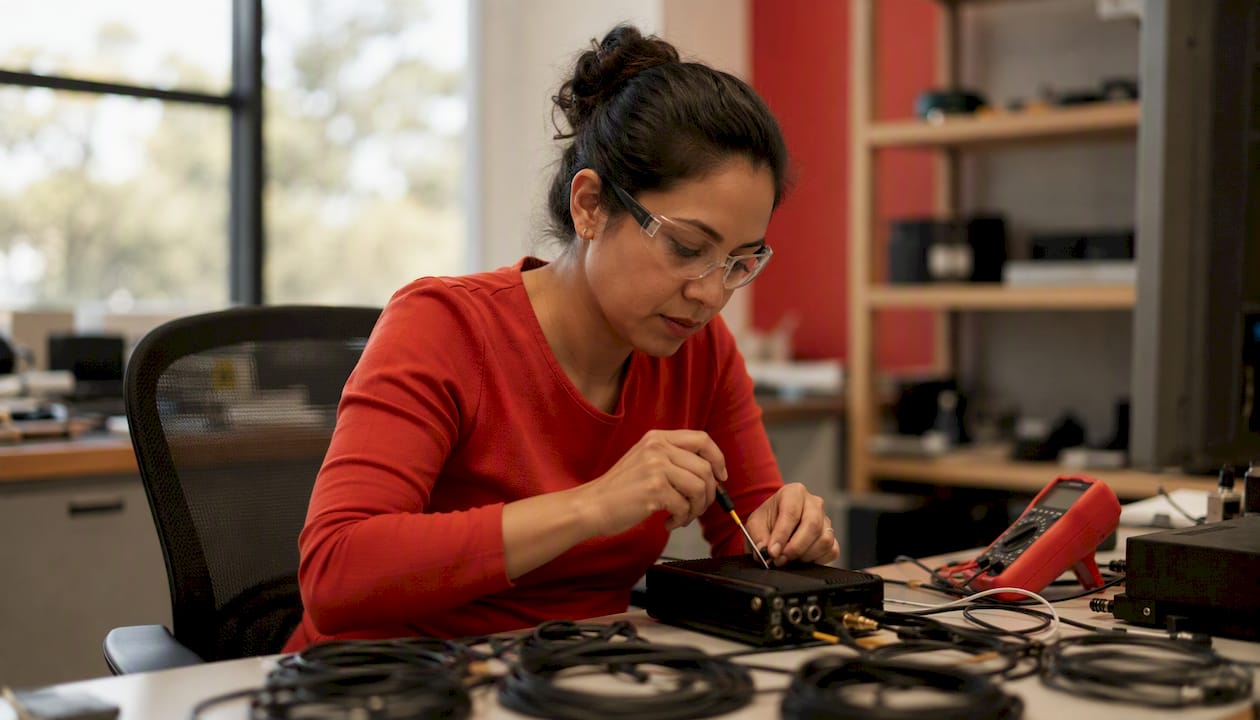
Technical guidance from production deployments shows that starting with purpose-built edge audio hardware and collecting real-lane transcripts for weekly retraining can move word error rates from the low 70s to the mid-90s in vendor-reported examples. General-purpose speech APIs consistently underperform in drive-thru environments because they are not trained on the specific noise profiles, menu vocabularies, and multi-speaker patterns found in a fast-food lane.
Pro Tip: During any pilot, tag every human-intervention event with a failure reason (misrecognition, complex modifier, ambient noise, customer repeat) and every remake with the originating order ID. That transcript-to-remake linkage is the fastest path to identifying which model updates will move containment.
What ROI levers should operators and investors model?
The financial case for drive-thru automation technology rests on four measurable channels:
- Labor hours recovered: High-containment systems allow one employee to monitor multiple lanes rather than staff each lane individually, reducing labor cost per transaction.
- Throughput improvement: Voice-automated systems reduce ordering time, with McDonald’s ArchIQ pilots reporting an average service time reduction of approximately 18 seconds per car across 500+ locations.
- Average order value (AOV) uplift: Vendor claims in the industry cite a 4–5% average ticket increase attributable to consistent AI-driven upsell prompts, which do not fatigue or skip the upsell the way human staff sometimes do.
- Operational consistency and analytics: Every AI-handled order generates structured data on item combinations, modifier frequency, and time-of-day demand patterns, feeding menu engineering and inventory decisions.
The economics compound at scale. A single-location deployment may show marginal ROI if containment sits at 70–75%, but the same system at 88–90% containment across 50 locations generates enough labor reallocation to materially shift unit economics. Remake cost is the primary sensitivity: industry operator analysis identifies remake expenses as a core ROI risk that can offset labor savings if accuracy degrades. Investors modeling this should treat containment rate and remake rate as paired inputs, not independent variables.
Where does drive-thru AI break, and what are the real risk vectors?
Production deployments reveal consistent failure patterns that operators and analysts should track. Complex custom orders with multiple modifiers, group orders placed by a single speaker, and heavy regional accents or non-standard phrasing all degrade containment. Ambient noise spikes from passing trucks or adjacent lane crosstalk cause misrecognition events that the system may not flag before pushing an incorrect order to the KDS.
Viral incidents from early Taco Bell deployments illustrated a specific risk: customers discovered they could manipulate AI upsell logic by repeating certain phrases, generating unintended order additions. These incidents, widely reported in technology media, highlight that upsell logic requires guardrails, not just accuracy thresholds. An AI that upsells aggressively but incorrectly inflates AOV figures in the short term while generating remakes and customer complaints that erode brand trust.
Privacy and consent represent a regulatory exposure that is still developing. Audio capture in a drive-thru lane may implicate state-level biometric and voice data laws, particularly in Illinois (BIPA), Texas, and Washington. Operators should confirm that their vendor’s data retention and processing agreements are compliant with applicable state statutes before deployment, and that customer-facing disclosures meet local requirements.
How should operators structure a pilot and select a vendor?
A disciplined deployment process reduces the risk of committing capital to a system that performs well in a demo environment but degrades in a live lane.
- Define the pilot scope. Run a single lane during a single daypart (lunch or dinner) for a baseline period before expanding. A 60–90 day window is the standard practitioner recommendation for building a statistically meaningful containment and remake baseline.
- Audit audio infrastructure first. Confirm that lane microphones, speaker systems, and edge processing hardware meet the vendor’s specifications. Purpose-built drive-thru audio hardware is not optional; retrofitting consumer-grade equipment is the single most common cause of underperformance in early pilots.
- Establish POS and KDS integration requirements. Confirm that the AI system can write directly to your POS without a manual confirmation step, and that KDS routing logic handles AI-originated tickets identically to human-originated ones.
- Require vendor transparency on containment reporting. Ask specifically: How is containment calculated? Does a partial human assist count as a containment failure? What is the update cadence for menu changes and LTO items?
- Negotiate fallback behavior contractually. Define what happens when the system cannot achieve containment: does it transfer to a human employee seamlessly, or does it loop, creating customer friction?
- Address privacy compliance before go-live. Require the vendor to provide a data processing agreement that specifies audio retention periods, anonymization practices, and compliance with applicable state biometric laws.
Franchise dynamics add a layer of complexity that corporate operators sometimes underestimate. Franchisees bear the capital cost of hardware installation and may face different ROI timelines than company-owned locations. Pilot programs that demonstrate positive unit economics at the franchisee level, not just the system level, are more likely to achieve rapid network adoption.
Which vendors lead, and what do the case studies show?
| Vendor | Primary Customer | Deployment Scale | Primary Use Case | Reported Accuracy / Containment | Known Incidents |
|---|---|---|---|---|---|
| Omilia | Taco Bell | more than 890 U.S. restaurants | Voice ordering, menu/inventory sync | Operator-cited accuracy improvements | Viral upsell manipulation incidents |
| FreshAI | Wendy’s | Hundreds of locations | Voice ordering, upsell | Not publicly disclosed at system level | Limited public incident reporting |
| ArchIQ | McDonald’s | 500+ locations (pilot/expanding) | Voice ordering | ~90% order accuracy | Early pilot limitations noted |
| Presto | Dairy Queen | Dozens of locations | Voice ordering, upsell | Not publicly disclosed | Deployment in early stages |
Omilia / Taco Bell: The most publicly documented rollout in the U.S. QSR sector. Taco Bell’s expansion to hundreds of restaurants across multiple states makes it the reference deployment for enterprise-scale voice AI. Omilia’s system handles slang, adapts to menu updates, and syncs with inventory, which addresses one of the most common failure modes in earlier-generation systems: ordering items that are unavailable. Operator statements cite employee retention improvements alongside accuracy gains, suggesting that labor redeployment is occurring in practice, not just in projections.
FreshAI / Wendy’s: Wendy’s FreshAI deployment has processed orders across hundreds of locations and is the subject of detailed investor-facing analysis at Buywendys. The system’s persistence through the period when McDonald’s paused its own AI drive-thru program is a meaningful competitive signal. FreshAI’s integration with Wendy’s franchise economics is covered in depth in the case study section below.

ArchIQ / McDonald’s: McDonald’s is testing ArchIQ at hundreds of locations with reported high order accuracy and a service time reduction in pilot data. The scale of McDonald’s network means even a partial rollout represents a significant market signal. Bloomberg reported that McDonald’s continues testing AI drive-thru technology alongside other menu and operational initiatives in 2026.
Some vendors claim accuracy rates approaching or exceeding 95%, with ticket uplift in the 4–5% range. Analysts should treat vendor-reported accuracy figures with appropriate skepticism until containment methodology is disclosed.
What does the adoption trajectory look like through late 2026?
- Q3 2026: Enterprise chains complete or announce major network expansions. Taco Bell’s 890+ location footprint sets a new baseline expectation for what “at scale” means in voice AI drive-thru.
- Q3–Q4 2026: Accuracy and containment improvements accelerate as training datasets from millions of real orders feed model updates. Yum Brands has already processed multi-million AI-handled orders, generating the data volume needed for meaningful model refinement.
- Late 2026: Pricing compression begins as competition among vendors increases. Mid-market and regional chains that were priced out of enterprise-tier deployments in 2024–2025 begin receiving commercially viable proposals.
- 2026–2027 transition: Independent operators and smaller franchise groups start structured pilots. The containment threshold at which human reallocation becomes economically realistic, generally above 85%, becomes achievable for a broader set of deployments as model quality improves.
The National Restaurant Association’s technology data confirms that tech integration is a primary operational priority across the restaurant sector, providing institutional tailwind for continued capital allocation toward drive-thru automation.
What should investors and operators monitor in filings and dashboards?
For investors tracking QSR earnings disclosures:
- Watch for containment rate language in earnings calls and investor presentations. Chains that disclose specific containment percentages are signaling operational maturity; vague references to “AI-assisted ordering” without metrics warrant follow-up questions.
- Track the pilot-to-scale ratio: how many locations are in active pilots versus full production? A high pilot count with slow conversion to production often indicates unresolved accuracy or integration issues.
- Monitor capital expenditure line items for technology infrastructure. A meaningful increase in per-location capex without a corresponding labor cost reduction in subsequent quarters is a red flag.
- AOV uplift figures that appear disproportionately large relative to containment rates may indicate that the system is generating upsell additions that customers subsequently reject or that result in remakes.
For operators managing performance dashboards:
- Track containment rate, remake rate, and AOV uplift as a triad, not individually. A rising AOV with a rising remake rate suggests the upsell logic is misfiring.
- Segment containment by daypart and lane. Night-shift performance often differs from lunch-peak performance due to different order complexity and staffing levels.
- Review QSR profitability metrics alongside AI performance data to confirm that throughput gains are translating to measurable margin improvement at the unit level.
Wendy’s FreshAI: what the economics mean for franchise investors
Wendy’s FreshAI deployment is the most investor-relevant case study in the U.S. drive-thru AI space for one specific reason: Wendy’s is a predominantly franchised system, which means the economics of AI adoption flow through franchise unit margins, royalty revenue, and system-wide same-store sales rather than through company-owned store P&Ls. Buywendys’s analysis of FreshAI’s franchise economics provides the most detailed public modeling of this relationship.
The table below illustrates how containment rate sensitivity affects the net economic benefit at the franchise unit level. These are illustrative sensitivity bands, not disclosed Wendy’s figures.
| Containment Rate | Labor Hours Recovered (per week, per lane) | Remake Cost Offset Risk | Net Benefit Direction |
|---|---|---|---|
| Below 75% | Minimal | High | Negative to neutral |
| 75% | Moderate | Moderate | Neutral to marginally positive |
| 85% | Meaningful | Low to moderate | Positive |
| Above 90% | Significant | Low | Strongly positive |
FreshAI’s persistence as Wendy’s primary drive-thru AI platform, through a period when a major competitor paused its own program, is a signal that the system has cleared the operational threshold needed for franchise-level adoption. The investor case for WEN stock incorporates FreshAI’s potential to improve franchisee unit economics, which in turn supports royalty revenue stability and system-wide same-store sales growth. Investors modeling Wendy’s should test containment rate assumptions as a key variable, alongside AOV uplift and remake cost per incident, when projecting the technology’s contribution to EBITDA.
Key Takeaways
Drive-thru AI adoption is production-ready at enterprise scale, with containment rate and remake cost as the two variables that determine whether a deployment creates or destroys unit-level value.
| Point | Details |
|---|---|
| Containment drives ROI | Systems above 85% containment enable meaningful labor reallocation; below that threshold, savings are marginal. |
| Taco Bell sets the scale benchmark | Omilia-powered voice AI operates across more than 890 U.S. restaurants, the largest confirmed enterprise deployment. |
| Remake rate is the hidden risk | Rising remakes can offset labor savings; track remake rate at the order-ID level alongside containment. |
| Wendy’s FreshAI is franchise-relevant | FreshAI’s economics flow through franchisee margins and royalty revenue, making containment a direct WEN valuation input. |
| Investors should demand metric disclosure | Containment percentages in earnings disclosures signal operational maturity; vague AI references without metrics warrant scrutiny. |
The competitive window is narrower than most models assume
The conventional framing around drive-thru AI treats adoption as a long, gradual curve where laggards have years to catch up. That framing is probably wrong, and the Taco Bell deployment is the clearest evidence. When a single chain crosses 890 locations with a production system, it begins accumulating training data at a rate that smaller or slower adopters cannot replicate quickly. The model improves faster because it sees more orders, more edge cases, and more regional variation. That compounding data advantage is not visible in a single quarter’s earnings disclosure, but it is real and it widens with time.
For investors, the implication is that the valuation premium for early adopters should be modeled as a durable competitive advantage, not a temporary cost reduction. For operators, the implication is that a 2027 pilot timeline is not equivalent to a 2025 pilot timeline, even if the hardware and software costs are similar. The system a late adopter deploys in 2027 will be technically superior, but the data moat of a chain that has been running production AI since 2024 will be difficult to close.
Wendy’s position in this dynamic is worth specific attention. FreshAI’s survival through the period when McDonald’s paused its program suggests that Wendy’s has resolved the core operational challenges that caused larger chains to hesitate. That operational learning, combined with the franchise economics analysis available through Buywendys’s research on WEN, positions Wendy’s as a case study in how a mid-scale QSR can use AI adoption to punch above its weight in competitive positioning.
Useful sources for further research
The sources below are organized by primary audience. Operations teams will find the technical and deployment-focused sources most useful; investors and analysts should prioritize the financial and market-scale sources.
For operations teams and technology practitioners: The Deepgram voice-automated drive-thru explainer provides the clearest technical breakdown of ASR, NLP, and containment measurement methodology. The Food on Demand Taco Bell coverage offers the most detailed public operator account of a large-scale deployment.
- Voice-Automated Drive-Thru: How AI Speech Recognition Transforms QSR Operations — technical stack, containment concept, audio hardware guidance
- Taco Bell Expands Voice AI to Nearly 900 Restaurants — enterprise deployment scale, Omilia capabilities, operator quotes
- The Next Wave of AI Drive-Thrus — vendor accuracy claims, AOV uplift data, investor context
- Dairy Queen AI Drive-Thru — mid-market chain adoption signal
- Taco Bell AI Drive-Thru Trolls and Glitches — failure mode documentation, upsell manipulation incidents
- McDonald’s AI Drive-Thru Testing — ArchIQ pilot background and early testing context