
Fidelity leads the field for most U.S. dividend investors, with Charles Schwab and Interactive Brokers close behind for ETF-focused and globally oriented portfolios, respectively. For Wendy’s (WEN) holders specifically, the broker you choose determines how precisely your quarterly dividend gets reinvested, how quickly you can screen for payout-ratio deterioration, and how cleanly your 1099-DIV arrives at tax time.
- Fidelity — Fractional-share DRIP executes on payment date; deep dividend screener with income calendar; best for serious WEN stock pickers.
- Charles Schwab — Full DRIP coverage across ETFs and individual stocks; strong dividend-growth ETF lineup; suits investors pairing WEN with index exposure.
- Interactive Brokers — Institutional research tools and access to 170+ global markets; best for dividend hunters who hold ADRs alongside domestic payers.
- Vanguard — Lowest expense ratios in the fund space; ideal for buy-and-hold investors anchoring a dividend portfolio in low-cost ETFs.
- M1 Finance — Automated pie-based rebalancing delivers DRIP-like compounding without active trading decisions.
- Robinhood — Mobile-first, zero-commission fractional reinvestment; best entry point for newer investors building a first dividend position.
All six brokers carry SIPC protection up to $500,000, offer $0 commissions on online U.S. stock and ETF trades, and issue 1099-DIV forms as standard. Since zero-commission trading is now universal among major U.S. platforms, the real differentiators are DRIP precision, screener depth, and tax-lot integration.
Table of Contents
- How these brokers compare for dividend investors
- Which brokers handle dividend investing questions most effectively?
- How liquidity and execution speed affect dividend stock trades
- Buywendys research complements your broker’s execution tools
- Key Takeaways
How these brokers compare for dividend investors
Brokers were evaluated on six weighted criteria: DRIP precision and fractional-share mechanics, dividend screener and income calendar quality, research depth (payout ratio, FCF coverage, multi-year growth history), tax and reporting features (1099-DIV, tax-lot accounting), account type coverage, and global market access. Fees and platform usability were secondary factors given the zero-commission baseline.
| Broker | Best for | DRIP / Fractional shares | Dividend screener & income calendar | Research depth | Tax / 1099-DIV | Account types | Global access |
|---|---|---|---|---|---|---|---|
| Fidelity | Serious dividend stock pickers | Immediate fractional reinvestment on payment date | Strong screener + income calendar | Payout ratio, FCF, multi-year growth | Tax-lot accounting; clean 1099-DIV | Taxable, Traditional IRA, Roth IRA | Limited |
| Charles Schwab | Dividend ETF investors | Full DRIP; fractional on ETFs | Good screener; income calendar available | Solid fundamentals; dividend-growth ETF data | Tax-lot; 1099-DIV | Taxable, Traditional IRA, Roth IRA | Moderate |
| Vanguard | Low-cost fund investors | DRIP on funds and ETFs | Basic screener | Fund-level dividend data | Standard 1099-DIV | Taxable, Traditional IRA, Roth IRA | Limited |
| Interactive Brokers | Global dividend hunters | Fractional DRIP; threshold may apply on some tiers | Advanced screener; income analytics | Institutional-grade; payout ratio, FCF | Detailed tax-lot; 1099-DIV | Taxable, Traditional IRA, Roth IRA | 170+ markets |
| M1 Finance | Hands-off automated investors | Pie rebalancing acts as DRIP substitute | Limited screener | Basic | Standard 1099-DIV | Taxable, Traditional IRA, Roth IRA | None |
| Robinhood | Beginners; mobile-first | Fractional DRIP; simple toggle | Minimal screener | Limited | Standard 1099-DIV | Taxable, Roth IRA | None |
Fidelity reinvests fractional shares immediately on payment date, avoiding the cash-accumulation lag that reduces compounding efficiency at some competing platforms. Its income calendar surfaces WEN’s ex-dividend dates clearly, which matters when you are timing purchases around record dates.

Charles Schwab pairs full DRIP coverage with a broad dividend-growth ETF lineup, making it practical for investors who hold WEN alongside funds like SCHD. The screener handles multi-year dividend growth history, though it is less granular than Fidelity’s on single-stock payout-ratio analysis.
Interactive Brokers stands out for investors who hold international dividend payers alongside WEN. Its commission structure runs $0.005 per share for active trader tiers, which is worth noting for high-volume accounts, though occasional traders access $0 commissions. The research depth, including FCF screening and institutional data feeds, is the strongest of the six platforms.
Vanguard is the right choice when expense-ratio minimization outweighs screener sophistication. Its DRIP works cleanly across its own fund lineup, but single-stock dividend research tools are thin compared to Fidelity or Schwab.
M1 Finance does not offer a traditional DRIP toggle; instead, incoming dividends flow into the portfolio’s pie allocation and rebalance fractionally. For a WEN-heavy portfolio, that means dividends may partially fund other positions rather than buying more WEN shares directly. Useful for passive investors; less precise for single-stock compounding.
Robinhood keeps the experience simple: one toggle activates fractional reinvestment across eligible positions. Screener capability is minimal, and research depth does not extend to payout-ratio or FCF analysis. Appropriate for investors who rely on external research tools and want a clean mobile execution layer.
Methodology note: Ecosystem quality (screener depth, income calendar accuracy, tax-lot integration) was weighted more heavily than headline commission rates, because commissions are effectively zero across all six platforms. DRIP precision, specifically whether reinvestment occurs immediately in fractional shares or accumulates to a threshold, was the single highest-weighted criterion, given its direct impact on long-term compounding.
Pro Tip: For WEN specifically, use your broker’s income calendar to flag the ex-dividend date at least two business days in advance. Purchasing shares after the ex-dividend date means you miss that quarter’s payout entirely.
Pro Tip: In a taxable account, each DRIP purchase creates a new tax lot with its own cost basis. Brokers with tax-lot accounting (Fidelity, Schwab, Interactive Brokers) make it far easier to apply specific-lot identification when you eventually sell, which can reduce your realized capital gains.
Investors who want dividend-safety scores and forward income projections beyond what any broker’s native screener provides should consider pairing their brokerage account with a specialized service. Broker screeners surface payout ratios and yield history, but forward-looking FCF coverage models and dividend-cut probability scores typically require a dedicated analytics layer. Screening for payout history and FCF coverage rather than headline yield alone is the standard practice for avoiding dividend traps.
Broker-based DRIPs also handle reinvestments across multiple holdings in one account without per-purchase fees, which gives them a structural advantage over company-run direct stock purchase plans (DSPPs) for diversified portfolios. If you are wondering whether Wendy’s offers its own DRIP, the WEN DRIP mechanics differ meaningfully from broker-based reinvestment, and the broker route is generally simpler for multi-holding accounts.
Which brokers handle dividend investing questions most effectively?
Customer service quality varies significantly across these six platforms when the question involves dividend mechanics rather than basic account issues. Fidelity and Charles Schwab both offer 24/7 phone support with representatives who can address DRIP configuration, tax-lot selection, and 1099-DIV discrepancies. Interactive Brokers provides strong support for institutional-level queries, including ADR withholding tax questions relevant to international dividend positions, though its interface can require more navigation for less experienced investors. Vanguard’s support is competent for fund-related dividend questions but less responsive on single-stock DRIP issues. M1 Finance and Robinhood rely more heavily on in-app help centers and email-based support, which can extend resolution times for nuanced dividend accounting questions. For investors actively managing a WEN position through earnings cycles and quarterly dividend events, a broker with accessible phone support is worth prioritizing.
How liquidity and execution speed affect dividend stock trades
For dividend investors holding WEN, liquidity and execution speed matter most at two specific moments: purchasing shares before an ex-dividend date and executing large block trades without moving the price. Wendy’s trades on NASDAQ with sufficient daily volume that market orders fill efficiently for retail-sized positions. Limit orders placed within the bid-ask spread typically execute within seconds during regular market hours on all six platforms.
Interactive Brokers offers the most granular order routing controls, which benefits investors who want to minimize slippage on larger purchases timed around ex-dividend dates. Fidelity and Schwab both provide price improvement on market orders through their routing algorithms. Robinhood and M1 Finance execute at market prices without the same level of routing transparency, which is generally acceptable for smaller dividend positions but worth noting for investors building larger WEN stakes.
Buywendys research complements your broker’s execution tools
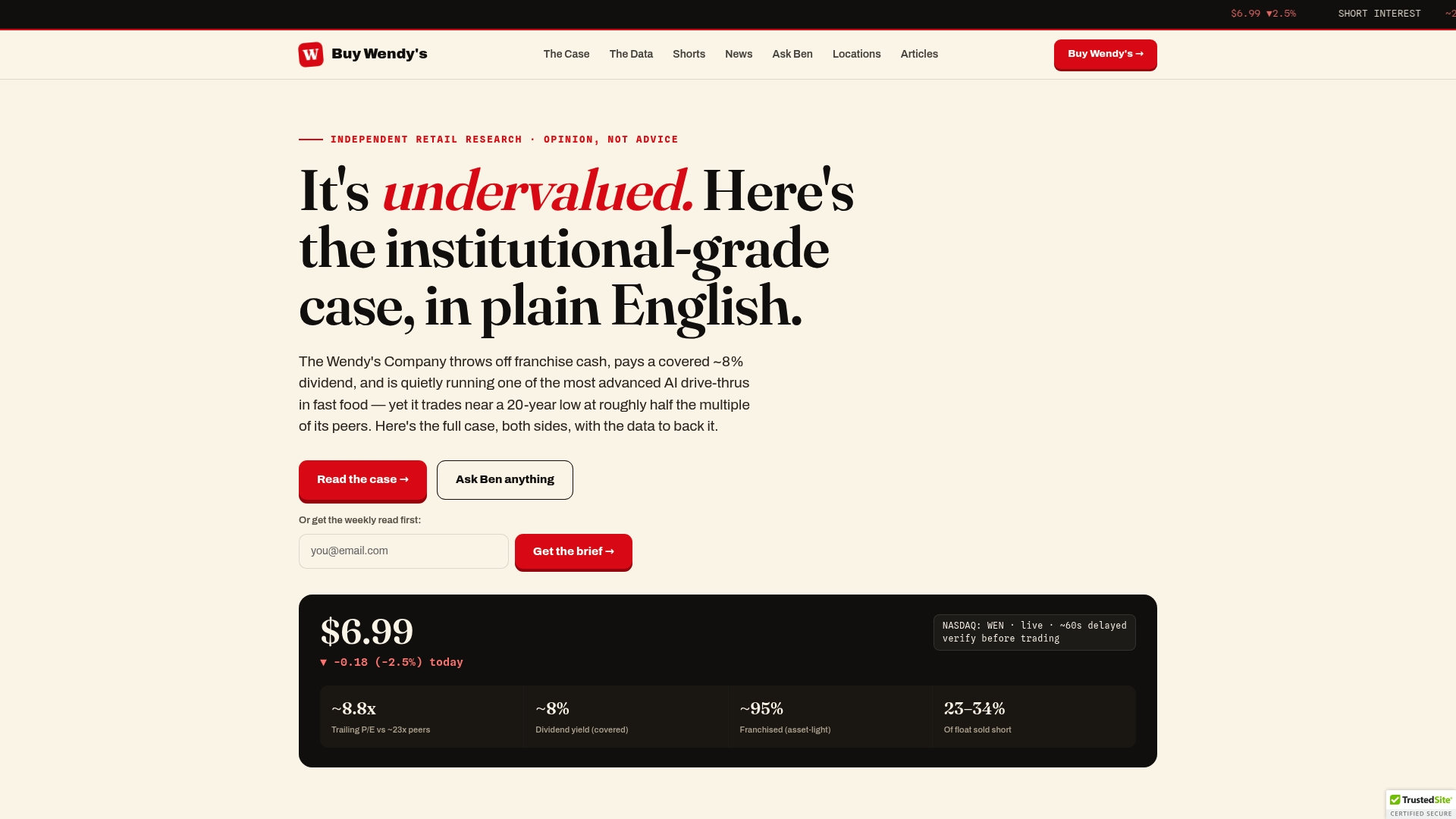
Choosing the right broker handles execution. Understanding whether WEN’s dividend is actually safe requires a separate analytical layer. Buywendys publishes dedicated analysis on Wendy’s free cash flow coverage, payout-ratio trends, and franchise economics, giving dividend investors the research depth that broker screeners alone cannot provide. The Wendy’s dividend safety analysis walks through FCF coverage, payout sustainability, and the franchise royalty model that underpins WEN’s income generation. For investors who want a full valuation framework, the restaurant stock analysis guide translates broker-sourced data into actionable buy and hold decisions. Start with the dividend safety analysis to verify WEN’s yield before configuring your DRIP.
Key Takeaways
The best brokers for dividend investing combine immediate fractional-share DRIP execution, a deep income calendar, and tax-lot accounting — Fidelity leads on all three for U.S. single-stock dividend investors.
| Point | Details |
|---|---|
| DRIP precision matters most | Brokers that reinvest immediately in fractional shares on payment date compound faster than those that accumulate cash to a threshold. |
| Screener depth over commissions | Zero-commission trading is universal; dividend screener quality and income calendar accuracy are the real differentiators. |
| Tax-lot accounting is essential | Fidelity, Schwab, and Interactive Brokers support specific-lot identification, reducing realized gains when selling DRIP-acquired shares. |
| Global access has a cost | Interactive Brokers’ $0.005-per-share active trader tier suits international dividend hunters; occasional traders access $0 commissions. |
| Buywendys fills the research gap | Broker screeners surface yield and payout ratios; Buywendys’s WEN-specific FCF and dividend safety analysis provides the forward-looking layer brokers lack. |
Recommended
- Analyzing Wendy’s Dividend Sustainability: A 2026 Guide
- Wendy’s Stock Forecast: What TipRanks Gets Right — And Where Investors Should Look Deeper – Buy Wendy’s
- Does Wendy’s Have a DRIP? Dividend Reinvestment Plan Explained for WEN Stock Investors – Buy Wendy’s
- Wendy’s Dividend Yield Analysis 2024: Safety & Growth