Table of Contents
- Executive Summary: The Financial Reality of Operating a Wendy’s
- Wendy’s Franchise Startup Costs: What the FDD Reveals
- Understanding Wendy’s FDD Financial Performance Representations
- Wendy’s Restaurant Operating Margins: Revenue Streams vs. Fixed Costs
- The Impact of Technology and Digital Orders on Franchisee Profitability
- Single-Unit vs. Multi-Unit Franchise Economics
- Macroeconomic Sensitivity: How Interest Rates and Labor Costs Affect Franchisees
- Exit Strategy and Resale Value for Wendy’s Franchisees
- Frequently Asked Questions
Last Updated: September 6, 2026
Executive Summary: The Financial Reality of Operating a Wendy’s
Operating a Wendy’s requires high initial capital, significant ongoing expenses, and unit economics that depend heavily on sales volume and labor management. Prospective franchisees must look beyond the headline startup cost to analyze fixed costs, royalty fees, and profit margins.
Understanding franchisee economics is critical. The Wendy’s system is vast, but individual unit success is far from guaranteed. The difference between a top performer and a struggling restaurant often comes down to site selection, labor efficiency, and adapting to the increasing digital share of orders.
Below, we analyze the costs, margins, and ROI potential of a Wendy’s franchise, including the impact of multi-unit ownership and macroeconomic pressures.
Wendy’s Franchise Startup Costs: What the FDD Reveals
The initial investment for a Wendy’s franchise is substantial, reflecting real estate, construction, equipment, and initial fees paid to the franchisor. The most reliable source is the Franchise Disclosure Document (FDD), which outlines estimated costs that vary by restaurant size and location.
These startup costs are just the beginning. Prospective franchisees must also account for the initial franchise fee, which grants the right to operate under the Wendy’s brand. Review the current FDD for accurate, up-to-date estimates, as figures are updated annually.
Understanding Wendy’s FDD Financial Performance Representations
The FDD also contains Financial Performance Representations (FPRs), the only area where a franchisor may legally provide specific financial performance data, such as average gross sales or operating costs. Understanding the context and limitations of this data is crucial.
The FPR often presents average sales, but it is not a guarantee of individual performance. A common mistake is to assume these averages are a floor; a significant number of restaurants may perform below the median. Focus on operating expenses and profit margins, not just top-line revenue.
Wendy’s Restaurant Operating Margins: Revenue Streams vs. Fixed Costs
Wendy’s restaurant operating margins are determined by the push and pull between revenue streams and fixed costs. The primary revenue streams are dine-in, drive-thru, and digital orders, with the latter two increasingly dominating the mix. The largest fixed costs are typically occupancy (rent) and labor overhead.
Food and paper costs are variable and scale with sales, but labor is often a “sticky” cost that doesn’t decrease proportionally when sales dip. A healthy operating margin depends on achieving high sales volume to spread fixed costs.
| Revenue Stream | Primary Cost Driver | Profitability Lever |
|---|---|---|
| Drive-Thru Sales | Labor, Food Cost | Speed of Service, Throughput |
| Digital / Mobile Orders | Labor, Packaging, Delivery Fees | Order Accuracy, Average Check Size |
| Dine-In Sales | Occupancy, Labor | Customer Experience, Store Cleanliness |
The Impact of Technology and Digital Orders on Franchisee Profitability
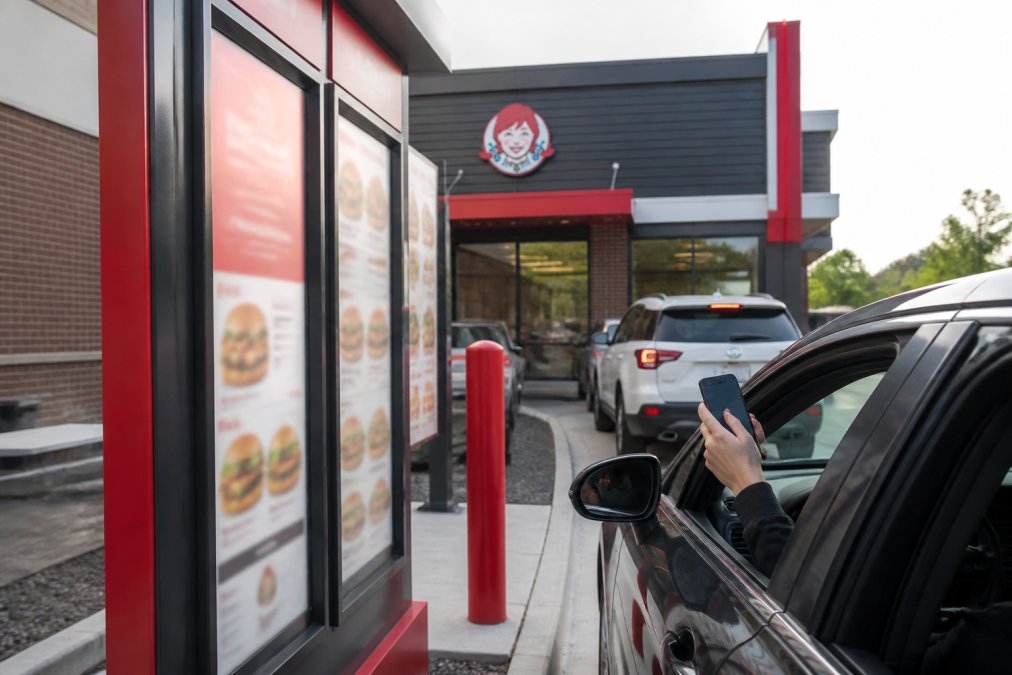
Most franchise-level analyses treat digital orders as a simple revenue add. In practice, the shift toward mobile app orders, third-party delivery, and kiosks has fundamentally restructured the unit-level profit and loss statement. The digital channel is a different cost structure with its own economic levers.
How Digital Orders Change the Cost Structure
The most immediate impact is on variable costs. A third-party delivery order carries a commission deducted from the gross sale before the franchisee sees revenue, behaving like a royalty on top of the standard royalty paid to The Wendy’s Company (restaurant.org). A mobile app order does not carry that commission, but it shifts labor demand toward order assembly and staging.
Digital orders do not replace labor, they reallocate it. A delivery order requires a dedicated staging area and a verification step to prevent errors. The franchisee’s challenge is to manage this reallocation without letting total labor hours creep upward.
The Throughput Paradox: Digital Ordering and Drive-Thru Economics
The drive-thru remains the highest-margin channel because it has no third-party commission and no delivery fee. The economic value of digital ordering is that it can increase drive-thru throughput. When a customer orders ahead through the app, the kitchen can begin preparing food before the car arrives, reducing “order to delivery” time at the window.
Top-performing franchisees use the digital channel to smooth the demand curve. Instead of a lunch rush peaking sharply between 12:00 PM and 1:00 PM, targeted mobile offers can pull some demand to 11:30 AM or 1:30 PM, flattening the labor requirement.
The Capital Expenditure Cycle for Technology
Technology is not a one-time purchase. The Wendy’s system requires franchisees to keep pace with point-of-sale updates, kitchen display system upgrades, and digital menu board refreshes. Falling behind carries two penalties: a potential violation of the franchise agreement and reduced operational efficiency.
The capital expenditure cycle for technology is roughly three to five years for software and five to seven years for hardware. Many prospective franchisees treat the initial build-out as the only major technology expense, but the ongoing refresh cycle is a permanent line item in the annual budget.
The AI and Automation Angle
The Wendy’s Company has been public about its investment in AI-driven drive-thru ordering. For the franchisee, the economic question is whether this technology reduces labor hours per transaction. Early evidence suggests AI ordering can handle a significant portion of routine orders, but it is not yet a full replacement for human order-takers during peak hours or with complex customizations.
A franchisee should evaluate this technology as a labor productivity tool, not a labor elimination tool. The realistic economic benefit is a reduction in labor hours required for the drive-thru channel, improving operating margin.
When evaluating a Wendy’s franchise, ask the current owner for a breakdown of digital order volume as a percentage of total sales and the associated third-party commission expense. This single data point will tell you more about the unit’s true profitability than the gross sales figure in the FDD.
The Bottom Line on Technology ROI
The return on investment for technology is measured in three financial outcomes: (1) a reduction in labor hours per transaction, (2) an increase in drive-thru throughput during peak periods, and (3) a reduction in order error rates that lead to free food replacements.
For a deeper look at how digital ordering and technology investments factor into the broader financial picture, review our analysis of Wendy’s digital transformation and its impact on franchise operations.
Single-Unit vs. Multi-Unit Franchise Economics
The decision between owning one Wendy’s and operating a multi-unit portfolio is not simply a matter of available capital. It is a choice between two fundamentally different business models with distinct financial profiles, risk exposures, and management requirements.
The Single-Unit Owner-Operator Model
The single-unit owner-operator is the classic small business model. The owner is present in the restaurant, often working 50 to 60 hours per week, directly supervising crew and personally handling difficult customer situations. This hands-on presence reduces the need for a general manager.
The limitation of the single-unit model is that it does not scale. Once the restaurant is running well, the owner cannot simply open a second location and manage both at the same intensity. It is often described as a “lifestyle business”, it generates a solid income but does not build significant enterprise value beyond the single restaurant.
The Multi-Unit Operator: Economies of Scale and Their Limits
The multi-unit operator is playing a different game. The goal is not to maximize the profit of a single restaurant but to build a portfolio that generates a higher aggregate return on invested capital. The economies of scale are real but often misunderstood. They do not come from lower food costs, Wendy’s supply chain pricing is largely standardized. They come from three areas:
-
Management Overhead Spreading: A single-unit operator needs a general manager. A five-unit operator needs a general manager at each location plus an area director who oversees all five. The area director’s salary is spread across five restaurants, reducing per-unit overhead.
-
Marketing and Community Engagement: Local store marketing is a fixed cost that does not double when you go from one to two units. A multi-unit operator can sponsor a local sports team or run a community fundraiser across multiple locations, spreading the cost across a wider revenue base.
-
Labor Scheduling Flexibility: A multi-unit operator can move crew members and shift leaders between locations to cover absences and manage peak periods, reducing the need to overstaff each location.
The Hidden Cost of Scale: Debt Service and Management Complexity
The multi-unit model is not without economic pressures. The most significant is debt service. A multi-unit operator typically finances each new restaurant with a combination of equity and debt. As the portfolio grows, so does the total debt load, and interest payments must be paid regardless of performance.
Management complexity is the second hidden cost. A single-unit operator can make decisions quickly and adjust based on daily observations. A multi-unit operator must build systems, delegate authority, and trust managers to execute. The most common failure mode is running out of management bandwidth.
The Franchisor’s Perspective on Multi-Unit Development
The Wendy’s system, like most major quick-service franchise systems, favors multi-unit development. The franchisor’s economics are simpler with fewer, larger franchisees: less administrative overhead, more consistent brand execution, and a stronger financial base. This preference is reflected in development agreements, which often require a franchisee to commit to opening multiple units over a defined period.
The trade-off is that a development agreement is a binding commitment. If the first unit underperforms, the franchisee is still obligated to build the second and third units. A multi-unit development agreement is not an option to expand, it is a contractual obligation.
Which Model Generates Better Unit-Level Economics?
There is no universal answer, but there is a clear pattern. The single-unit owner-operator often achieves a higher profit margin at the unit level because of hands-on management intensity. The multi-unit operator often achieves a higher total return on invested capital because overhead costs are spread across a larger base.
The decision comes down to the operator’s personal financial goals and management capabilities. An owner-operator who wants to maximize annual cash flow from a single asset should stay with one unit. An investor who wants to build long-term enterprise value and is willing to step back from day-to-day operations should pursue multi-unit development.
A multi-unit development agreement is a contractual commitment to build multiple restaurants. If the first location underperforms, you are still obligated to build the second and third. Do not sign a development agreement unless you have stress-tested your financial model against a scenario where the first unit generates below-average sales.
For a more detailed look at the capital requirements and financing pathways for expanding your portfolio, see our guide to Wendy’s franchise financing and multi-unit development.
Macroeconomic Sensitivity: How Interest Rates and Labor Costs Affect Franchisees
Wendy’s franchisee economics are highly sensitive to macroeconomic shifts, particularly interest rates and labor costs. Because the initial investment is so large, most franchisees rely on lending to finance their purchase. When interest rates rise, the cost of servicing debt increases, directly reducing net income (federalreserve.gov).
Labor costs are also a major variable. In a competitive labor market, wages rise, compressing operating margins. This is where the system’s reliance on technology becomes a strategic hedge. The break-even analysis becomes more challenging when debt servicing and labor costs rise simultaneously.
Exit Strategy and Resale Value for Wendy’s Franchisees
A critical and often overlooked part of franchisee economics is the exit strategy. The resale value of a Wendy’s franchise is a function of financial performance, the remaining term on the franchise agreement, and the condition of physical assets (franchise.org). A franchisee with strong, documented profit margins and a modern, well-maintained restaurant will command a premium price. Prospective buyers can use our Wendy’s Cleanliness Ratings to benchmark a target location’s store conditions against system-wide standards, which directly impacts resale value.
Planning for an exit begins on day one. Keeping meticulous financial records, maintaining the capital expenditure schedule, and building a strong management team all enhance resale value. The goal is to build an asset that can be sold for a profit.
Key Takeaways
- Capital-Heavy Investment: Wendy’s franchisee economics require significant upfront capital, making access to favorable financing a critical component of the business model.
- Margins are Earned, Not Given: Restaurant operating margins are the result of relentless management of labor overhead and supply chain costs against a backdrop of increasing digital sales.
- Scale Changes the Game: Multi-unit development offers economies of scale but introduces greater financial risk and operational complexity compared to a single-unit operation.
- Macro Factors Matter: Interest rates and labor costs are the two largest external forces that can compress profit margins and extend the time to recoup your initial investment.
- Plan the Exit Early: The resale value of your franchise is built over the life of your ownership through disciplined financial management and continuous reinvestment in the business.
Frequently Asked Questions
What is the most important factor in Wendy’s franchisee profitability?
The most important factor is achieving high sales volume to spread fixed costs like rent and labor overhead. A high-volume restaurant with tight operational controls will be far more profitable than a lower-volume store, even if both have similar cost structures.
How do Wendy’s operating margins compare to other quick-service restaurants?
Operating margins are highly variable and depend on the specific location and operator. The key is to analyze the FPRs in the FDD and compare them against the operational benchmarks for the quick-service restaurant industry as a whole to gauge a realistic target for performance.
How does the debt financing of a franchise affect its economics?
Because the initial investment is large, most franchisees carry significant debt. The interest payments on this debt are a major fixed cost that directly reduces net income. Fluctuations in interest rates can therefore have a meaningful impact on a franchisee’s bottom line and overall return on investment.
Frequently Asked Questions
How profitable is a Wendy’s franchise?
Profitability varies widely based on location, management, and whether the operator runs a single unit or multiple units. The FDD provides financial performance representations, but these are only for specific company-owned or franchise locations and do not guarantee future results. Prospective franchisees should analyze the relationship between initial investment, operating expenses, and potential revenue streams. Unit-level economics, including royalty fees and labor overhead, determine whether a location can achieve healthy profit margins.
What are the primary components of Wendy’s franchisee operating costs?
Operating costs for a Wendy’s franchisee generally include royalty fees, advertising fund contributions, food and paper costs, labor overhead, occupancy costs like rent and real estate taxes, and utility expenses. Fixed costs such as rent remain consistent regardless of sales, while variable costs like food and labor scale with revenue. Managing working capital and operational efficiency is critical, as these expenses directly reduce the profit margins reported in the FDD’s financial performance representations.
How do royalty fees and advertising contributions affect Wendy’s franchisee cash flow?
Royalty fees and advertising contributions are significant ongoing expenses that directly reduce a franchisee’s gross revenue. These fees are typically calculated as a percentage of net sales, meaning they increase as the restaurant grows. While the franchisor uses these funds for brand development and national marketing, franchisees must account for them when calculating operating margins and break-even analysis. These costs are key factors in assessing the return on investment for a Wendy’s franchise.
What impact do digital initiatives and AI drive-thru technology have on franchisee margins?
Digital ordering and AI drive-thru technology aim to improve order accuracy, reduce labor costs, and increase throughput, which can positively impact unit-level economics. By automating order-taking, franchisees may reduce labor overhead and reallocate staff to food preparation and guest service. However, the initial capital expenditure for these systems can be substantial. The long-term return depends on whether the operational efficiency gains offset the technology investment and ongoing maintenance costs.